
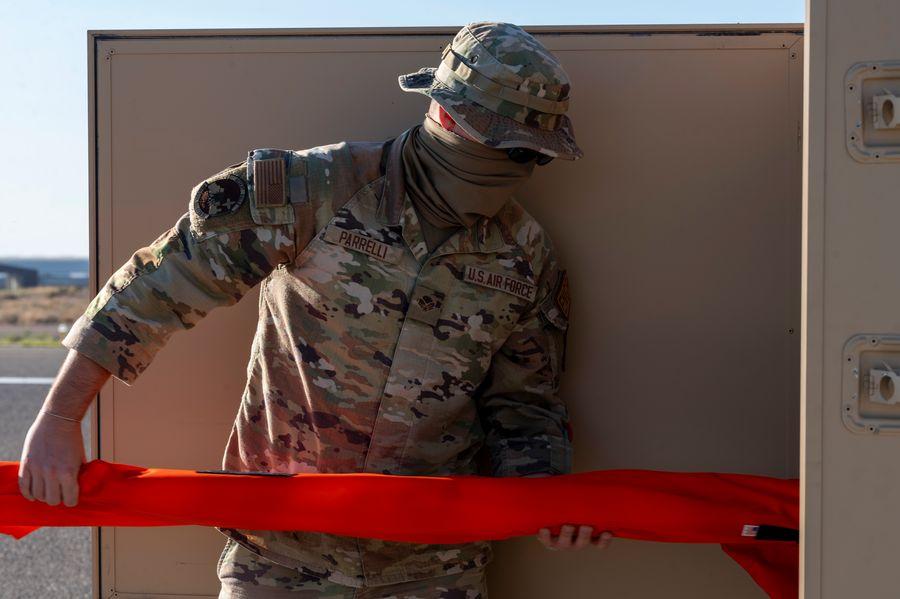
U.S. Air Force Senior Airman Hayes Parrelli, 49th Civil Engineer Squadron execution support technician, helps set up markers on a runway during Operation TRAILBLAZER at Holloman Air Force Base, New Mexico, Oct. 1, 2024. Operation TRAILBLAZER marks the first time Expeditionary Airfield Lighting Systems-C has been set up on an active runway in the continental United States. (U.S. Air Force photo by Senior Airman Nicholas Paczkowski)
America Must Win the Biotech Race Against China
Last updated 05:38 AM EST • Read time: 5m
For years, American leaders have warned about the dangers of depending on China for products that are critical to our economy and national security. Semiconductors, rare earth minerals, telecommunications equipment, and energy technologies have all received well-deserved scrutiny. The medicines and biotechnology that underpin public health deserve the same attention, and the competition in that field is moving faster than many policymakers realize.
Today, China occupies a central position in the global pharmaceutical supply chain, particularly with regards to the key starting materials used to manufacture many essential medicines. Hundreds of drugs approved for use in the United States rely on at least one chemical produced solely in China, in part because Beijing has heavily subsidized its chemical and drug-ingredient producers, allowing them to sell at prices competitors elsewhere struggle to match. This creates a vulnerability that impacts not just healthcare but also our national security.
The United States has spent decades building military capabilities designed to deter conflict and respond to crises. But military power alone cannot eliminate every threat. In a major geopolitical confrontation or another large-scale emergency, access to medicines would be just as important as access to fuel or food. A nation without a resilient supply of essential pharmaceuticals might be exposed at a time when reliability matters most.
Beijing has repeatedly shown a willingness to use supply chain dominance in other sectors as a tool of statecraft, which is why building more resilient medicine supply chains at home and with our allies matters. But the challenge is no longer confined to pharmaceutical manufacturing. The CCP has also made biotechnology a national strategic priority, and it is treating it like one.
China has spent years investing heavily in biotechnology and is moving well beyond its traditional role as a low-cost manufacturer. Through streamlined regulation, centralized clinical trial networks, and deliberate investment in manufacturing and talent, China has built the world's fastest-growing drug innovation pipeline.
Chinese researchers are now producing innovative breakthroughs such as the world's first CAR-T cell therapy for solid tumors, and global pharmaceutical companies increasingly look to Chinese firms for promising new drug candidates. The value of biotechnology licensing deals originating in greater China reached nearly $138 billion last year, nearly ten times the level recorded just four years earlier. That is a measure of how far China has come, and a reminder that American leadership cannot be taken for granted.
Biotechnology is no longer simply a commercial enterprise but a strategic asset that will help shape economic, technological, and geopolitical power in the decades ahead. How America chooses to respond to this challenge will be one of the most important questions policymakers will face in the years to come.
China's unfair trade and intellectual property practices are real, and Washington should continue to hold Beijing accountable for them. But it would be a mistake to assume that theft is the sole reason for China's rise. Its regulators have built a system designed to move innovations from the lab to patients more quickly. America's answer should be to respond in kind.
The United States still holds the advantage. It remains the world’s leading source of new medicines and the largest destination for early-stage clinical research. But keeping that lead depends on leveraging not just our own research and development, but that of other countries. Last year, China accounted for nearly one-third of global clinical trial starts and it is rapidly closing the gap with the United States. Rather than ceding that ground, America should put China’s growth to work for our own biotech sector. That means clearing the way for promising early-stage research conducted in China to feed into the American drug development pipeline.
Early trials abroad can help identify the most promising treatments sooner, and licensing agreements give American companies the rights to turn those discoveries into finished medicines developed, tested, and approved on American terms. Those trials, and the data drawn from them, must meet the same regulatory and ethical standards we demand at home, and supporting domestic research and development should always come first. But writing off valuable data simply because it was generated in an adversarial nation would put the United States at a needless disadvantage. Beijing has never hesitated to capitalize on American innovation. We should not hesitate to capitalize on theirs.
At the same time, policymakers should make it faster and simpler to launch clinical trials in America, building on coordinated efforts like Operation TrialBlazer. They should also clear the permitting and inspection bottlenecks that slow new American plants, work with industry and allies to rebuild capacity for the chemical inputs essential medicines depend on, and protect the strong intellectual property rights that make long-term investment possible.
There is growing bipartisan recognition that leadership in medicines and biotechnology is a strategic matter. Policymakers should meet that moment by strengthening domestic innovation, investment, and production. In the competition for biotechnology leadership, preserving America's innovative edge is not simply good economic policy. It is a national security necessity.
Col Rob Maness (U.S. Air Force, ret.) is a geostrategic analyst, the former wing commander of Kirtland Air Force Base, and host of The Rob Maness Show.

2949 Marine Prisoners, Hostages, and Peacetime Governmental Detainees Since Our Corps' Founding
By Jon Couch • RealClearDefense
America Must Win the Biotech Race Against China
By Rob Maness • RealClearDefense
How Digital Twins Can Strengthen Naval Readiness Before a Crisis Begins
By Carl Napoletano • RealClearDefense
The Uninsured Sky
By Joe Sandri • RealClearDefense
Counterterrorism and the Growing Convergence in Homeland Security and Homeland Defense
By Austin Doctor • RealClearDefense
How Digital Twins Can Strengthen Naval Readiness Before a Crisis Begins
By Carl Napoletano • RealClearDefense
F-16s Build on Iran Combat Lessons to Prepare for China Threat
By Rebecca Grant • Lexington Institute
Key Space Force Satellites Can’t Talk to Each Other
By T. Hitchens, Breaking Defense
Blue Angels Pilot Scott Laux Removed for Failing To Uphold Standards
By Johnson, PNJ
The Future of the Ground Reconnaissance Enterprise
By Joe Albano, The Connecting File