
Toward an Arctic City
Published March 30, 2021 • Read time: 12m
From national capitals to company towns, the city as a mode of social organization and civic life has shaped mankind since the Neolithic Revolution. Prosperous countries have popular cities, and popular cities have powerful industries. The Arctic is no exception: in Murmansk, Russia, the Alyosha Monument towers over a bustling seaport, an ornate, turquoise rail-station, and nearly three hundred thousand citizens. Indigenous peoples for millennia have inhabited the region, but the location and lack of infrastructure have prevented the emergence of a true city in the American Arctic. As polar ice recedes and opens new pathways and resources, Americans' access to this bounty will depend on mustering an Arctic citizenry. The solution is part intentional community, part infrastructure project, and part stereotypical American adventurism: the planned city.
A Historical View
Every American era included planned cities to some degree. Charleston, South Carolina and Saint Augustine, Florida, two pearls of the South, were built from blueprints during America's first wave of colonial expansionism. The original 'Venice of America,' now the Venice Beach neighborhood of Los Angeles, was designed from the ground up as a seaside resort town. Like Hershey, Pennsylvania, company towns were prefabbed and put down across the country, with some maintaining healthy populations and industry to this day. America is defined by building: cities, railroads, ports, bridges, churches, and all the other essentials of human life were erected across the continent from scratch. The planning and development of Charleston, originally Charles Town, exemplifies the civilizational spirit of the age.
Charleston was developed by Lord Proprietor Anthony-Ashley Cooper on land gifted to him by King Charles II. Cooper set out to construct "a great port towne", and developed the 'Grand Model' to this end. From the beginning, this master plan set out "the model of an exact regular town," accounting for the trappings of religious, civic, family and industrial life. Its location in the Albemarle Sound made Charleston the perfect port city, but its idyllic surroundings belied a silent killer.
Malaria ravaged the settlers. Eighty percent of those under 25 died during the sweltering, mosquito-laden summers. However, these very same pestilent wetlands offered up fertile ground for cotton, indigo, and rice. Cooper’s dream of Charleston as a prosperous port-city and agricultural powerhouse was ultimately realized, and ‘Carolopolis’ became one of the South’s most influential antebellum cities and the nation’s fifth largest. In spite of and because of its harsh conditions, Charleston survived a decades-long onslaught of malaria, Civil War shelling and siege, the postbellum collapse of the Southern economy, and numerous natural disasters. Today, Charleston enjoys a prosperous tourism industry, art scene, and technology sector. As Manifest Destiny pushed intrepid settlers to the Western Frontier, the Charleston miracle was repeated several times over.
Since World War II, this frontier spirit has faded. American building has concentrated on suburban sprawl, robbing citizens of their sense of place. Both pastoral harmony and urban character elude the contemporary suburbanite. Though America stopped building new cities and settling new frontiers, other countries are rediscovering the spirit of expansion. Today, planned city projects are underway across Asia and Africa, already seeing considerable success.
Planned Cities of the Present
Planned cities typically take one of two forms. The first is development on a ‘greenfield site’, uninhabited land without previous man-made improvements. The second are satellite cities. These exurban areas typically have minor development and few residents. Proximity to existing cities allows builders to utilize extant infrastructure and accelerates relocation. Developing a new city creates the necessary density and livability to avoid sprawl. Songdo, South Korea, is a flagship admixture of these two new-city development motifs.
Mark Lutter highlights Songdo in his recent article, "A Beginner's Guide to Charter Cities," just as instructive for would-be American-Arctic frontiersmen as for global construction companies. Lutter characterizes Songdo as “arguably the most successful master planned city in modern history." Developed on 1500 acres of reclaimed tidal flats, Songdo is home to a commercial district worth $35 billion dollars and currently hosts over 100,000 residents. The United Nations Green Climate Fund, also referred to as the 'World Bank of the Environment,' is headquartered in Songdo, giving the district extra influence in international finance. Songdo was built both on a greenfield site, reclaimed waterfront, and as a satellite of Incheon, one of Korea's leading free economic zones. For those who visit Songdo, it is a step into the future. Even the most hard-hearted eco-traditionalist will feel a bit of techno-optimism. Instead of recycling bins and dumpsters, Songdo has an underground network of pneumatic tubes ferrying garbage to collection and filtration stations. The entire waste management system is staffed by seven people. Bicycle lanes and electric-car charging stations criss-cross the cityscape. Forty percent of Songdo’s total area will be greenspace and parks, and every building in the city touts the globally recognized Leadership in Energy and Environmental Design (LEED) certification. Incheon fishermen who frequented the tidal flats prior to Songdo’s creation were given free plots of urban farmland in exchange for fishing disruption – a model that may be employed on behalf of America’s Arctic indigenous population as well.
Songdo’s relocation incentives are attractive to the desired milieu of academics, scientists, and businessmen: no income tax for non-Koreans, tariff reductions, international schools as well as high-powered Korean universities, and so on. Songdo is also nestled in the heart of the Northeast Asian trade zone, allowing residents access to a third of the global population in under four hours. Gale International CEO Stanley Gale, spearheading the public-private partnership that brought Songdo into existence, characterized his building philosophy as "crack the code of urbanism, then replicate it." Though any American Arctic city would necessarily reorient its incentive structures and development toward nationalism, Songdo is proof-of-concept for the new cities movement. Two parts of the Arctic city puzzle are complete: its connection to America's own tradition and its place in the new cities movement. To fully understand the boons and hardships of Arctic development, however, there is one more piece: Russia.
Russia’s Arctic Renaissance
The Soviet Union prioritized Arctic development. Timothy Heleniak, the author of Sustaining Russia's Arctic Cities, characterizes the seven decade development campaign as a series of "the greatest human-environmental battles that the Soviet Union undertook." Norilsk, built entirely by the Soviet Union as the center of a gulag archipelago and an extraction point for heavy metals, and Murmansk, established briefly before the Russian Civil War, are two examples of intentional cities that remain alive today, fluttering with hundreds of thousands of bundled-up residents. The importance of the Russian Arctic for the Federation cannot be understated. In Russia’s Oceanic Reach, Jean-Baptiste Betton characterizes Russia as "geographically outside the network of oceanic highways," making the Arctic Ocean extremely important both militarily and commercially, Russia's lifeline to the sea. Russia's Arctic territory hosts over 80 percent of their gas and 70 percent of their oil. As a result. Soviet central planners correctly believed development of the region to be essential to Russian industrialization and geostrategic ambitions. Soviet expansion in the High North saw new cities cropping up along the ice and old towns industrialized. Nearly half of Russian citizens living in the North reside in cities of over 100,000 people. This vastly distanced smattering of urban collectives is described as 'archipelago Russia' by ethnographers and urbanists.
‘Archipelago Russia’ nearly fell into the sea during the Soviet collapse. The region lost almost two million people from 1990 to 2010. After regaining its footing and rebuilding its state capacity following post-Soviet blitzkrieg liberalization, the Russian Federation established several effective incentives to stabilize Arctic demographics. The 2007 Federal Law On Supplementary Measures of State Support for Families with Children, for example, provided cash payments to families with two or more children. A number of joint projects between Russia and China have created jobs and infrastructure in the region, such as the Power of Siberia natural gas pipeline, a 400 billion dollar project that will operate indefinitely. There are around 40 icebreakers in the Russian fleet, all requiring constant crew, maintenance, docking assistance, and the like. The Northern Sea Route (NSR), where the fleet is commonly utilized, is consistently being developed, mapped for maritime navigation, and researched by climate scientists. Under the surface, it holds rare earth minerals currently monopolized by the Chinese. In terms of trade, it’s nearly a ten day shorter journey compared to the Suez Canal route. Russia has put its money where its mouth is in the Arctic, and it’s been remarkably effective. The Federation’s efforts stymied the migration outflow, with the total decrease ground down to a mere 1.1 percent from 2010 to 2017. This constitutes a fourfold reduction in emigration. Some regions even grew.
The Soviet Union, and later the Russian Federation, demonstrated the power and prosperity possible with a settled Arctic. Unfortunately, the United States is lagging behind. With two almost derelict icebreakers, almost no Arctic deep-water ports, limited Alaskan infrastructure, and no Arctic cities, the polar gap is only widening. Charleston elucidates America’s frontier heritage and urbanist tradition, Songdo the viability of new-city projects, and Russia the Arctic’s geostrategic value. On that basis, an American Arctic city is imaginable.
North to the Future
As America’s only Arctic territory, Alaska is the key to America’s Arctic future. The state needs a new city to defend its sovereignty in an era of Arctic competition. A joint Sino-Russian mission discovered the Northern Sea Route no longer has multi-year sea ice, meaning it can be traversed for months longer each year. As the polar caps melt, sea lanes and resources will become available for states capable of utilizing them. Arctic-Americans depend on Russian ships for emergency fuel shipments, go without adequate transportation, sustenance, and telecommunications infrastructure, and are generally neglected by the powers that be. Many Alaskans below the Arctic Circle are in a similar predicament. In great power terms, the United States demands maritime access through the Bering Strait pass but is incapable of advancing or defending this claim. As the earth warms, Arctic trade and resource extraction will increase. For America to secure its sovereignty and its citizens' interests, something new is needed: an Arctic city, a new heart for infrastructure projects in the region, and a potent revival of American urbanism.
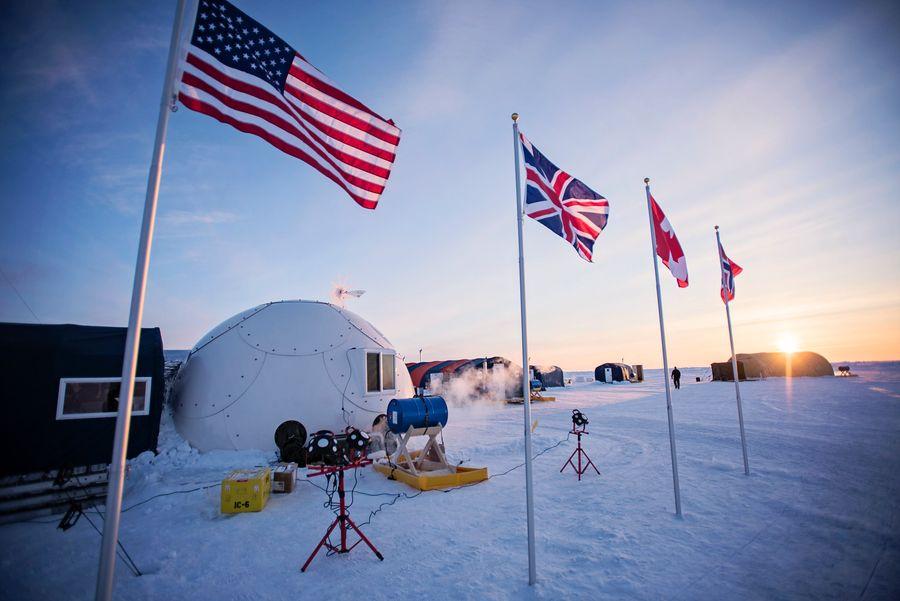
The American government has turned its attention toward the Arctic in recent years. The Arctic Energy Office was reestablished in Fairbanks, Alaska, studying climate change, renewable energy, and fossil fuels. The 2021 National Defense Authorization Act authorized the construction of six new icebreakers. Congress greenlit Nome’s deep-water port project. Upon completion, Nome, population 5,000, can host larger vessels and more of them. Nome’s Port Director envisions "ten years down the road, a very bustling busy military facility that's also supporting industry and providing jobs that are desperately needed in our region." Nome can be more than just a military facility – it can be an urban gateway to the Arctic. The Coast Guard's 2013 Arctic Strategy report identified the "paucity of air and sea infrastructure along Alaska's western and northern shores" as the preeminent impediment to American military and commercial regional capabilities. In a region as sparse as the Arctic, state-led development is essential. Relocation incentives, state subsidies, and infrastructure lay the foundation for civic life. Private companies, local institutions, and a sense of somewhere emerge from this foundation. The Alaska Permanent Fund, paying all residents a stipend from oil revenues, is unique among the fifty states. In this way, Alaska is uniquely suited for relocation incentive programs, and as such, a new city. Nome can be the infrastructural lynchpin of an Alaskan new cities movement. Based on principles of sustainability and self-sufficiency, an Arctic city would ameliorate the quality-of-life gap between Alaskans and the Lower Forty Eight. Antarctica’s McMurdo Station is nearly autarkic amid much harsher conditions, depending on outside support only for refueling. However, urbanizing Nome, or another site like it, can soothe a deeper rot: America’s crisis of confidence.
The Last Frontier
Xi Jinping astutely diagnosed the West with a "crisis of confidence." America's animating myths are dead or have become kitsch. Space Age futurism burnt up in the Challenger Disaster, and traditional institutions of faith and family were deracinated by atomizing capitalism. Russia and China, emerging from the ravages of internal strife, have embraced themselves as 'civilization-states,' encompassing a variety of ethnicities but sharing a common mythological heritage. This animating self-belief produces great works such as the Main Cathedral of the Russian Armed Forces, an archeofuturistic statement of confidence. The United States has yet to make the leap. Silicon Valley, America's 21st century powerhouse, sits atop a sea of tent cities and shantytowns. For authentic American futurism that connects with and benefits the common person, we must look to the past. At its heart, America is a society of settlers, adventurers, and frontiersmen. A new Manifest Destiny in the Last Frontier is an opportunity to short-circuit decadence. Today, we are expansionists with nowhere to expand. We weep, for there are no worlds left to settle, no strange lands to explore. An Arctic city satisfies dire infrastructural needs, provides jobs and civilizational spirit to native Alaskans, indigenous peoples, and Lower Forty Eight settlers alike. It pushes America out of sclerotic, post-Cold War managed decline. An Arctic city can be the first step toward resolving America’s crisis of confidence, and ultimately, restarting history.
Nick Solheim is Founder of the Wallace Institute for Arctic Security, Director of Business Development at Nativ3, and Co-Founder of American Moment. Follow him on Twitter at @NickSSolheim.
Benjamin Roberts is a Wallace Institute Policy Fellow. He has previously written for The Daily Caller, Oxford Political Review, Athwart, and others. Follow him on @RadicalBenjamin.

Iran’s Nuclear and Chemical Weapons Threat
By Ben Ollerenshaw • RealClearDefense
Europe’s Rearmament Paradox
By Daniel Darling • RealClearDefense
Pentagon’s Pursuit of Faster Acquisition
By Ben Harris • RealClearDefense
The Army’s AI Cyber Defenders Need a Proven Stand-Down Order
By Gleb Tsipursky • RealClearDefense
After the Silence
By Chase Skylar DeMayo • RealClearDefense
The First Surface Drone-v-Drone Fight
By CDR Salamander, CDR Salamander
Air Force Strengthens F-22 Raptor Combat Readiness in the Pacific
By Global DefenseAfter the Silence
By Chase Skylar DeMayo • RealClearDefense
Underwater Arms Race Puts U.S. Naval Supremacy at Risk
By Tom O'Connor, Newsweek
New Facilities To Pump Out Upgraded F/A-18E/F Super Hornets
By Trevithick, WarZone