
Uncrewed and Untested: The Wrong Lessons for a Hybrid Navy
Last updated 04:14 PM EDT • Read time: 5m
Ukraine’s drones achieved sea denial – but that’s not what a blue-water navy needs to maintain.
When the U.K. launched its Defence Investment Plan on 30 June, the government promised a “generational transformation” of the military that would apply the lessons of Ukraine’s fight to resist Russian invasion and equip Britain to fight the wars of today and tomorrow. For the Royal Navy, this meant a hybrid fleet in which frigates operate alongside uncrewed vessels above and below the surface, linked by artificial intelligence as a single force.
This amounts to a blueprint for a hybrid navy, with fewer crewed surface combatants and greater reliance on large uncrewed vessels operating as part of a distributed force.
For navies such as Australia’s, this may look like an attractive – potentially cheaper – answer to capability gaps.
But looks are deceiving.
Naval leaders from Australia to the United States have adopted the term “hybrid fleet” to describe their future ambitions. But the U.K.’s plan takes the concept much further, without first demonstrating that the enabling technology can deliver it. In doing so, it misreads the most important lessons of maritime drone warfare in Ukraine.
The problem is not the use of uncrewed systems. It is the assumption that they can provide a cheap and reliable substitute for crewed warships operating far from home in harsh seas.
Ukraine’s maritime challenge was one of sea denial. It employed remotely controlled) boats between 5 and 8 metres, packed with explosives, alongside cruise missiles, to deny Russia’s freedom of manoeuvre in the Black Sea. This forced much of the Russian Black Sea Fleet to remain in port and allowed Ukrainian grain shipments to leave the Black Sea through the Turkish Straits, hugging the coast. Ukraine also benefited from land borders through which weapons and supplies could flow.
As the U.K.’s Defence Investment Plan notes, nearly 90% of U.K. freight trade is transported by sea. Its maritime challenge is therefore much broader than Ukraine’s. It needs to deny adversaries freedom of manoeuvre in areas such as the Greenland–Iceland–U.K. Gap, including through its Atlantic Bastion plan. But it must also be able to achieve sea control and maintain its own freedom of manoeuvre.
Sea control requires the sustained projection of maritime power, which in turn requires endurance and persistence. Enthusiasm for drone warfare risks overlooking the practical challenges of operating large uncrewed vessels at sea, particularly in a contested electromagnetic environment. These challenges have not been resolved through experimentation.
The U.K.’s proposed future fleet includes at least 19 crewed surface combatants: 13 frigates and at least six Common Combat Vessels.
By comparison, at the end of the Cold War in 1990, the Royal Navy operated 13 destroyers and 35 frigates. The Royal Navy currently has six Type 45 destroyers and seven remaining Type 23 frigates on its books, although announced decommissionings will soon reduce the frigate fleet to five.
The Royal Navy intends to address its numbers problem through an undisclosed number of large uncrewed vessels: the Type 91 missile barge, Type 92 anti-submarine warfare platform and Type 94 radar picket. All are intended to enter service between 2030 and 2035.
But these are not the platforms used in Ukraine. Industry concepts suggest they could be between 80 and 100 metres long and displace approximately 2,000 to 3,000 tonnes, making them larger than Australia’s Arafura-class offshore patrol vessels. Unlike Ukraine’s small uncrewed surface vessels, these will be expected to operate at sea for extended periods as part of a force seeking to achieve sea control.
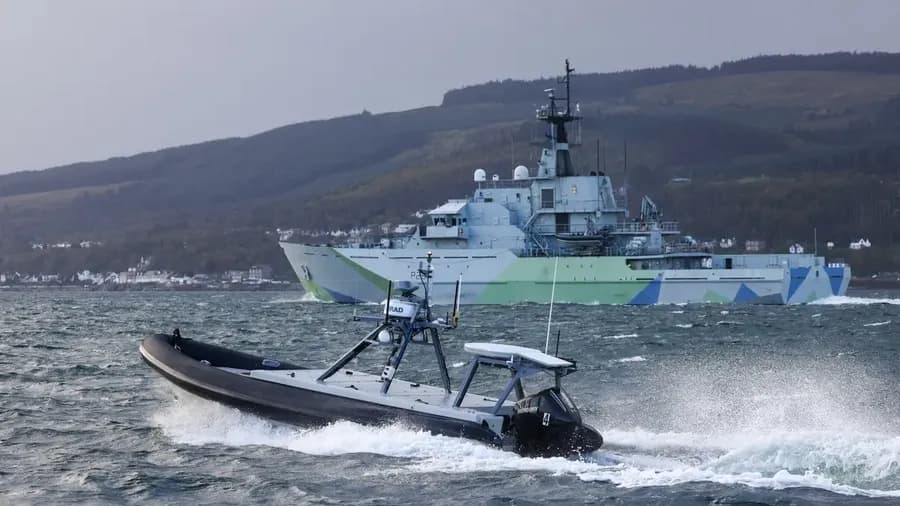
A console to control a Crewless Pacific 24 boat operating off the coast of Portsmouth, United Kingdom (Oliver Leach/U.K. MoD)
Three practical problems stand out: maintenance, survivability and control.
While the designs for these large uncrewed vessels do not yet exist, they will be complex. The sea is a harsh environment, and keeping vessels at sea requires constant maintenance. These vessels may need to deploy for months without it. Missiles at sea also require strict environmental controls and regular attention, which will be difficult to provide without personnel onboard.
Beyond the challenges of maintenance and likely reduced operational availability, the next problem is defence. If these vessels cannot defend themselves, they will become priority targets. If they are designed to defend themselves with surface-to-air missiles and counter-drone capabilities, they will become more expensive and complex, with additional systems requiring maintenance.
Even if they can operate autonomously for periods, coordinating them, passing targeting information and authorising engagements will still depend on reliable communications in a contested electromagnetic spectrum. That is a considerable risk. Fighting in Ukraine has shown how heavily contested (Opens in new window) the electromagnetic spectrum will be.
Uncrewed systems will have an important role in the future Royal Navy, but they cannot be treated as a cheap substitute for crewed surface combatants. Ukraine has demonstrated the value of small, expendable systems in achieving sea denial. It has not demonstrated that large uncrewed warships can provide sustained sea control across the North Atlantic.
Fleet design should begin with the strategic task, not enthusiasm for a particular technology. The U.K. risks reducing its proven fleet concepts of today in return for an untested fleet tomorrow. Australia and other smaller navies should be wary of following it.
Jennifer Parker is the principal and founder of Barrier Strategic Advisory.
This article appeared originally at Lowy Institute's the interpreter.

From Siberia to Fairford: How Operation Spider’s Web Has Changed the Rules of Airpower
By Frank A. Rose • RealClearDefense
Faster Simulations, Better Defense Decisions
By Rut Lineswala • RealClearDefense
Will HASC Have an Oversight Subcommittee in the Next Congress?
By Christopher J. Bright • RealClearDefense
The U.S. is Overpaying for Missiles
By Alex Lee • RealClearDefense
The U.S. Nuclear Deterrent Umbrella
By Peter Huessy • RealClearDefense
From Siberia to Fairford: How Operation Spider’s Web Has Changed the Rules of Airpower
By Frank A. Rose • RealClearDefenseFaster Simulations, Better Defense Decisions
By Rut Lineswala • RealClearDefense
Bombers Could Have a Major Air-to-Air Combat Role
By Joseph Trevithick, The WarZone
Pentagon, Lockheed Agree to 10-Year Deal for 850 F-35 Jets
By M. Scanlon, Military T.
The Marine Corps Has a Boot Problem
By Travis Pike, Sandboxx News