
The U.S. Ally Who Learned the Lesson of 'Black Hawk Down'
Last updated 05:25 PM EDT • Read time: 6m
America’s first convoluted involvement in a major military operation in the Red Sea region was immortalized in the film “Black Hawk Down” which sought to dramatize the 1993 “Battle of Mogadishu” which left 19 American soldiers dead, 25 Malaysian and Pakistani peacekeepers and as many as 1,000 Somalis. Months later the United Nations force of which the United States was part withdrew from Somalia. The battle marked its grim 25th anniversary earlier this month.
Since then Mogadishu has become a byword for a reckless military endeavor and getting bogged down in urban combat. It is often seen as a forerunner to U.S. Counter-terrorism operations in Afghanistan and Iraq. Operation Restore Hope marked the first substantial U.S. combat operations in Africa since the Second World War. Iraqi President Saddam Hussien told his loyalists and military officers to study the film on the eve of the 2003 U.S. invasion.
The real lesson of the 1993 Operation Restore Hope may be more strategic than practical – feed the people. In short, you need to win bellies before you can win hearts and minds. The United States went into Somalia with the best of intentions to restore order and end a humanitarian. In then-President George Bush’s reportedly told his staff “'No one should have to starve at Christmas-time.”
Both sides of the Bab El Mandeb are struggling to deal with growing populations that have put increased strain on a region with temperamental rainfall which has seen some of the worst famines of the past 50 years.
What contributed to the “Black Hawk Down” incident? The international community failed to gain control of humanitarian relief efforts and thus the narrative in the streets of Mogadishu. Instead, petty warlords capitalized on and disrupted aid deliveries. While the United States and United Nations forces were there ostensibly to provide humanitarian aid, Warlord Somali Farrah Aidid was able to skim from the profit of food aid. A trick he may have learned from Ethiopia’s communist rulers a decade earlier who used the same trick to suppress anti-communist rebels.
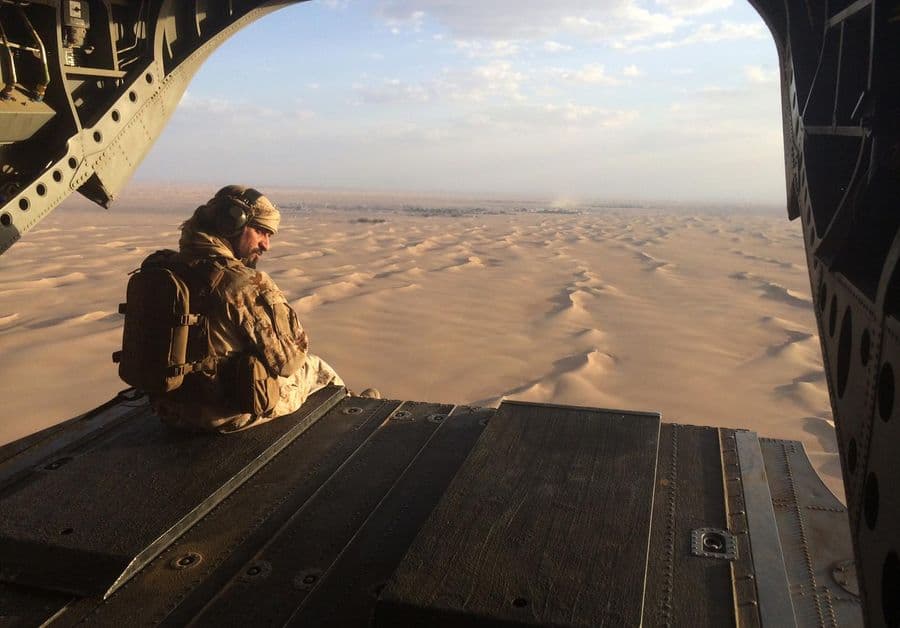
The UAE military contributed to Operation Restore Hope in 1993 and appeared to have learned the correct lesson from the campaign. Today, a quarter of a century later the United Arab Emirates is now operating its own military campaign just across the Red Sea. Like Somalia, its Red Sea neighbor, Yemen across the sea is just as prone to drought and famine. Indeed acceding to some projects the country is set to run out of water at some point in the next decade.
Secretary of Defense James Mattis, then a military officer, once classified the UAE “ Our Sparta” along with Saudi Arabia has been one of two countries in part of a Coalition fighting in Yemen to uphold a United Nations Resolution 2204 (adopted unanimously in 2015) in support of the internationally recognized government of Yemen which was ousted from the Yemeni Capital by Houthi rebels supported by Hezbollah and Iran. Though often styled the “Arab Coalition” the group has included support from some African states.
The conflict has had many stages, and American military planners have watched closely. In 2015, the Emirati intervention began as a largely conventional military operation with the U.S. Like the U.S. operations in Mogadishu the intervention was supposed to be quick and largely humanitarian. In Somalia, were buttressed by Al-Qaeda who may have applied the lessons learned downing Soviet Hind-Helicopters to shoot down U.S. Black Hawks. Similarly, in Yemen, the Houthi rebels have been buttressed by Iran and Hezbollah who have allowed it to launch rocket attacks on Saudi Arabia and suicide boat attacks in the Bab El Mandeb – like the one which damaged the U.S.S Cole in Yemeni waters in 1998.
However, as the conflict humanitarian concerns have started to outweigh all others in military operations. Recently the head of World Food Program, David Beasley, a former South Carolina congressman and governor called the situation in Yemen “the world’s worst humanitarian crisis.” The Emirates is well aware of the echoes of 1993 and the Arab Coalition has even named its operation “Restoring Hope.”
One of the problems of the 1993 operation was that international organizations and military forces often worked at cross-purposes due to conflicting visions. The Emirates has sought to instill close coordination between its military and humanitarian efforts with full knowledge that the Emirates Red Crescent (ERC) is just as important as the Emirati military.
''The ERC is scaling up its humanitarian operations in liberated governorates by providing a package of humanitarian, food and therapeutic assistance to help the Yemeni people cope with the deteriorating humanitarian and economic conditions,'' said in a statement in early October of new humanitarian in the key region of Hadrumat.
The lesson of Somalia was that food security is closely linked to the other kind of security, the kind that involves with bullets. Humanitarian efforts have increasingly taken importance for the Emiratis who have as quickly as possible sought to get local government functioning again in liberated areas from schools to prisons. Food aid is dispatched under armed convoy to even remote areas. Working to uphold another UN mandate in 1993 the United States failed to develop local interlocutors. The Mark Bowden book and the subsequent movie are almost bereft of Somalis working with the Americans and UN efforts -- a telling absence. As in one of the most important tasks from the UAE, forces have been the protection of food aid convoys.
Overall the UAE aid to Yemen since roughly the start of the campaign in April 2015 to July 2018 amounted to an estimated US $ 4.03 billion – more in fact than any other country including Saudi Arabia, according to figures from the Financial Tracking Service, a monitoring group.
UAE assistance has reached some 16.7 million Yemenis, including 10.1 million children, and 3.4 million women. New bakeries have been built in several regions. The UAE announced earlier this month a new security plan was unveiled in Hadrumat one of Yemen’s key regions.
“We are launching a gradual security deployment plan, which will enable security personnel to maintain security in the cities, after taking over from their brothers in the army who performed this task during a difficult period," said Staff Major General Faraj Salmeen Al Bahsani in a statement to the Emirates News Agency.
However, for the people of Yemen, the ongoing humanitarian crisis marks an even more difficult period than that which has already convulsed the country. With the political process stalled, the Houthis were a non-show at peace-talk set to take place in Geneva last month the Emiratis might be in for a long-haul.
Joseph Hammond is a senior contributor with the American Media Institute. As a former Cairo correspondent for Radio Free Europe during the 2011 Arab uprisings, he has also reported from four continents on issues ranging from stability in Somalia to the M23 rebellion in the Eastern Congo.

A Passage to the Middle East: India as a Mediator and Security Partner
By Irina Tsukerman • RealClearDefense
South China Sea is Key to Invigorate Positive U.S.–Malaysia Relations
By Brent D. Sadler • RealClearDefense
The Necropolitics of the Wasteland
By Yunus Emre Tumen • RealClearDefense
AI, Robotics, and Marines
By Gary Anderson • RealClearDefense
The Emerging SQUAD
By Muhammad Shoaib • RealClearDefense
AI, Robotics, and Marines
By Gary Anderson • RealClearDefense
AUKUS Partners Test Autonomous Maritime Systems
By Jangoulun Singsit, Naval Tech
AUKUS: USS Colorado Announced as First Submarine for SRF – West
By USNI News
Navy, Marine Corps Simulate Ship Strikes From Air and Land
By Alex Wilson, S&S
Air National Guard To Stand Up a New Special Tactics Squadron
By Patty Nieberg, T&P