
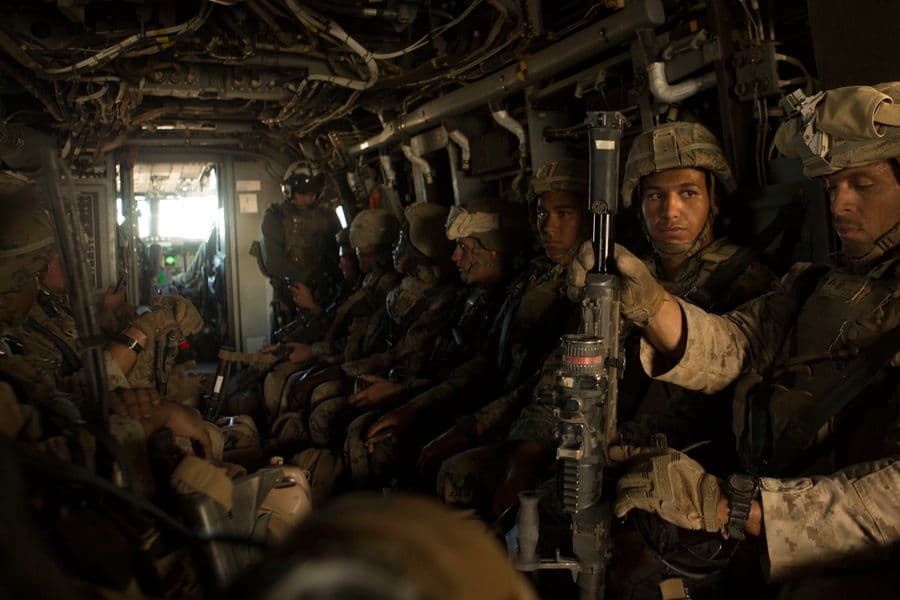
Evolving Marine Corps Force Design
Last updated 06:38 AM EST • Read time: 5m
In 2019, the Commandant of the Marine Corps decided to focus on China and protecting naval dominance of the South China Sea (SCS) and China’s “first island chain.” He undertook a major restructuring of the Corps in order to buy anti-ship missiles, radars, and other sensors needed to equip the shore based Stand-in-Forces (SIF) needed to occupy the sand spits and small islands to snipe at Chinese warships in the event of a war. This new strategy was called Force Design 2030, now referred to as simply Force Design.
To achieve Force Design, the Marine Corps divested itself of all of its tanks and heavy engineers as well as much of its towed artillery and aviation assets, thus crippling the Marine Corps combined arms capabilities intrinsic to the Marine Air Ground Task Force.
The commandant also released the Navy from its responsibility to maintain thirty-eight large deck amphibious ships in order build smaller, less capable craft to support Force Design's SIF units. Neither the joint area combatant commander (INDOPACOM) nor the Navy asked for this help. Ironically, like Dorothy trying to get home from Oz, the Marine Corps always had that capability and and could have exercised it without any major force structure changes by using existing attack aircraft.
The proverbial chickens inherent in Force Design are now coming home to roost.
The unintended consequences of those 2019 decisions are piling up, and the current commandant is in a quandary. Due to maintenance problems, the Navy is finding that it cannot maintain a 24/7 amphibious ready Group/ Marine Expeditionary Unit (ARG/MEU) presence in the three of world's most vexing trouble spots (the Persian Gulf, the Indo-Pacific, and the Mediterranean) with the current thirty-one amphibs, further exacerbated by the current administration's emphasis on a presence in the Caribbean.
The small amphibious Medium Landing Ship (LSM) program needed to support Force Design is grievously behind schedule, over budget, and will not be available to sustain Force Design until well into the next decade. Many naval thinkers have opined that they will not be survivable against the 2030 Chinese threat. All of this means that Force Design in 2030 will be incapable of: accomplishing its assigned mission, unsupportable, and detract from the Marine Corps' mission of being the nation's global force-in-readiness.
There is worse news. The anti-ship missiles that seemed so promising in 2019 when the decision to buy them was made are now rapidly becoming obsolete due to fast-moving ongoing improvements in the Chinese Navy's air defense capabilities. The current Marine Corps leadership is faced with a situation where it cannot fulfill today's world-wide requirements and may end up with strategy that is irrelevant by 2030.
The current commandant is now in a conundrum of his own making. He was part of the planning and execution of Force Design along with the previous commandant. He can't abandon the Force Design without looking foolish. However, there is an honorable way out.
The Marine Corps has always maintained attack aircraft that can accomplish anti-ship missions from well outside the weapons engagement zone of the first island chain of the SCS when armed with modern ordnance.
Operating from Okinawa, Guam, the Philippines -and even Australia- these aircraft can effectively attack Chinese shipping at ranges far exceeding those of the near-obsolete Tomahawk and NEMSIS anti-ship systems.
Marine Corps leadership is now rethinking Force Design. The Corps has cancelled its buy of the Tomahawk missile system. It has reduced the number of planned missiles armed Littoral Combat Regiments and is scaling back plans to reduce the number of infantry battalions. The Fourth and Eighth regiments will remain infantry formations. The current commandant has reaffirmed the requirement for a 24/7 world-wide ARG/MEU presence and the need to have more big deck amphibs. The Navy cannot afford to have both enough conventional amphibs as well as LSMs. Something has to give.
This gives the commandant a plausible solution to the present situation. He can claim that fast moving technology and the ongoing lessons of the Russo-Ukraine war have allowed Force Design to "evolve." This obviates the need for ground-based anti-ship missiles, their associated radars, and Littoral Combat regiments as well as the LSMs.
These savings would allow the Navy to get back to thirty-eight or more large deck amphibious ships It would also clear the decks for the Marine Corps to buy lighter and more survivable armored vehicles, modern heavy engineer assets, and artillery more suitable to amphibious shipping and air mobility than the legacy systems discarded in the early years of Force Design.
By partnering with the Air Force and Navy in the development of air launched long range-hypersonic air launched anti-ship missiles, he would be conforming to his predecessor's original vision of keeping up with technological modernization.
Technology caught up and passed the original Force Design concept. There isn't any shame in adjusting to emerging technology if the Corps accepts that fact and moves on.
Gary Anderson retired as the Chief of Staff of the Marine Corps Warfighting Lab and later served as a Special Advisor to the Deputy Secretary of Defense. He is the Author of Beyond Mahan: A Proposal for a U.S. Naval Strategy in the Twenty-First Century.

We Cannot Build Tomorrow's Weapons With Yesterday's Alloys
By Joseph F. Krause • RealClearDefense
Americans Will Sacrifice for Their Country, Not for Politicians
By Jane Li • RealClearDefense
No Need for a New World Order
By Will Thibeau • RealClearDefense
Congress: Don’t Let the NDAA Hand China Our Defense Blueprints
By Richard Newton • RealClearDefense
Washington Cannot Ignore Afghanistan’s Weapons Legacy
By Saima Afzal • RealClearDefense

Marines Deploy Neros Archer Drone in Live Fire Exercise for First Time
By USNI News
Confessions Of An SR-71 Blackbird Pilot
By Howard Altman, The WarZone
Air Force Exploring Creative Ways to Produce More Pilots
By Laura Heckmann, NatDef
"Super F-22' Propels Rator to Fly With F-47 Into 2060s
By Kris Osborn, Warrior Maven
GA-ASI and Saab Test AEW Payload on MQ-9B
By Stefano D'Urso, The Aviationist