
For Peace, America Must Negotiate From Strength
Last updated 04:48 PM EDT • Read time: 4m
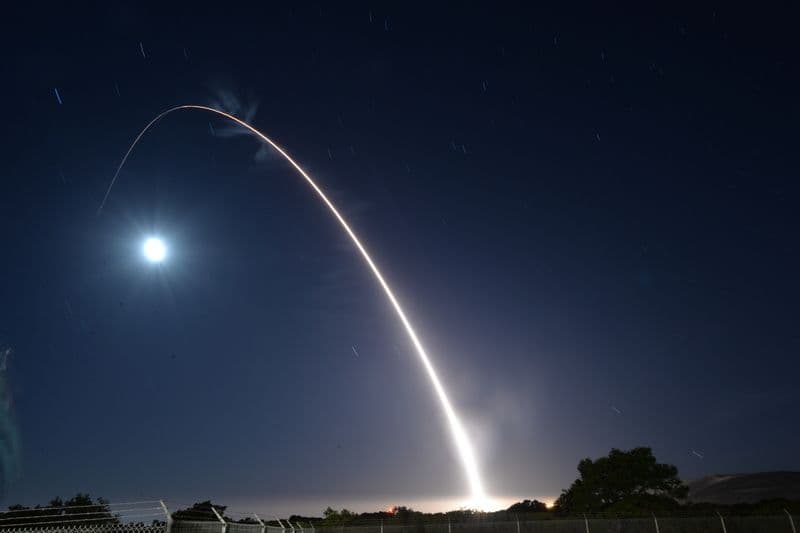
In an era of global pandemic, economic downturn, and social unrest, a growing chorus of voices is advising Congress to reduce spending on nuclear modernization in the National Defense Authorization Act for Fiscal Year 2021. This advice is misguided. In order to build a new arms control framework, the United States must negotiate from a position of strength. Slowing nuclear modernization would end any hope for arms control, even as the United States is pursuing new negotiations aimed at curbing competition between the United States, Russia, and China. Only a commitment to modernization of American nuclear forces will bring adversaries to engage in serious discussions about long-term nuclear restraint. In the meantime, the United States should take sensible steps to slow the growth of adversary forces, including extending the New START treaty with Russia, which further reduces and limits strategic offensive arms (including ICBMs, SLBMs, nuclear equipped-heavy bombers, and nuclear warheads).
Historically, arms control negotiations between the great powers have always been linked to a strong American military. The early Cold War was not a fruitful period for arms control, but as the Soviet and American nuclear arsenals approached numerical parity, an opportunity for serious negotiations arose in the Strategic Arms Limitation Talks (SALT). The American nuclear modernization program played a clear role in instigating negotiations. Soviet negotiators were determined to limit the expansion of the American missile defense program begun in the Johnson and Nixon administrations. The result was the 1972 Anti-Ballistic Missile (ABM) Treaty and Interim Agreement on Offensive Forces. These agreements headed off a race for missile defenses, while also shifting competition into the realm of qualitative weapons improvement where the United States could overmatch the Soviet Union through superior technology.
After years of false starts to limit medium- and intermediate-range missiles, the United States and the Soviet Union began serious negotiations only after the United States deployed a new generation of advanced intermediate-range missiles in the early 1980s. These missiles served as an explicit bargaining chip to convince the Soviets to limit their own arsenal. The Soviets responded negatively to what they called nuclear blackmail, but after American missiles were deployed, Soviet leaders returned to the negotiating table to hammer out an agreement. Under the resulting 1987 Treaty on Intermediate-Range Nuclear Forces (INF Treaty), the superpowers agreed to dismantle all of their land-based intermediate-range missiles, while allowing the United States to retain its sea- and air-based capabilities.
Talks on strategic offensive weapons were also stalled by the early 1980s, as the United States and the Soviet Union struggled to reduce their arsenals of long-range missiles in a transparent way. In an effort to break the deadlock, the United States deployed a new generation of intercontinental ballistic missiles to pressure the Soviets into making real concessions. The deployment of the new Missile Experimental (MX) helped bring about the hoped-for Soviet concessions, leading to the 1991 Strategic Arms Reduction Treaty (START I).
Recognizing the historical importance of a strong defense program to achieve arms control goals provides important guidance for the present. Progress in arms control requires continued investment in American nuclear forces, without which rivals will have no incentive to negotiate seriously. In previous cases, real progress in negotiations occurred only after the United States had deployed real capabilities. Congress must resist the temptation to make unilateral cuts in American nuclear forces in the naïve hopes of generating reciprocal restraint from great power rivals.
Arms control is a long game. American leaders should acknowledge that future arms control talks will take time. Progress on arms limitation will only occur once the current phase of American strategic nuclear modernization matures — a process that will take years. Any realistic strategy for future arms control must be a long-term strategy to shape adversary behavior over the coming decade, not the coming year. This makes it all the more imperative that the United States retain what advantage it can from existing arms control arrangements like New START. Extending New START is not an alternative to progress on future arms control agreements, but rather a natural complement to a long-term strategy of great power arms limitation.
The United States’ long history of successful arms control negotiations offers hope for future success in this era of renewed great power competition. Though it may seem counterintuitive, history shows that only through strength can we hope to persuade our competitors to agree to meaningful arms control measures. As they hammer out the 2021 NDAA, the president and Congress should work closely together to ensure that the United States has the robust and well-funded nuclear forces it needs to bring Russia and China to the table. Rapid nuclear modernization is the key to future arms control success.
John D. Maurer is a Jeane Kirkpatrick Fellow at the American Enterprise Institute, where he studies the history of nuclear strategy and arms control.

Trump's Disrupt First, Negotiate Second: Greenland in Focus
By Meda Parameswara Reddy • RealClearDefense
In Seeking Peace With Beijing, Taipei Is an Asset, Not a Burden
By Alexandru Filip • RealClearDefense
Strike First: Israel's Inevitable Doctrine for the Iranian Axis
By Lance Gordon • RealClearDefense
It’s Not President Trump but Thomas Friedman Who Should Be Ashamed
By Francis P. Sempa • RealClearDefense
Putin, Plague, and America’s Biodefense Gap
By Ryan Kane • RealClearDefense
U.S. and Japan Begin Naval Exercises Near Taiwan
By Mari Yamaguchi • Associated PressU.S. and Japan Begin Naval Exercises Near Taiwan
By Mari Yamaguchi, AP
U.S. Navy, Gecko Robotics Surge AI Maintenance Contract
By Ceder, Simkins, Navy T.
Ghost Shark XL-AUV Payload Bay Seen For First Time
By Thomas Newdick, The WarZone
Dakota Meyer Tapped As Barracks Task Force Senior Advisor
By C. Stassis, MC Times