
How Geography Will Shape U.S. Military Options in Eastern Europe
Published March 10, 2022 • Read time: 5m
The full-scale invasion of Ukraine by Russian forces changed Europe overnight. Still, questions remain about what would happen if Vladimir Putin decided to invade a neighboring NATO country, such as one of the three Baltic States. Ultimately, though, the essential nature of that scenario can be understood by looking at a map.
The region's geography tends to favor Russia and put outsiders wanting to deter it at a disadvantage. This, in turn, leaves frontline states vulnerable to the violation of their sovereignties. Recent events have made this even more true. Russia has effectively pushed its borders up against NATO's easternmost front by making Belarus, which borders Poland, a satellite, and invading Ukraine, which borders both Poland and Romania.
Unfortunately, a Russian invasion of a NATO country, which would trigger the involvement of all members of the alliance, is an increasingly possible though still unlikely development in the future. The three Baltic countries—Estonia, Latvia, and Lithuania—would presumably be next on Putin's list, all being former Soviet Republics and vulnerable due to their small size and relative isolation from other NATO allies. The location of Poland and Romania up against the borders with Ukraine and Belarus also dramatically increases their risk of one day being attacked.
Given the creeping omnipresence of Russia in Eastern Europe, the geography of the region also makes it clear that any defense of the Baltic States, Poland, and/or Romania will be waged primarily by the U.S. Army and Air Force, with the Sea Services locked out by various strategic chokepoints.
U.S. and Australia Should Give ANZUS Teeth
How to Win Without Military Victory
Tailored Deterrence and Nuclear First Use in Europe
When Access Becomes the Fight
The Baltic Sea and Black Seas are the areas with the largest concentrations of Russian Navy ships, based respectively in Saint Petersburg and the Crimean Peninsula. Due to the Russian advantage at sea and in the air, NATO will not be able to count on the U.S. Navy or Marines moving into these areas, as their prospects of survival would be bleak.
The Russian Navy’s Black Sea Fleet was strengthened after the annexation of Crimea, and the risk of sending U.S. Navy vessels there has already been observed. Last year, two naval vessels, one cruiser and one destroyer, entered the Black Sea around the time Ukrainian President Volodymyr Zelensky began discussing NATO membership for his country, further stoking naval tensions between Ukraine and Russia. It is, therefore, safe to say a repetition of this scenario would be far more ill-advised now. Deploying U.S. vessels to the Baltic Sea, where the Leningrad Naval Base is located, would invite potential catastrophic defeat.
There are frustratingly few alternatives. It is conceivable that aircraft carriers could participate from the Adriatic Sea, but that would require overflight rights inside Balkan airspace, which would be too time-consuming to obtain on short notice in the event of a new invasion. One possible long-term solution would be the deployment of unmanned warships, which would reduce the inherent risk of transporting troops and supplies into a conflict zone, but they do not exist. However, several programs are in development to change that, though they would likely not be ready for combat at the advent of the next geopolitical crisis.
It is not the case that allied ground operations would be without logistical challenges in current conditions. Rail gauges from country to country are not uniform, so transporting equipment from Germany to one of the Baltic countries, for example, may require transferring materiel between different types of rolling stock. This kind of inconvenience would almost certainly delay the transport of supplies to the front lines, which could have dire consequences in critical stages of a conflict. This is why it is so urgent to adequately equip the U.S. Army and Air Force for future deterrence of Russia and to facilitate as much operational cohesion with allied air and ground forces in Europe as possible.
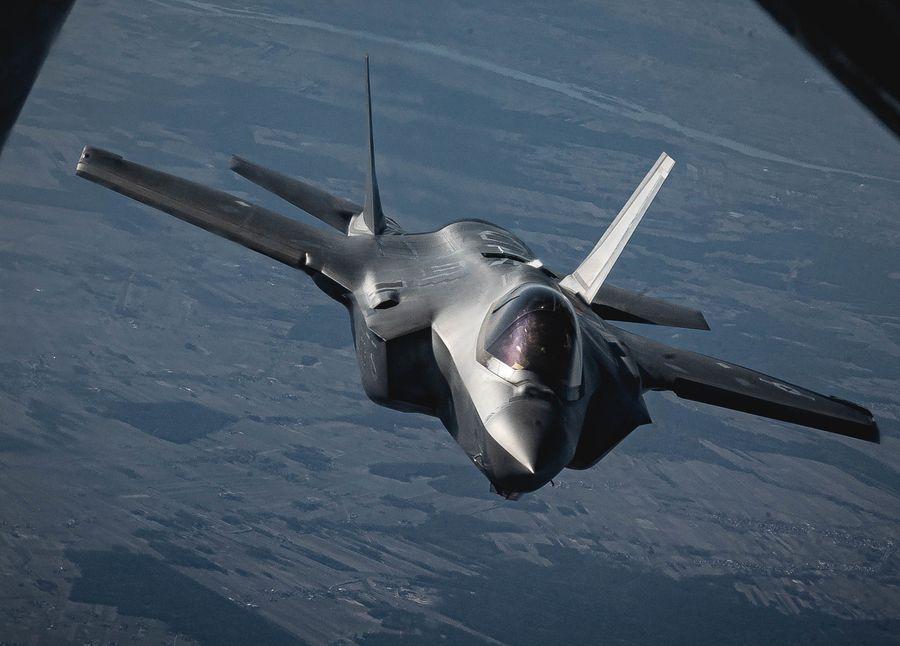
Allied air forces would fare better, not having the same challenges of moving over land or sea. Countries with the F-35, the world’s most cutting-edge stealth fighter, would have a special advantage, as it can collect more intelligence than any other aircraft while remaining essentially invisible to Russian radar. At the current level of risk to NATO allies, it is at least fortunate that multiple countries are equipped with the F-35 or are scheduled to be. There is also growing speculation that Finland, the most recent country to acquire the fighter, may consider pursuing full NATO membership despite tacit threats from Russia in the past.
Of course, whether the invasion of a NATO country happens is dependent on the state of the Russian military after it ceases its assault on Ukraine. Moscow likely did not count on the fierce resistance put up by Ukrainian soldiers and civilians. It certainly did not count on the numbers of armored vehicles that have been destroyed, planes and helicopters shot down, and prisoners taken. In Russia, the war’s unpopularity is growing as the number of soldiers killed, many of whom were both misled about their purpose in Ukraine and very young in age, increases. And, conversely, to the Ukrainian population, morale among Russian troops is also reportedly low.
Deliveries of new weapons systems such as the F-35, Abrams tanks, and Patriot missile systems to countries in Eastern Europe that already have them on order were months or even years away at the time of the invasion. Accelerating these deliveries on the United States’ part would at least better prepare our allies for a future that remains unpredictable. As the heavy shelling of residential areas in Ukraine’s major cities reminds us, it is impossible to plan for the long term once war is underway.
Sarah White, M.A. is Senior Research Analyst & Editor at the Lexington Institute. Views expressed are the author’s own.
The Pressure Is the Message: What Xi and Putin Faced in Shenzhen
By Emzari Gelashvili • RealClearDefense
China’s Revised Mobilization Law and the Expanding Reach of National Defense
By Muhammad Shoaib • RealClearDefense
U.S. Putting Weapons in Space: A Strategic Blunder?
By Ajey Lele • RealClearDefense
The Clearance Myth Is a Readiness Problem
By Elijah Fernandez • RealClearDefense
The Pentagon's Next Readiness Test Should Begin When the Cloud Goes Dark
By Colton Overcash • RealClearDefense
U.S. Putting Weapons in Space: A Strategic Blunder?
By Ajey Lele • RealClearDefense
U.S. Senate Seeks to Exchange Shipbuilding Funds for More Munitions
By Naval News
F-35C Completes First Launch and Recovery Trials on a Ford-Class Carrier
By Navy T.
USS George Washington Leaves Mideast As Trump Mulls Ending Iran War
By S&S
ULA’s Latest Launch Failure Spells Trouble for Space Force
By Greg Hadley, A&SF