
The Perils of Misplaced Priorities
Last updated 07:51 AM EDT • Read time: 14m
Lessons from History for America’s Strategic Focus
“He who defends everything defends nothing,” warned Frederick the Great, whose mastery of concentrating force made him a major military commander of 18th-century Europe. What Frederick said of the battlefield is also true, perhaps more so, between theaters.
Ancient Athens learned the lesson the hard way in 415 BCE. Locked in an existential struggle with Sparta in the Aegean, Athens re-directed its troops off on a side expedition to Sicily. What began as a diversion ended in total annihilation of its forces, a setback in Athens’ overall military capability, in battle at Syracuse. Eleven years later, Athens surrendered to Sparta, its true strategic adversary, having drained its strength in Sicily. Centuries later, Napoleon repeated this error when, between 1808 and 1814, he committed more than 300,000 troops to a disastrous Peninsular War in Spain and Portugal. Those forces and supplies were unavailable for the central European campaigns that were essential for Napoleon’s success. In both of these cases, these great powers squandered their positions by diverting resources and attention from their main strategic focus. The question for today is whether the United States is committing the same error with Iran.
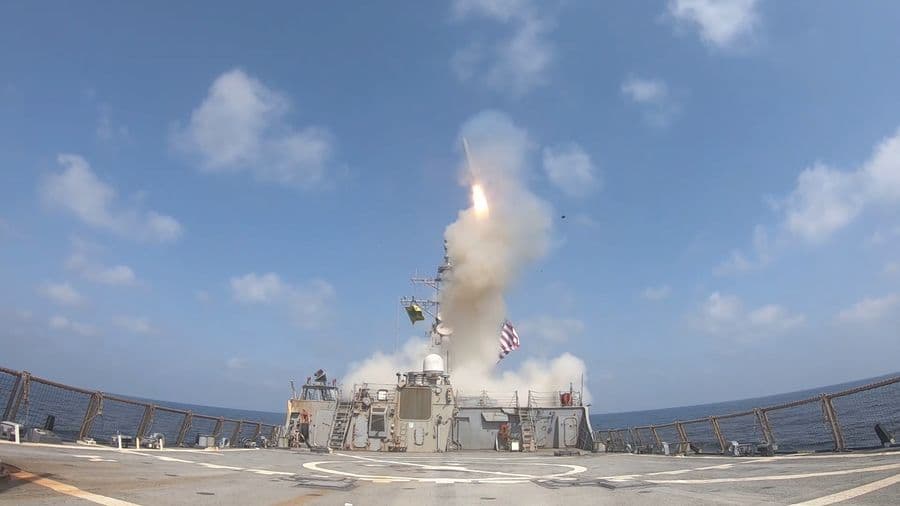
Leading up to and following its attack on Iran on February 28, 2026, the U.S. Navy shifted power away from its primary strategic threat: China. In December 2025 there were no aircraft carriers in service in the Middle East. As of mid-April 2026, there were three carrier task groups (USS Abraham Lincoln, USS George H.W. Bush, and USS Gerald R. Ford) committed to support CENTCOM. There is only one aircraft carrier left in Asia at this time, the USS George Washington, which was still at homeport in Yokosuka, Japan as of April 26.
In just the short period since the commencement of the war, there has been a substantial drawdown of U.S. precision-guided munitions and missile defense interceptors, exposing both the large-scale wartime consumption and the current limits of the U.S. defense industrial base. Across key systems, roughly forty to sixty percent of inventories of high-demand interceptors such as Patriot PAC-3 and THAAD have been expended. Strike weapons were similarly stressed, with around a quarter to a third of stocks of systems like Tomahawk cruise missiles, JASSM, and ATACMS-class weapons, and sixty percent of newer systems like PrSM missiles reportedly used. To put this in some perspective, 850 Tomahawk missiles were fired in the first four weeks, more than were expended in the 2003 Iraq War.
Missile replenishment timelines for these capabilities are measured in years rather than months, reflecting perilously constrained production capacity and complex supply chains. Patriot interceptors require roughly 2.5 to 3.5 years to rebuild inventories, THAAD and SM-3 systems range from about three to over five years depending on surge conditions, and air- and sea-launched cruise missiles generally require two to four years to replace. High-priority strike weapons like Tomahawk cruise missiles can take as long as four years. Even a relatively short but high-intensity conflict can deplete advanced munitions faster than the defense industrial base can reliably replenish them, creating a troubling, persistent gap between operational demand and industrial production capacity. The American way of war is to go into battle with extremely high-tech, very expensive tools, while faced with simpler, ample, low-cost weapons.
In spite of the claim by the president at the outset of hostilities that the U.S. supply of munitions was “unlimited,” the U.S. may find it difficult to sustain operations against Iran should the war drag on for an expectedly prolonged period, not to mention the diminished inventory that will exist for future use once this war ends. According to Mark Cancian, a retired Marine colonel with the Center for Strategic and International Studies (CSIS): “Even before the Iran war, stockpiles were deemed insufficient for a peer competitor fight. That shortfall is now even more acute, and building stockpiles to levels adequate for a war with China will take additional time.”
Going back to the lessons taken from the Athenians, America must step back with cold pragmatism and ask what the greatest strategic challenge is to the country. The answer to that question is clear: China. China is the only potential near-peer military adversary the U.S. will face for decades. Beijing possesses the world’s largest navy by hull count, a rapidly modernizing air force and missile arsenal—conventional and nuclear—and the world’s second-largest economy.
Six of the United States’ ten largest trading partners, excluding China, are in the Indo-Pacific, while none are from the eleven nations of the Middle East. Total annual U.S. trade with these Indo-Pacific countries is $1.5 trillion compared with just $225 billion from the Middle East, which altogether is only equivalent in scale to U.S. trade with Canada. Unlike decades when the United States depended on oil from the Middle East, today that region now accounts for just eight percent of U.S. imports. The shipping lanes from the Strait of Malacca, the largest chokepoint in the world, on through the South China and East China Seas are vital to the U.S. and its principal Asian allies, Japan and South Korea. Three times as much trade by dollar volume passes through Malacca than through the Strait of Hormuz, through which a fifth of global hydrocarbon supplies transit. Oil from Hormuz must still transit Malacca.
Although not recognizing Taiwan independence, the United States has a particular interest in the protection of Taiwan from attack by China under the Taiwan Relations Act (1979). Taiwan has a near monopoly on the production of the most advanced (3nm, 5nm) microchips and an eighty percent market share of the next-highest category, each of which is of absolute importance to the future of high technology: artificial intelligence, quantum computing, cloud computing, data centers, smartphones and consumer electronics, automotive systems, and defense and aerospace systems. In other words, the future. China asserts that Taiwan is an integral part of a “One China” policy and threatens that it will “reunite” the two by force, if necessary. Should China gain control of Taiwan, it would have a stranglehold over high technology globally, including over the defense systems on which the United States and its allies depend. And should China control Taiwan, it could establish a naval presence there that would not only strengthen its intimidation of neighboring countries but would also provide a base and deep-water ports on the First Island Chain from which to project a blue-water navy.
This shift from the Indo-Pacific to the Middle East due to the war in Iran has caused U.S. Asian partners to feel uncertainty regarding the U.S. commitment to the region. As an example, South Korea has seen U.S. THAAD and Patriot air-defense batteries redeployed from the Korean Peninsula to the Middle East in March 2026, weakening its layered missile defenses against a very real threat from the massive North Korean forces situated just 30 miles from Seoul. Since February 28, Pyongyang has conducted multiple ballistic missile launches and has just announced its intention to increase the size of its nuclear stockpile. It should be noted that, unlike Iran, North Korea possesses an inventory of nuclear weapons and ballistic missiles capable of carrying those warheads, and its leader on has on several occasions claimed that these missiles have the United States within range.
All the while, as noted above, the U.S. military is drawing down many of its technological munitions, and the replenishment windows will extend well past when the U.S. presumably refocuses its forces back on Asia. As was noted in The New Yorker: “A 2023 war game developed by CSIS, and later run for the House Select Committee on Strategic Competition Between the United States and the Chinese Communist Party, found that, in a conflict with China over Taiwan, the U.S. would run out of key munitions in just a month and, in the case of one missile, in three to seven days, a worrisome conclusion even before the giant depletion of stockpiles caused by the Iran war.”
The issue is not only whether the U.S. will have the ability to confront, but also the ability to deter. Military planners in Taiwan and South Korea have to be concerned about whether the redirection to the war against Iran might lead Beijing and Pyongyang to see a window of opportunity for the former to institute a blockade of Taiwan or aggression by the latter against South Korea. Japan’s new Prime Minister Sanae Takaichi has dramatically accelerated defense spending and incurred the wrath of the Chinese government in so doing, approving a record ¥9+ trillion ($58+ billion) budget for fiscal year 2026—a 9.4 percent increase. She has explicitly stated that a Chinese assault on Taiwan would constitute a “survival-threatening situation” for Japan, implying potential Japan Self-Defense Forces (JSDF) involvement. Yet with U.S. carrier strike groups absent from the Western Pacific, Tokyo would be effectively hung out to dry should China take the current “window of opportunity” to take action such as a blockade; Japan cannot lead a credible defense of Taiwan without the United States in the vanguard.
The events since February 28 have caused nations in Asia to question their confidence in America and to consider “balancing” their relationships between the U.S. and China. China wasted no time in seizing this opportunity. On April 7, Cheng Li-wun, the head of Taiwan’s opposition party the Kuomintang (KMT), began a six-day “journey of peace” to the mainland, culminating in a meeting with Xi, who said that both the PRC and Taiwan were part of “one family.” The KMT, which has long endorsed the so-called “1992 Consensus,” conceptually agreeing that there is “One China” (open to interpretation), is committed to warmer relations and more interchange with the People’s Republic of China (PRC). This trip was followed by a visit by Tô Lâm, Vietnam’s new president, who stated that he wanted to “prioritize” relations between China and Vietnam. Finally, on April 12, Philippines President Ferdinand Marcos Jr. stated his intention to open discussions with China on joint resource development in the South China Sea.
The decision by the United States to attack Iran on February 28 was puzzling in that it came less than one year after the administration’s Threat Assessment, which named China as the nation’s primary strategic threat and prioritized Indo-Pacific deterrence. The Assessment classified Iran as a regional destabilizer, not a nation that posed an existential danger to the United States. Although Iran’s nuclear program was cited initially as a motive for the February 28 attack, the official position of the United States, up to that point as stated by the Secretary of Defense, was that Iran’s nuclear capability had been “obliterated” by Operation Midnight Hammer, a bombing campaign targeting Iranian nuclear facilities in June 2025. At the time of the February 28 attack, the American intelligence community did not view Iran as an imminent nuclear threat, a judgment that the Director of National Intelligence confirmed in Congressional testimony two weeks after the war began. In addition, The New York Times reported that the Vice President, Chairman of the Joint Chiefs of Staff (JCS), and the Secretary of State all expressed reservations in the leadup to the attack.
The United States launched the attack on February 28 with the view that a rapid decapitation of the Iranian leadership would result in regime change, with the fall of the theocratic government replaced by civilian elements of the Iranian government in its place. So rapid would this change occur that Iran would not respond militarily to the attack, nor would it take any action to close the Strait of Hormuz. In addition, it was envisioned that the new regime would waive its right to develop nuclear weapons. Instead, the existing regime has remained in place with new faces in charge, and with the militant Revolutionary Guard (IRGC) acquiring more power. And, just as promised by the Iranians preceding the war, the Gulf States (and U.S. military bases located there), Saudi Arabia, and Israel were attacked, and the Strait of Hormuz was closed. Although Iran has been subject to 30,000 strikes and the destruction of much of its military resources, Iran has retained enough missiles, drones, and launchers to remain a capable opponent. And it is also in possession of its store of enriched uranium. The principal constraint that Iran faces at this time is the reduction in its oil exports and the fact that it is running out of storage capacity for its oil production. Although certainly possessing greater pain tolerance, the war is bringing about even greater inflation and GDP decline than the nation has already experienced prior to the war after years of sanctions.
America finds itself in a dilemma. Its war aims have not been achieved and may not even be achievable without committing ground forces into inhospitable Iranian terrain. The resumption of bombing will be met by Iran with potentially devastating reprisal missile and drone attacks on oil and natural gas production facilities in the Gulf States, which will result in reductions in oil and natural gas production capacity that will last for perhaps years. The closure of the Strait of Hormuz has already caused, by day sixty of the war, what the International Energy Agency (IEA) has declared “the greatest global energy security threat in history,” resulting in severe fuel shortages and sharply higher prices for hydrocarbons and all products and services that depend on supplies as inputs . At ninety days, the shock to the global economy would be catastrophic with some predicting oil at $200 a barrel. Realism also makes it necessary to mention that U.S. midterm elections in November raise the temperature on the U.S. administration due to the rising inflation and recessionary pressures that would exist by that time.
All the while, the United States continues to deplete both its stockpile of munitions as well as the global perception of the power of the U.S. military to dictate a political result. And China: on one hand, the United States’ shift of focus from the Indo-Pacific to the Middle East has been of regional geopolitical benefit to China, but the fact that fifty percent of China’s oil imports come via the Strait of Hormuz makes it far more than just an interested party in the ongoing closure of the passageway, and thus a possible source of direct conflict between the two nuclear-armed countries. The April 24 announcement of U.S. sanctions against Hengli Petrochemicals, a Chinese refinery, plus 40 Chinese tanker companies, raises the possibility of such a conflict, while at the same time giving indication that the so-called shadow fleet is having some success in bypassing the blockade by the U.S. Navy intended to cut off Iranian exports. The prospect of a U.S. Navy ship stopping and boarding a Chinese-flagged ship highlights the risk.
America needs to find a way to bring this war to a conclusion on the best terms possible. Both Iran and the United States are facing time pressures and have incentive to find some accord. By chasing a secondary theater in the Middle East, despite intelligence consensus that it did pose an immediate threat to the US, the United States lost sight of its primary strategic theater, weakened deterrence in Asia, alarmed key allies, and raised the risk of conflict with is primary major potential adversary. America must return its focus to Asia before the window of credible deterrence closes. It is time for America, and for Iran, to recognize that although not the resolution they would each prefer, they must find a resolution that circumstances permit—and that wisdom lies in knowing the difference.
David W. Wise is a retired businessman who writes frequent articles on public policy. He is a graduate of The Fletcher School of Law and Diplomacy at Tufts University.

Trump's Disrupt First, Negotiate Second: Greenland in Focus
By Meda Parameswara Reddy • RealClearDefense
In Seeking Peace With Beijing, Taipei Is an Asset, Not a Burden
By Alexandru Filip • RealClearDefense
Strike First: Israel's Inevitable Doctrine for the Iranian Axis
By Lance Gordon • RealClearDefense
It’s Not President Trump but Thomas Friedman Who Should Be Ashamed
By Francis P. Sempa • RealClearDefense
Putin, Plague, and America’s Biodefense Gap
By Ryan Kane • RealClearDefense
U.S. and Japan Begin Naval Exercises Near Taiwan
By Mari Yamaguchi • Associated PressU.S. and Japan Begin Naval Exercises Near Taiwan
By Mari Yamaguchi, AP
U.S. Navy, Gecko Robotics Surge AI Maintenance Contract
By Ceder, Simkins, Navy T.
Ghost Shark XL-AUV Payload Bay Seen For First Time
By Thomas Newdick, The WarZone
Dakota Meyer Tapped As Barracks Task Force Senior Advisor
By C. Stassis, MC Times