
Warfare's New Equation
Last updated 05:31 AM EST • Read time: 6m
Warfare's New Equation: Why Numbers, Not Just Technology, Will Win Future Wars
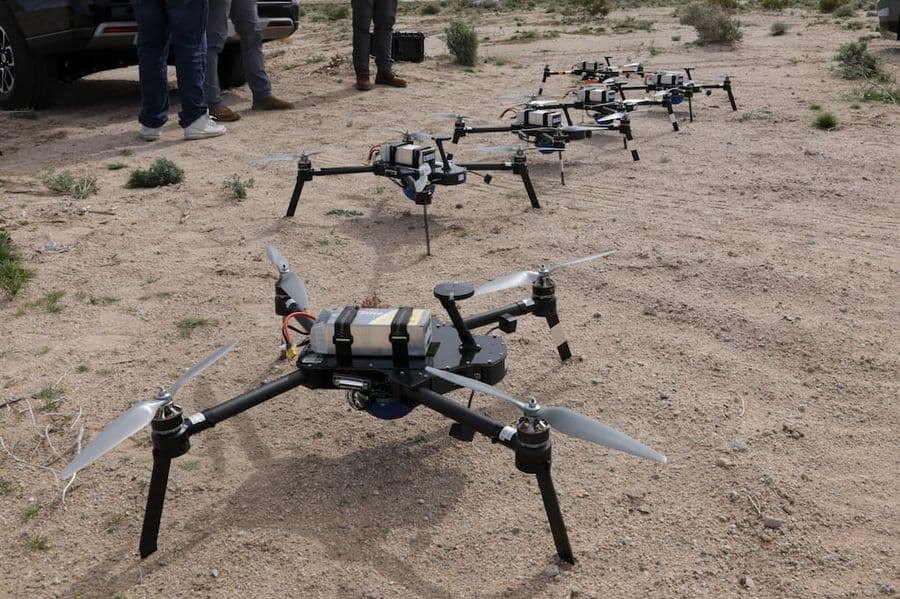
Modern Warfare has become a battle of numbers. Yet no longer is the main data point the number of troops but rather the number of systems and their cost. Reporting from the modern battlefields in Ukraine, the Red Sea, and Gaza, and Northern Israel frequently comes with a cost analysis. What was the cost of the missile to shoot down one drone? Or how much did a drone cost to destroy a tank? Mass matters now more than ever because warfare has become democratized. Small, one-way drones - which have effectively become piloted munitions, are relevantly cheap yet extremely effective.
The U.S. military industrial complex has created incredibly complex, expensive, exquisite products for the last half-century. The USS Ford Aircraft Carrier takes the number 1 spot at $13 billion, with other platforms, such as the F35, costing between $80m to $100m per aircraft. While The U.S. was building such systems, China has been focused on cheaper systems that, in mass, can destroy these large systems. Sure, the USS Ford has defenses, but if the People’s Liberation Army (PLA) fires five DF-21 missiles that cost $25m each at the U.S. Navy's crown jewel, only one needs to get through. The cost of the PLAN to destroy a $13 billion asset could be only $125 million. Or about 1% of the cost of its target.
In the Red Sea, the U.S. Navy has been shooting down Houthi attack drones that cost around $40,000 with two $ 1 million missiles. The targeted drone is 2% of the cost of the U.S. missiles required to shoot it down.
The numbers of war have been pushed front and center in Ukraine. The battlefield in Eastern Europe is now littered with hundreds of thousands of drones. Reporting indicates that the Ukrainian forces are using anywhere between 20,000 and 40,000 drones per month, with Russian numbers likely similar. The reason for the use of so many drones is that a one-way attack drone often referred to as a kamikaze drone or suicide drone and sometimes called an FPV (First Person View) Drone, can be built for under $1000. The drone can fly (one-way) up to 25km (with an extended-range antenna) and can carry a required munition to destroy a variety of targets. Ukrainians and Russians have spun up drone training academies to teach their soldiers to fly drones instead of shooting rifles or missile systems.
Thankfully, our U.S. military understands the importance of the numbers game and has been paying attention to the prevalence of low cost on the modern battlefield. The Department of Defense, knowing it needed to find a way to mass produce smaller, more attributable or one-way systems, created the Replicator Initiative to “field attritable, autonomous systems at a scale of multiple thousands [and] in multiple domains within the next 18-to-24 months."
On a recent trip to Ukraine, I saw the vision of DoD’s Replicator Initiative. Thousands of drones. Tens of thousands. Small attritable drones built for one purpose: mass production to overwhelm and defeat a peer adversary. The amazing Ukrainian entrepreneurs I met with weren’t building exquisite systems; rather, they assembled an ad hoc manufacturing force: young boys, old women, and old men all side by side, working together to build small, cheap, one-way drones. The average price point I found was between $500 and $800 per drone, including the battery. Visiting one of the many drone facilities hidden throughout Ukraine - the locations of which are kept a secret for fear of Russian targeted attacks - I saw the mass-produced scale in action. An assembly line that serpentined through rooms all interconnected, and in every corner, 1000s and 1000s of drones stacked up, ready for combat. The scale of the operation was impressive, but equally impressive was the buzz of activity. Everyone was working fast and hard to keep pushing their part of the process down the line. This was a people at war, doing their part to fight for freedom.
I saw firsthand what it took to defeat a peer adversary- the scale of which the world has never seen before. I saw the spirit of a country banded together to do what they could - in this case - to make drones. Some soldering, some packing boxes, some assembling flight components, some flight testing, some quality controlling. All working relentlessly for one common goal. To defend their nation. Their efforts have produced an incredible result. Last year Ukrainian built somewhere between 1.1 million and 1.5 million one-way attack drones.
I commend the efforts of the U.S. DoD to attempt to produce our version of mass drones - in the fall of 2023, Deputy Secretary Hicks launched the Replicator Initiative and the concept of replicating best practices.
Recently, the DoD announced phase 2 of the Replicator Initiative. With the first tranche of drones on contract for Replicator 1, the program is moving to phase 2, which is geared towards CUAS - a vital area that needs innovation and investment. I completely agree with the focus on counter-UAS. Considering the deaths of U.S. service members at Tower 22 and the reportedly 0% of Ukrainian casualties from FPV stiles, CUAS is a righteous effort.
Yet Replicator 1 is not complete. We are still an order of magnitude off. Our forces still need mass. Not 100 drones. Not 1,000 drones. But over 100,000 drones per month.
China understands the concept of mass –the PLA reportedly submitted a purchase order of 1 million attack drones. Our adversaries are out producing us right now and doing more to integrate modern warfare doctrine into their fighting force.
Our new administration needs to take note and build off the work of programs like the Replicator Imitative but take these concepts to a whole other level.
We need more low-cost systems at scale. We need more attention to the integration of these systems into our warfighters training concepts. We need to focus more on lethality to deter and if necessary, defeat our adversaries.
This is what it takes to defeat a peer adversary. A whole-of-nation approach. We are already behind.
Let’s go.
Mr. Yakulis is CEO and a co-founder of Vector and a former Army special-operations commander.
Washington Cannot Ignore Afghanistan’s Weapons Legacy
By Saima Afzal • RealClearDefense
Moral Injury at One O'Clock
By Jeff Hood • RealClearDefense
The Mirror-Life Trap: When Deterrence Must Prevent Invention
By Lawrence J. Kaiser • RealClearDefense
The Pentagon’s AI Agents Could Complete the Mission and Still Leak Secrets
By Burak Oktenli • RealClearDefense
A Passage to the Middle East: India as a Mediator and Security Partner
By Irina Tsukerman • RealClearDefense

U.S. Intel Confirms This Is China’s Secret Spaceplane
By Joseph Trevithick, The WarZone
Navy Sees 10-year High For Class A Aviation, Afloat Mishaps
By H. Mongilio, USNI News
U.S. Navy To Install AI Vessel Detection System on Five Destroyers
By The Defense Post
U.S. Navy’s CHAOS Program
By Dylan Malyasov, Defence Blog
Two U.S. Navy Carriers Ready to Operate New MQ-25A Tankers
By Global Defense News