
We've Already Solved the AI Dilemma – We Just Forgot Our History
Published Sept. 8, 2026 • Read time: 5m
In the military, when a complex new mechanical system is introduced, we don't shut down operations out of fear; instead, we learn how to operate it, adapt our standards, and put it to work. On a submarine, every critical system—from high-pressure hydraulics to nuclear propulsion—carries inherent operational risks. Yet we do not manage those risks by refusing to leave port or declaring the technology too hazardous for human hands. We manage them through disciplined protocols, continuous qualification, and practical operational experience. Yet as a 24-year-old active-duty submariner now entering college, I see modern anxiety over artificial intelligence driving people to do the exact opposite. Modern policy debates would benefit from that same pragmatic military doctrine: risk is not a reason to freeze progress, but a mandate to master it. If we look to our past, we find that American prosperity has never been built by retreating from transformative technology, but by having the courage to master it.
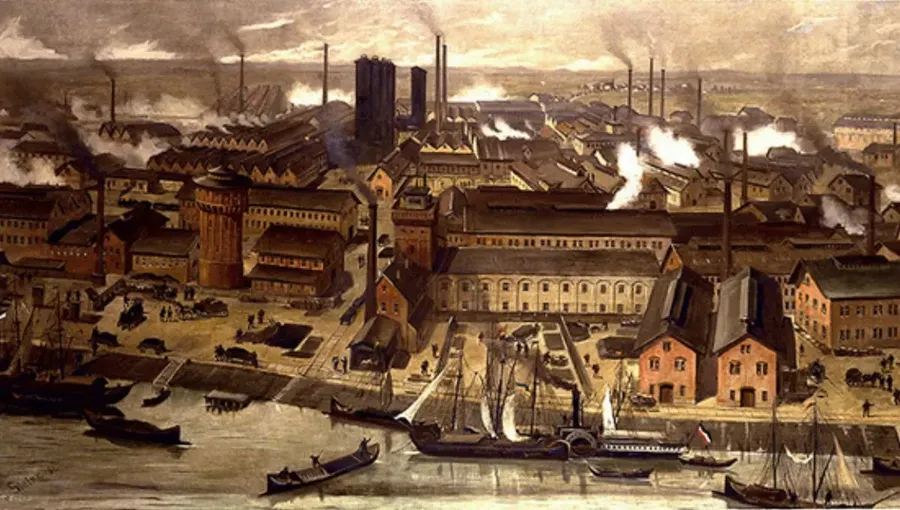
This tension between innovation and anxiety is as old as the republic itself. In 1793, Samuel Slater built the first water-powered cotton spinning mill, sparking the American Industrial Revolution. As machines began to perform everyday tasks, many grew anxious about the future. By the 1820s, early labor groups like the Working Men's Parties warned that automated machinery would concentrate wealth among a few elite factory owners. Even Thomas Jefferson initially feared that rapid industrialization would undermine agrarian freedom. Yet early American leaders did not smash the looms or freeze production. Instead, states began enacting early public education mandates to ensure workers could read technical manuals, while courts steadily evolved contract and property law to accommodate industrial trade. As policy evolved alongside technology by establishing fair labor standards and updating workforce education, the country didn't just survive the shift; it thrived. Jefferson himself eventually acknowledged the pivot, writing in 1816: "experience has taught me that manufactures are now as necessary to our independence as to our comfort." By choosing adaptation over prohibition, America transformed its economy, increasing national output, slashing the cost of everyday goods, and setting the precedent for every technological leap that followed.
A century later, technological fear took on global stakes. When the Soviet Union launched Sputnik in 1957, widespread panic swept the nation—a sudden, deep-seated anxiety that America had lost its technological supremacy. Yet this fear did not trigger calls to halt progress or freeze research. Instead, American anxiety accelerated progress. The nation mobilized through legislative action, passing the National Defense Education Act to heavily fund STEM programs, establishing NASA, and unleashing domestic ingenuity. By choosing to out-innovate rather than retreat, America didn't just win the moon race; we built the technological infrastructure, computing power, and satellite networks that cemented our status as a global superpower for the next half-century.
That same pattern repeated in living memory with the dawn of the internet. In the 1990s, the early World Wide Web was widely dismissed as a chaotic "Wild West"—a lawless frontier defined by rampant fraud, privacy anxieties, and dire warnings that digital automation would render millions of jobs obsolete. Yet rather than shutting down the network or choking it with panic-driven regulation, society adapted. Congress enacted targeted framework laws, such as Section 230 and early digital signature standards, providing legal guardrails without burdening underlying code with precautionary bans. We established basic online consumer protections, built cyber infrastructure, and allowed the digital economy to mature. What began as an unpredictable experiment became an indispensable pillar of modern life, giving rise to entire industries, generating millions of new careers, and driving the largest economic expansion in human history.
Artificial intelligence is far from perfect. In its current form, the technology faces genuine growing pains, from administrative errors and hallucinated outputs to real anxieties over workplace displacement and data privacy. But early-stage technology has always been clumsy. The first steam engines were notoriously dangerous, the early Space Race was fraught with costly test failures, and 1990s dial-up was slow, unreliable, and prone to security exploits. What defines the American system is not that our innovations arrive flawless, but that our culture of open competition and pragmatic adaptation steadily refines them over time.
Today, however, a contrasting model threatens to take root: the precautionary principle. We see overseas regulators rushing to draft sweeping, preemptive restrictions on foundational AI models before their actual real-world applications are even fully understood. If America adopts this reactionary posture out of misplaced anxiety, we risk forfeiting our competitive edge to global adversaries who feel no such hesitation. True safety and security do not come from locking technology behind administrative barriers; they come from deploying it under vigilant, iterative oversight. Stifling AI today because it is imperfect misses the fundamental lesson of our history: progress isn't built by waiting for a technology to be foolproof, but by having the courage to develop it until it is.
From the water mills of 1793 to the rocket pads of 1957 and the web servers of the 1990s, America's playbook has remained unchanged. We do not secure our economy or protect our workforce by retreating behind panic-driven regulation or freezing progress out of fear. On college campuses and operational commands alike, the path forward isn't to ban AI from classrooms or units out of fear of misuse, but to integrate it, train workforce candidates to leverage these tools ethically, and equip the next generation to engineer safer, faster, and more reliable systems. Looking at today's campus and policy debates, I see the current AI debate not as an unprecedented crisis, but as our generation's turn at a familiar exam. The solution isn't to shut down the machine; it is to do what Americans have always done: adapt our standards, train our workforce, and out-innovate the world.
Jace Robertiello is an active-duty U.S. Navy submariner and an engineering student through FSCJ and UNF.
The views expressed are those of the author and do not reflect the official policy or position of the Department of the Navy, the Department of War, or the U.S. Government.

Operation Epic Fury and the Illusion of Victory
By Stephen D. Cook • RealClearDefense
Previewing The Shenzen Summit: A Critical View
By Stephen Blank • RealClearDefense
How to Win Without Military Victory
By Kevin Eyer • RealClearDefense
We Keep Funding ‘Shared Infrastructure.’ Nobody Has Defined It.
By Frederick Gale • RealClearDefense
Congress Must Reauthorize Section 702 of the Foreign Intelligence Surveillance Act
By Bryce G. Poole • RealClearDefense

Five Takeaways From Navy Nominee’s Rocky Hearing
By Seligman & Weisgerber, WSJ
U.S. Air Force Taps Anduril for Containerized Launcher
By Global Defense News
Time To Say Goodbye to the NMESIS and NSM
By Marine Corps Compass Points
HII and U.S. Navy Break Ground on Shipyard Complex
By George Allison, UKDJ
Rare U.S. Air Force Spy Plane Spotted Over the Black Sea
By D. Malyasov, Defence Blog