

Why the Pentagon's Drone Revolution Could Run Out of Power
Last updated 04:17 PM EDT • Read time: 5m
The United States is making historic investments in autonomous platforms. But it is not sufficiently bolstering the battery supply chains they depend on.
The Pentagon is dedicating historic levels of funding to rapidly develop and field new military platforms with unique power requirements – from drones and undersea vehicles to directed energy weapons.
But their underlying supply chains, particularly for specialized lithium-ion batteries to power them, have not received anywhere near the level of investment needed. Instead, they remain heavily dependent on China for key components, which has repeatedly demonstrated its willingness to delay or even sever access to critical materials for the U.S. defense and aerospace sectors.
Congress and the Trump Administration have taken important initial steps to change that. Last year, Congress barred Chinese materials and batteries to power these weapons systems beginning in 2028. And this year the Pentagon requested billions to help prepare U.S. companies to fill the gap.
But now Congress must provide adequate funding to ensure Pentagon acquisition programs can meet the upcoming deadline and kick the Chinese battery habit.
Almost all the subcomponents that make up lithium-ion batteries have supply chains dominated by China. That includes critical minerals like cobalt, nickel, and processed lithium, as well as graphite anodes and cathode chemistries, cathode and anode manufacturing, other inputs such as electrolyte salts and solvents, and cell production, according to Benchmark Minerals Intelligence. Battery cell production in particular plays an integral role in this supply chain as the integrator of all of those materials and supply chains into a product that can be used for power systems.
While large-scale cell plants have been established in North America and Europe, most are configured for electric vehicles and grid storage rather than the smaller, high-performance cells required by many autonomous military systems.
Specifically, there are unique environments military-critical batteries need to operate in for the warfighter that place demands on energy density, extreme low or high operating temperatures, or ultra-high power compared to conventional commercial batteries. All of this is further exacerbated by the hundreds of shapes these batteries need to fit into for all the weapons systems they are supplying, which increases the specialized equipment to produce it.
These supply chains are expensive and time consuming to develop and mature, from acquiring the equipment, to qualifying battery materials into cells. Any additional delay in bolstering them just pushes the development of these strategic assets further in the future.
Last year, the FY2026 National Defense Authorization Act phased in restrictions on the Department of Wars’ ability to procure battery materials and cells that are traced to China and other “foreign entities of concern.” That means building a resilient battery sourcing pipeline is no longer merely a preference or aspirational goal. It is law.
The clock to meet to these mandates is ticking. The first deadline applies to new acquisition programs starting January 1, 2028, little more than a year away. Some emerging U.S. military programs are already preparing to comply, such as the Drone Dominance program, which is working to enact these requirements earlier than the statute requires.
But the Department of War and Congress must take more aggressive action to ensure military platforms that rely on these batteries have the alternatives they need, when they need them.
The FY27 Presidential Budget request now before Congress included $2.1 billion for energy storage and batteries and approximately $6.4 billion for strategic and critical materials to be financed by the Defense Production Act. Considering the dollars dedicated to the downstream products they are powering that would be rendered useless without a reliable lithium ion battery supply chain, this is a relative bargain.
The proposed funding would work to enable not just current technology, but create an edge for the warfighter by funding next-generation materials to power the future for the warfighter. This would include helping companies span the dreaded valley of death, where innovation dies on the vine due to lack of scale-up support.
These proposed investments recognize that military capability depends not only on finished weapons, but also on the industrial capacity and material supply chains required to produce them.
Now, Congress must deliver the funding so American industry can meet the looming deadlines for severing the military’s dependence on China. The failure to invest in military-specific batteries not only threatens the military’s modernization plans but means that for years into the future China will retain the ability to disrupt access to mission-critical power technologies in a future conflict.
Samm Gillard is executive director of the Battery Advocacy for Technology Transformation (BATT) Coalition and Policy Director for the Military Power Sources Consortium.
Adrian Yao is the Founder & Chief Executive Officer of EnPower, Inc, a battery cell company based in Indiana.
James Trevey, Ph.D., is Chief Technology Officer of Forge Nano, an advanced materials and battery technology company based in Colorado.
image: A U.S. Army Soldier assigned to 7th Special Forces Group (Airborne) holds a student-built FPV drone—complete with carbon fiber frame, blue propellers, orange anodized motors, strapped lithium-polymer battery, and exposed wiring—following successful assembly during the Operator Drone Basic Course at Eglin Air Force Base, Florida, Jan. 26, 2027. After Week 1 hands-on construction, troubleshooting, and simulator training, students walk away with a fully functional drone they built themselves, enabling Green Berets to deploy these unmanned systems for reconnaissance, precision observation, or action—placing robots in harm's way to protect personnel and enhance situational awareness on future battlefields. (U.S. Army photo by Sgt. Jacob Bradford)

Trump's Disrupt First, Negotiate Second: Greenland in Focus
By Meda Parameswara Reddy • RealClearDefense
In Seeking Peace With Beijing, Taipei Is an Asset, Not a Burden
By Alexandru Filip • RealClearDefense
Strike First: Israel's Inevitable Doctrine for the Iranian Axis
By Lance Gordon • RealClearDefense
It’s Not President Trump but Thomas Friedman Who Should Be Ashamed
By Francis P. Sempa • RealClearDefense
Putin, Plague, and America’s Biodefense Gap
By Ryan Kane • RealClearDefense

U.S. and Japan Begin Naval Exercises Near Taiwan
By Mari Yamaguchi • Associated PressU.S. and Japan Begin Naval Exercises Near Taiwan
By Mari Yamaguchi, AP
U.S. Navy, Gecko Robotics Surge AI Maintenance Contract
By Ceder, Simkins, Navy T.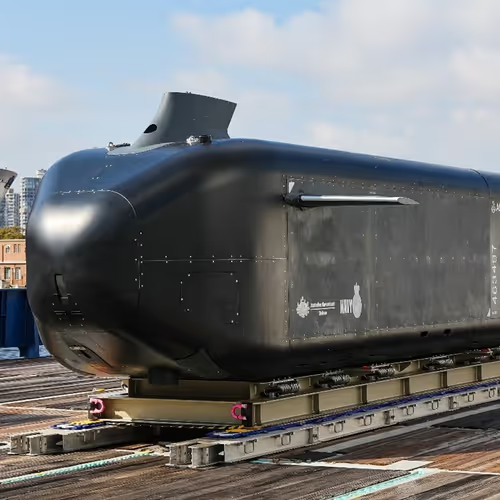
Ghost Shark XL-AUV Payload Bay Seen For First Time
By Thomas Newdick, The WarZone
Dakota Meyer Tapped As Barracks Task Force Senior Advisor
By C. Stassis, MC Times