
Why We Need NGAD Now
Published July 23, 2024 • Read time: 5m
A pressing problem the next administration faces is how to achieve concurrent fiscal and strategic renovation of America’s defense establishment. This is urgent given the unceasing military buildups and mutual cooperation of the authoritarian axis, Russia, China, Iran, and North Korea. A worldwide military buildup against Western interests is occurring in multiple theaters. Chinese troops are carrying out exercises on the borders of Poland, the Houthis roam the Red Sea, and global instability is rising. Neither we nor our allies can afford to ignore the lessons of contemporary wars on daily display.
Our defense procurement system urgently requires transformation. We can no longer tolerate lengthy production delays, cost overruns, and other failures that continue to swallow huge budgets needed to produce new weapons and operational concepts to meet current challenges. Our adversaries plan to use initiative and cheap weapon systems en masse to bankrupt us. Houthi/Iranian drones costing $2,000 per unit are being intercepted by $2,000,000 American missiles. This is not a recipe for strategic success.
America’s procurement system suffers extreme bottlenecks, and it is unable to produce basic equipment in quantities needed to deter aggression. For example, the U.S. has a backlog of over $14 billion dollars in equipment owed to Taiwan, a vital American partner, that has already been paid for but is years behind schedule.
A few days of combat in the Red Sea nearly depleted existing stockpiles of Tomahawks. Artillery shell stocks have been so depleted the U.S. is now racing to open more factories. Even when funding is available, America simply isn’t making equipment fast enough.
U.S. air defense programs display multiple glaring examples of these flaws, such as the F-22 vs. F-35 fighter jet debate. One group wants to keep the F-22, citing it as an exceptional aircraft while making significant but cheap additions to it. This school of thought is driven by cost factors and points to a lack of money for a wholly new aircraft and weapons suite. However, it ignores contemporary developments in aerial warfare, especially cheaper drones and surface-to-air capabilities.
A second group still fights for the F-35. Despite this, the Pentagon’s top testing office, the Director, Operational Test & Evaluation (DOT&E), in its recently released annual report, showed that the F-35 program has a fleet-wide full mission capability rate of only 30% . F-35s have been plagued by hundreds of billions in cost overruns and years of production delays despite generous funding. These and other defects have long been known. Yet we continue to throw good money after bad.
U.S. and its allies are at risk of falling behind our rivals, particularly China, for future mastery of the crucial aerial dimension of future war. China is not deterred by bloated and expensive weapons platforms like the F-35. Furthermore, Beijing is intent on moving towards a whole new sixth-generation fighter, making clear that mere incremental add-ons to the F-22 or ignoring the defects of the F-35 cannot provide viable solutions to meeting China’s challenge in the aerial domain.
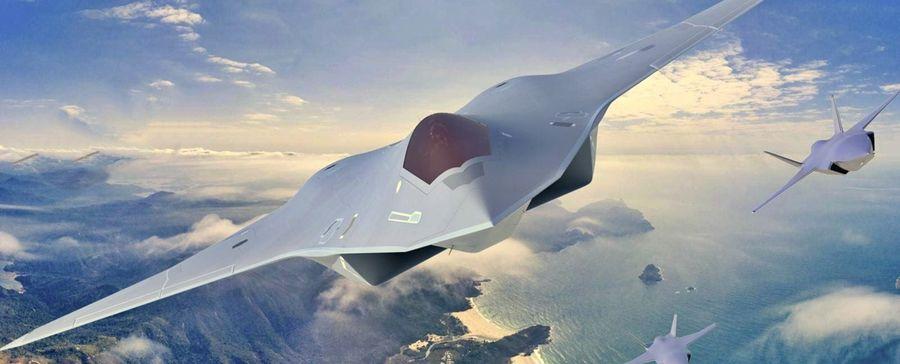
The rational solution to this impasse would be to support NGAD, the Next Generation Air Dominance system. The NGAD represents an entirely new approach which focuses on not just technological developments, but strategic cost and production capacity. Indeed, it appears more in tune with both the lessons of contemporary war and foreign developments than traditional efforts to modernize the F-22 or F-35. The NGAD is intended to be not just a fighter but the centerpiece of a network of systems, encompassing fighter air, drones, and air defenses, all possessing futuristic reconnaissance, electronic, command and control, and strike capabilities.
NGAD preempts what China is doing with its sixth-generation aircraft program. For instance, China’s program focuses on networking its aerial assets according to “the loyal wingman” concept, where UAVs accompany fighters, vastly complicating the tasks of defenders. As former Secretary of the Air Force Deborah Lee James has written, NGAD includes a manned, penetrating, counter-air platform and unmanned collaborative combat aircraft.
NGAD emerged from DARPA’s 2015 Aerospace Innovation Initiative (AII) that reached the same conclusion, namely that advancing to a wholly new system is better than merely adding new features to the older F-22. Frank Kendall, Secretary of the Air Force also strongly advocates the NGAD as the system of the future for the Air Force even as he acknowledges the difficult budgetary challenges of the immediate future.
The war in Ukraine has brought home the fact that air defenses, particularly when integrated with missiles and drones, offers undisputed superiority to virtually all manned aircraft. At the same time, the combination of UAVs integrated with fighters, bombers, and other craft has allowed for major increases in the effective lethality of the kill chain of offensive aircraft that also find it easier to evade defenses.
NGAD would be an optimal program to pursue, making it all the more depressing that Frank Kendall, the same Secretary of the Air Force who supports it, may be compelled by budget constraints to defund it.
America’s adversaries have learned how to mesh technological development, quantitative pressures, and budgetary priorities. Suffice it to see how Russia is rebuilding its guided bombs and drone capabilities against Ukraine. If the U.S. does not learn from their advances and streamline our bloated defense procurement process, we risk handing not just air superiority to our adversaries, but strategic initiative writ large.
Dr. Stephen J. Blank is a Senior Fellow at Foreign Policy Research Institute. He is an internationally renowned expert on Russian and Chinese defense policy. He is the author of "Light from the East: Russia's Quest for Great Power Status in Asia" (Taylor & Francis, 2023). He was a Professor of National Security Studies at the Strategic Studies Institute of the U.S. Army War College.

Iran’s Nuclear and Chemical Weapons Threat
By Ben Ollerenshaw • RealClearDefense
Europe’s Rearmament Paradox
By Daniel Darling • RealClearDefense
Pentagon’s Pursuit of Faster Acquisition
By Ben Harris • RealClearDefense
The Army’s AI Cyber Defenders Need a Proven Stand-Down Order
By Gleb Tsipursky • RealClearDefense
After the Silence
By Chase Skylar DeMayo • RealClearDefense
The First Surface Drone-v-Drone Fight
By CDR Salamander, CDR Salamander
Air Force Strengthens F-22 Raptor Combat Readiness in the Pacific
By Global DefenseAfter the Silence
By Chase Skylar DeMayo • RealClearDefense
Underwater Arms Race Puts U.S. Naval Supremacy at Risk
By Tom O'Connor, Newsweek
New Facilities To Pump Out Upgraded F/A-18E/F Super Hornets
By Trevithick, WarZone