
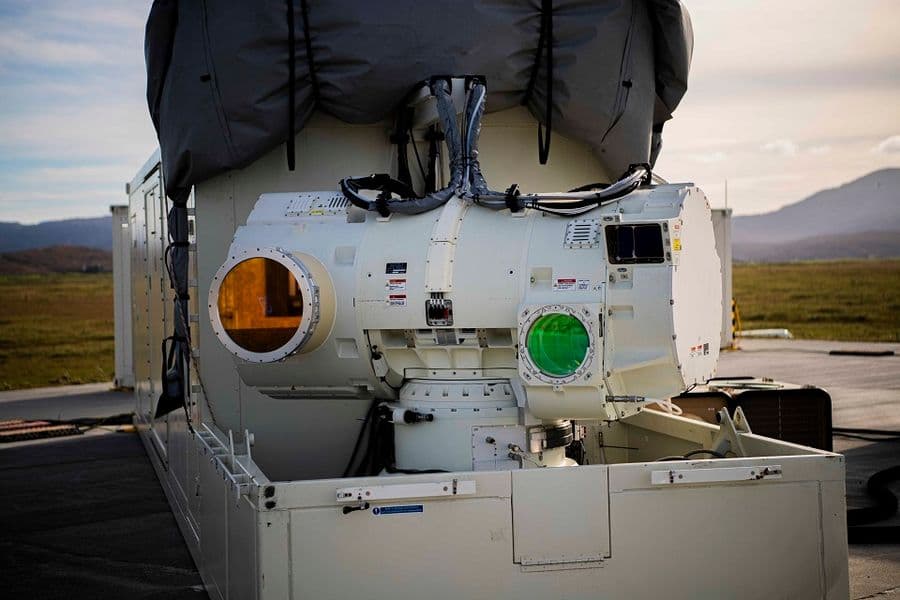
DragonFire (Laser Weapon) is led by the Defence Science and Technology Laboratory (Dstl), on behalf of the UK MOD, working with its industry partners MBDA, Leonardo and QinetiQ. (British Ministry of Defence)
A Quick Look at the Cheap Ways To Shoot Down Strike Drones
Last updated 03:20 PM EST • Read time: 4m
Militaries will have to turn to electromagnetic warfare, directed-energy weapons and passive defence to counter strike weapons, especially cheap, propeller-driven drones. The old paradigm of shooting costly, rocket-propelled, radar-guided missiles at incoming strike munitions is as exhausted as an interceptor stock would be after rolling salvos of attacks.
If we didn’t know that before the US–Iran conflict, we do now.
The now well-understood problem is that interceptor missiles can each cost 100 times as much as propeller-driven strike drones and therefore cannot be in anything like such plentiful supply. In less than six weeks of fighting with Iran from 28 February to 8 April, the United States used more than half of its pre-war inventory of interceptor missiles, according to the Center for Strategic and International Studies (CSIS). The stock could take up to four years to rebuild.
The CSIS report highlighted that modern air defence systems, no matter how advanced, are unsuitable for prolonged conflicts in which the primary aerial threat is not ballistic missiles. Using such systems may well protect targets that cost far more than the interceptors, but sooner or later rationing of the defensive weapons must begin.
What follows is a brief review of the inexpensive methods of handling the problem of strike drones.
A first layer of defence against them could be directed-energy weapons. One type, high-power microwave systems, can potentially disable not just one drone but an entire swarm by disrupting electronics. The engagement cost is consumption of electricity, not ammunition. Another type of directed-energy weapon, high-energy lasers, also offers comparably attractive economics, but can engage only one target at a time. Shots by the Leonardo DragonFire laser developed for Britain, for example, cost £10 each and are precise enough to hit a £1 coin a kilometre away.
Directed-energy countermeasures have limits. Their range is only a few kilometres, and high-energy lasers, in particular, lose effect in adverse weather conditions. The limited range means they are mostly useful at defending specific targets, not areas in which there may be several targets or through which the incoming strike weapons must pass. Iran targeted air-defence radars at US military bases in the Middle East. Short-range directed-energy weapons might have economically protected them.
A second non-kinetic air defence layer is electromagnetic warfare, particularly by jamming radio signals used for guidance. It plays a cat-and-mouse game with the drone designers, however, requiring continuous updates as they adapt their navigation and guidance systems. And more capable drones can navigate autonomously using optical scene-matching guidance. In that case, there’s no radio guidance to jam.
Traditional anti-aircraft guns deserve renewed attention. At low cost per engagement, they have proved remarkably effective in Ukraine against slow, low-altitude drones and even jet-propelled cruise missiles. The 35 mm Gepard, for example, destroys a Shahed for roughly US$300 to US$1,000 per engagement. Its radar-guided fire-control system enables all-weather, day-and-night targeting. Such systems have very short ranges compared with defensive missile systems, but they’re vastly cheaper to buy, so a defender may be able to afford enough to cover the wide approaches to target areas, such as cities. But they are less useful against jet-propelled drones. Still, if the enemy does turn to jet propulsion, the traditional anti-aircraft guns have at least driven up the cost of incoming attacks. This has happened in Russia’s war on Ukraine.
Propeller-driven interceptor drones offer compelling economics as the first kinetic layer of a future air-defence architecture against propeller-driven munitions. Ukrainian companies have developed interceptor drones for as little as US$2,500 per round. The weapons have accounted for most Russian drone intercepts over Kyiv and other cities: by February 2026, they were accounting for 70 percent of Russian Shahed intercepts in the Kyiv region. Gulf states have taken note. Ukrainian President Volodymyr Zelenskyy’s visits to Saudi Arabia, the United Arab Emirates and Qatar in late March 2026 concluded with 10-year defence cooperation agreements specifically covering interceptor drone technology, coproduction facilities and counter-drone expertise. Again, however, a propeller-driven interceptor loses effect as its target gets faster, as it would if propelled by a jet engine.
Perhaps the most underestimated measure that can be taken against cheap strike weapons is passive defence. No air defence architecture can remain impenetrable. A single drone may still bypass all layers and strike its target. Point defences cannot cover everything. But effects can be reduced by hardening bases, dispersing aircraft and building redundant infrastructure. Establishing hardened civilian shelters can also lower the psychological impact of any penetrating munition. Every country should explore how to harden critical infrastructure, including power plants, fuel depots and command centres.
Mustafa Bilal is a research assistant at the Centre for Aerospace & Security Studies, Islamabad.
Image of a DragonFire laser weapon: British Ministry of Defence.
AI contributed no ideas to this article—Mustafa Bilal.
This article appeared originally at The Strategist (ASPI).

ICE Is Not a Four-Letter Word
By Meda Parameswara Reddy • RealClearDefense
The U.S. Can Draw Down in the Middle East Without Going Blind
By Cudi Zerey • RealClearDefense
America Needs a Joseph Directive
By Jeff Ballabon • RealClearDefense
Partnering Decides Whether Flexible Military Construction Can Work
By Matt Russell • RealClearDefense
Eight Months of Epic Fury and Still No Internal Alternative
By Stephen D. Cook • RealClearDefense

GE Aerospace to Supply Engines for Two US Navy Flight III Destroyers
By Defense Post
U.S. Air Force Asks Industry for New Cruise Missile for Ukraine
By Michael Peck, DNews
First Flight II San Antonio-class Amphib Completes Builder’s Trials
By Mongilio, USNI N.
LGM-35 Sentinel ICBM on Track for 2030
By Kris Osborn, Warrior Maven
On American Destroyers, Avoid a Self-Inflicted Wound in Spain
By Defense News