
Why Trump's Germany Drawdown is Overdue
Last updated 06:24 AM EDT • Read time: 4m
Why the U.S. drawdown from Germany is the strategic realignment that Washington needs
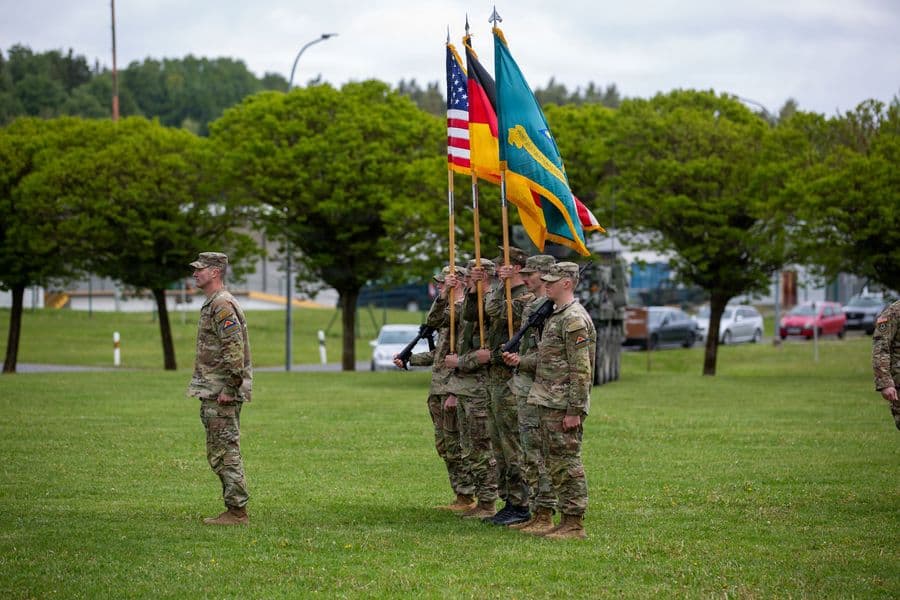
Washington’s retaliatory threat to pull troops out of Germany has become a reality in the Pentagon, following Secretary Hegseth’s announcement of the plan to withdraw 5,000 American troops in response to German Chancellor Merz’s criticism of American strategy in Iran. While this modest initial withdrawal is keeping with the Trump administration’s often reactive foreign policy, embarking on troop withdrawal is the right move and long overdue, even if its catalyst is rooted in a misplaced desire to punish Berlin.
The U.S. has maintained force presence in Germany for 80 years, today numbering 79 total installations and over 30,000 troops and accounting for over half of all American active-duty soldiers deployed in Europe. The Ramstein airbase serves as the core of U.S. force presence in the region, providing a complex network of infrastructure for global missions, including airdrops and medical evacuations. Other major bases in Germany hold the headquarters for U.S. Special Forces and Africa command, while the Grafenwoehr base serves as the largest American training facility outside of the United States.
Primary U.S. security concerns now lay elsewhere, both in the Indo-Pacific, and, as Washington has emphasized, close to home in the Western hemisphere. The German bases alone cost $4-5 billion a year to sustain, defense money that could no doubt be better spent elsewhere. Current U.S. force deployments and resources dedicated to maintaining the bases in Germany are simply disproportional to U.S. security interests in the region.
Aside from the sheer cost of the U.S. troop deployments in Germany and the pressing need to focus U.S. forces and resources elsewhere, sustaining a healthy and durable transatlantic security partnership rests on sustainable burden shifting. Further, asking American taxpayers to continue bearing the costs, both in terms of personnel and finances, poses a moral hazard for European security architecture going forward. For Europe, continuing to fall under the security umbrella of the U.S. is not sustainable or certain. Rather than allow European forces to atrophy and drag their feet, healthy decoupling is beyond necessary. As long as the U.S. continues to bear the bulk of the burden for European security, there will be no true impetus for European states to take more responsibility for their own security and assume a stronger and more sustainable role within the transatlantic partnership.
While the immediate case behind pulling these troops from Germany may be a petty vendetta, the timing is apt for European states as well. The EU has continued to roll out a variety of plans and mechanisms to incentivize the growth of European defense industries, working towards the implementation of the European Defense Fund (EDF), a permanent, multi-million-euro fund sourced from the EU budget aimed at fostering multinational cooperation on defense innovation within the EU community.
In addition to the EDF, which serves as a financial instrument to fund research and development and reduce the cost of building new defense capabilities, the Permanent Structured Cooperation (PESCO) treaty entails a legally binding commitment for member states to increase spending on defense and ensure interoperability between forces. Defense spending by EU member states has increased 62.8% between 2020 and 2025, with growth being driven primarily by investment in the defense industry, which topped 130 billion euros last year. Across the EU, member states have increased their spending on defense, and both individual European countries as well as the EU have shouldered much of the burden with providing bilateral aid to Ukraine.
A critical misstep that American policymakers and military leadership must avoid is simply redeploying U.S. forces elsewhere in Europe. While maintaining strong diplomatic and political ties with European allies should remain at the forefront of discussions concerning force withdrawal, placating critics by moving American forces elsewhere would not only undermine the opportunity to achieve more even burden sharing, a stronger European defense posture, and better globally situated American forces, it would prove that Washington is more occupied with vindictive tit-for-tat measures than prioritizing national security.
Ultimately, despite the inconsistent nature of the Trump administration’s foreign policy, drawdown of the U.S. troop deployments in Germany and elsewhere in Europe is long overdue and stands to benefit both sides of the Transatlantic alliance. For the EU and its member states, who are continuing to demonstrate both the willingness and ability to bear the burden of their own security, remaining tethered to an ally with massively divergent strategic interests poses a major risk. For U.S. interests, maintaining a massive and resource intensive network of bases and personnel is expensive and anachronistic, diverting resources away from more pressing U.S. national security interests.
Violet Collins is a Contributing Fellow at Defense Priorities and a PhD researcher on security and defense policy at the University of Genoa.
Is It Déjà vu All Over Again: The 2012 Report on Global Zero
By Peter Huessy • RealClearDefense
As Private Investment Pours Into Defense, the Clock Is Ticking
By Elaine McCusker • RealClearDefense
The First Test of Peace Lies in Ukraine's Borderlands
By Dennis T. Cosgrove • RealClearDefense
The VFW’s Gambling Addiction Victimizes Veterans
By Jack Yoest • RealClearDefense
Superintelligence Exposes a Gap in the Law of Delegated Authority
By Sue Ghosh Stricklett • RealClearDefense
When Your Navy is too Small, the Bill Comes Due Bigly
By CDR Salamander
Quo Vadis MCU?
By Marine Corps Compass Points
When the Network Goes Dark, Who Controls the Battlefield?
By Jonathan K. Corrado • RealClearDefense
Air Force Should Buy 250 Blended-Wing Tankers, as 2027 Demo Looms
By A&SF Mag.
Long Deployments to Be Navy Standard For Next Couple Years
By Mongilio, USNI News