
A CLIP for Ships
Published Jan. 15, 2026 • Read time: 6m
Applying a Century-Old Infantry Lesson to Modern Naval Warfare
Armies did not adopt ammunition clips and detachable magazines because they were elegant or technologically novel. They adopted them because combat proved that reloading individual rounds in the middle of a firefight was tactically fatal. Soldiers survived by keeping their weapons in the fight, by swapping a loaded clip in seconds and worrying about refilling it later, when safe. The lesson was simple and enduring: do not reload the weapon during the fight; extend the weapon’s magazine so the shooter can keep shooting.
That same logic can now apply at sea.
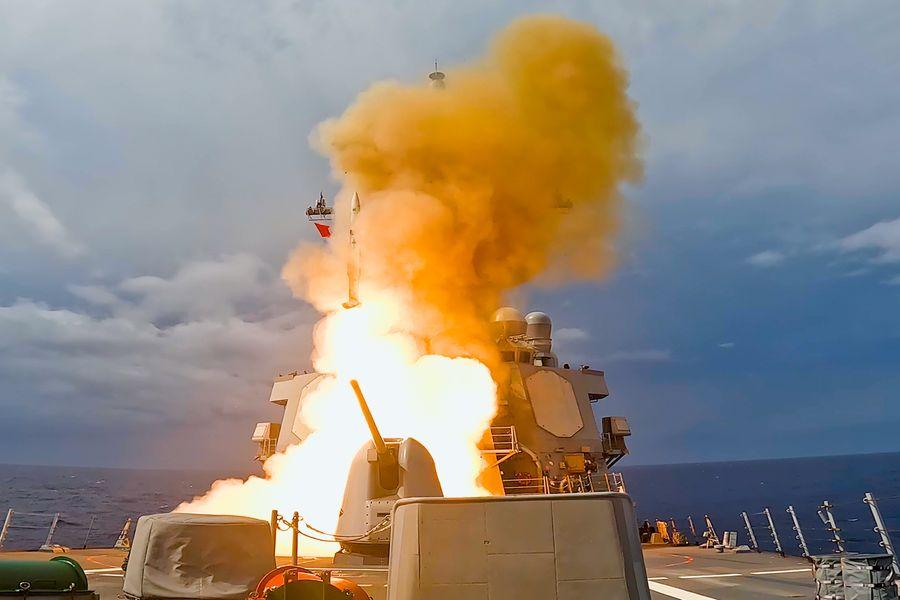
Modern surface combatants are among the most lethal platforms ever built, but once their vertical launch system (VLS) cells are empty, they must withdraw to reload. In a high-end naval conflict, particularly in the Indo-Pacific, this creates a dangerous and unnecessary vulnerability. A “CLIP for ships” applies an old, proven combat lesson to missile warfare: keep the shooter in the fight by extending its magazine, not by reloading it under fire.
The Navy’s challenge today is not a lack of firepower; it is a lack of sustained firepower. Arleigh Burke–class destroyers carry extraordinarily capable weapons, but their magazines are finite. Once expended, combat power drops precipitously regardless of how advanced a platform’s sensors or defenses may be. Over the past several years, the Navy has understandably pursued at-sea missile reloading concepts to mitigate this risk. These efforts deserve credit. But reloading remains fundamentally about refilling the same fixed magazine, often one cell at a time, under operational pressure and risk.
The Readiness Cliff: Pacific Lessons Drawn from the Middle East
Not Like the Old Days: Modern Sea Control Will Be Episodic and Local
To Build Golden Fleet Frigate Fast, Two Shipyards are Needed
Building Durable Demand for American Ships
A CLIP-based approach solves a different problem.
To make this concept concrete, the Navy can leverage existing large platforms, such as the Expeditionary Transfer Dock (ESD), as a CLIP, Containerized Launcher Integrated Payload, a combat-loaded extension of a destroyer’s magazine. Just as an infantryman carries pre-loaded magazines rather than loose ammunition, a CLIP extends a ship’s effective missile magazine without requiring reloads during combat. A CLIP-equipped ESD would carry containerized, already-integrated payloads, initially Tomahawk and SM-6 via existing Typhon launchers, and operate alongside major combatants without possessing its own sensors, targeting, or command-and-control systems. All mission planning, fire control, and launch authority remain entirely with the destroyer. The CLIP does not fight; it enables the fight by providing additional, immediately available magazine depth at a fraction of the cost and operational burden of adding VLS cells via high-end platforms.
Rather than forcing the shooter to pause and reload, the magazine moves to the shooter. The destroyer stays on station. The fight continues.
The Expeditionary Transfer Dock is uniquely suited to this role. Derived from commercial Alaska-class tanker hulls and operated by Military Sealift Command with a crew of roughly 34 civilian mariners, ESDs provide enormous open deck space, long endurance, and exceptionally low operating costs compared to frontline warships. They are already in the fleet, already paid for, and already designed to support modular mission packages.
Importantly, this concept can be demonstrated quickly and cheaply. The Army’s Typhon launcher already integrates Tomahawk and SM-6 missiles in standard ISO size containers. These launchers are certified, operational, and designed to be transported and secured without major ship modifications. Rolling a small number of Typhon launchers onto an existing ESD deck for a limited demonstration would require no new missile integration, no permanent structural changes, and no large budget commitment.
Once VLS capacity becomes abundant rather than scarce, the Navy gains additional operational freedom. Less valuable payloads, tube-launched UAVs, decoys, electronic warfare packages, and lower-cost missiles, can be carried without displacing high-end interceptors or strike weapons. Abundant magazine depth enables creativity, adaptation, and resilience.
This dynamic has already played out in recent asymmetric fights, such as the Navy’s experience in the Red Sea. When VLS cells are scarce and reserved for highly valued missiles like ESSM, Standard Missiles, and Tomahawk, there is little room for lower-cost interceptors designed to defeat inexpensive UAVs and one-way attack systems. The result is a costly mismatch: multi-million-dollar missiles expended against threats measured in the thousands of dollars. By making VLS capacity abundant rather than scarce, a CLIP-enabled force allows lower-cost interceptors, decoys, and counter-UAS payloads to be carried in quantity, without displacing high-end weapons needed for peer conflict. Magazine depth, not missile sophistication, becomes the decisive factor in sustaining both high-end and asymmetric fights affordably.
Critics may argue that ESDs are vulnerable or insufficiently survivable. That concern misunderstands the CONOP. The ESD does not replace destroyers, submarines, or aircraft carriers. It operates as a supporting asset, positioned and protected according to the tactical situation. In many scenarios, it need not operate within the highest-threat envelope to provide value.
Others may argue that future arsenal ships or purpose-built platforms would be better solutions. That may be true in the long term. But the CLIP concept deliberately lowers the barrier to action. It allows the Navy to learn, adapt, and refine operational concepts today, without waiting for new hulls, new programs, or new budgets.
A simple notional concept of operations illustrates the point. An ESD equipped with containerized launchers operates in company with a destroyer. The destroyer retains all mission planning and fire control authority. When additional missile capacity is required, the destroyer tasks the ESD’s launchers as if they were remote VLS cells. The destroyer fights; the CLIP equipped ESD enables.
A CLIP for ships does not eliminate the need for reloads, forward bases, or logistics ships. It complements them. It provides commanders with options, flexibility, and depth, exactly what modern naval warfare demands.
The Navy does not need a silver bullet. It needs practical, affordable ways to keep its most valuable combatants in the fight. Soldiers solved this problem over a century ago by separating firing from reloading and extending the magazine.
The Navy can do the same.
The only remaining question is whether it will test this idea now, cheaply, and quickly, or wait to learn the lesson under fire.
Russell A. Haas is a retired defense executive and former Subject Matter Expert at the U.S. Navy Fighter Weapons School (TOPGUN). He later served as Director of Raytheon Missile Systems’ Futures & Innovation Group and now works as a freelance writer and consultant specializing in defense analysis and strategic modernization initiatives.

The Pressure Is the Message: What Xi and Putin Faced in Shenzhen
By Emzari Gelashvili • RealClearDefense
China’s Revised Mobilization Law and the Expanding Reach of National Defense
By Muhammad Shoaib • RealClearDefense
U.S. Putting Weapons in Space: A Strategic Blunder?
By Ajey Lele • RealClearDefense
The Clearance Myth Is a Readiness Problem
By Elijah Fernandez • RealClearDefense
The Pentagon's Next Readiness Test Should Begin When the Cloud Goes Dark
By Colton Overcash • RealClearDefense
U.S. Putting Weapons in Space: A Strategic Blunder?
By Ajey Lele • RealClearDefense
U.S. Senate Seeks to Exchange Shipbuilding Funds for More Munitions
By Naval News
F-35C Completes First Launch and Recovery Trials on a Ford-Class Carrier
By Navy T.
USS George Washington Leaves Mideast As Trump Mulls Ending Iran War
By S&S
ULA’s Latest Launch Failure Spells Trouble for Space Force
By Greg Hadley, A&SF