
Path to a Larger Fleet Must Include LCS
Last updated 05:51 PM EDT • Read time: 6m
The Littoral Combat Ship (LCS) has been condemned by multiple studies and reports that suggest the class is neither lethal nor survivable for the missions envisioned for the 21st century U.S. Navy surface force. Its proposed frigate variant is equally criticized for a paucity of armaments mounted to unsuitable hull forms. Larger and more capable ships are always desired, but present strategic and budgetary reasons do not support a frigate. Both LCS and its proposed frigate variant have a reasonable mix of capabilities suited to present and near-term U.S. needs. The littoral combatant and its frigate variant should be fully funded to 52 hulls. The Navy should also begin in earnest the process to create a new small surface combatant tailored to emerging U.S. naval strategy.
The present, Navy-wide readiness crisis that has seen the numbers of carrier-based strike aircraft deployed on U.S. flattops plummet from near 70 to now 48 aircraft is just the “bow wave” of a series of financial burdens that confront the fleet in the next five years. Current Navy F/A-18 E/F strike aircraft purchases have been estimated at $2.32 billion and service life extensions for others billed at $50 million. The planned purchases of the F-35C in 2017 are expected at $1.3 billion. The purchase of the twelve Columbia-class ballistic missile submarines (SSBN’s) is estimated at $100 billion, spread over the next 20 years. Large numbers of the Arleigh Burke-class guided missile destroyers are approaching expensive mid-life overhauls. Years of postponed maintenance will likely cause the updating process of the DDG 51-class to take longer and be more expensive than the Navy planned. Clearly, this is not an environment that could sustain the production of another complex and heavily armed surface warship.
This U.S. has a Cooperative Maritime Strategy that discusses specific areas of operation and associated force structure, but it does not approach the scope and complexity of the 1980’s Maritime Strategy. That series of documents constituted the de facto maritime component of the U.S. National Security strategy and contained significant operational elements to be employed by commanders in wartime. The U.S. needs a new global maritime strategy as a key element of its efforts to manage the “4+1” list of potential and active opponents (China, Russia, Iran, North Korea, and various Islamist extremist groups like ISIS) as a pre-condition to the introduction of new classes of ships. Critics of LCS and the Zumwalt-class destroyers often suggest that these ships never received an appropriate analysis or are not prepared to fight in the post-Post-Cold War era, yet demand a new, larger, and more expensive frigate with capabilities approaching that of the DDG 51 without a similar analytical effort. The U.S. should first put in place a comprehensive, global maritime strategy that clearly defines expected missions before embarking on new construction just for the sake of having a “better” unit. Every ship is a compromise in capabilities and just having a larger ship that supports more is not necessarily the right choice.
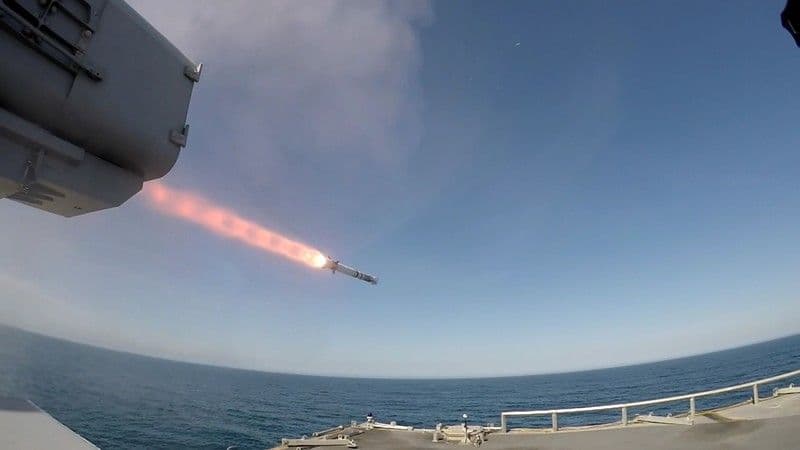
While the LCS is not an air defense frigate and does not have the same range of the preceding Oliver Hazard Perry-class guided missile frigates (FFG’s,) it boasts a modular design capable of accepting weapons unplanned at the time of LCS’ design, such as the Harpoon surface to surface missile and the Longbow Hellfire missile. The withdrawal of Harpoon by the Boeing Corporation from competition for the Navy’s LCS frigate armament program will not likely affect the effort to equip the ship with a cruise missile. LCS 4 USS Coronado, while embarked on its current deployment, has demonstrated that the littoral combatant may operate with a number of such weapons.
The Navy’s decision to delay the future frigate design will not likely result in a radically different solution from the baseline LCS variants but instead may allow for improvements in the LCS frigate variant’s capabilities. A year’s delay may result in an improved political climate in Washington D.C. Recent bipartisan budget agreements in Congress suggest that lawmakers may be working toward compromise measures that would allow for greater defense spending that could support additional frigate capabilities. In testimony last week, however, Navy surface warfare and LCS Program leaders suggested that neither a foreign-built nor radically different domestically designed frigate would emerge as the basis for a new frigate. Delaying the frigate choice also allows the Navy to determine how best to preserve the small combatant industrial base, as some sources have suggested that a down-select to one LCS variant would result in the potential closure and loss of jobs for the losing shipyard. It still seems that the LCS-variant frigate is the preferred choice, with perhaps another year in which to fund additional capabilities for that platform.
The baseline LCS has sufficient range to act in its intended forward deployed capability in presence and now distributed lethality combat operations. The LCS price tag (currently $562 million adjusted for inflation to 2017) is reasonable and has remained below required Congressional cost caps since 2011. It is not expected to have a 30-year lifespan (the option favored by the Government Accountability Office) necessitating an expensive mid-life overhaul such as that required by the DDG 51. Both LCS variants could produce workable frigate concepts with good surface and antisubmarine warfare capabilities. Concerns about the lack of anti-missile systems aboard LCS might be offset by mounting two SeaRAM point defense systems in place of the 30mm mounts currently employed as part of the interim surface warfare package. The next Navy small surface combatant may not be an LCS, but it will likely support similar off-board systems, have a small crew, and support a limited range of capabilities, vice some of the more complex that have been proposed
The seminal work on the origins of the Defense Department’s Planning, Programming, Budgeting, and Execution (PPBE) by Dr. Alain Enthoven and K. Wayne Smith suggested in its title that the operative question in defense spending was, “How much is enough?” Those demanding larger and more capable frigates do not seem to have asked that basic question. The current defense budget situation suggests that a lot less is available than many think. Build LCS and its frigate variant to their full, planned strength, and then start the process to build the next small surface combatant that is tailored to support U.S. strategic needs in a new era of great power rivalry.
Dr. Steven Wills is a retired Navy surface warfare officer. He graduated from Ohio University with a Ph.D. in Military History.

The Services Do Not Need a Four-Star Autonomous Warfare Command
By Steven Wills • RealClearDefense
Honor Them While There Is Still Time
By Jeffrey Rosales • RealClearDefense
From Siberia to Fairford: How Operation Spider’s Web Has Changed the Rules of Airpower
By Frank A. Rose • RealClearDefense
Faster Simulations, Better Defense Decisions
By Rut Lineswala • RealClearDefense
Will HASC Have an Oversight Subcommittee in the Next Congress?
By Christopher J. Bright • RealClearDefense
Hegseth Barred Trans Troops. Military Boards Are Rejecting Those Orders.
By NYT
Closing the Sea: Lessons from Ancient Mediterranean Blockades
By DeCasien, CIMSECFrom Siberia to Fairford: How Operation Spider’s Web Has Changed the Rules of Airpower
By Frank A. Rose • RealClearDefenseFaster Simulations, Better Defense Decisions
By Rut Lineswala • RealClearDefense
Bombers Could Have a Major Air-to-Air Combat Role
By Joseph Trevithick, The WarZone