
Getting Real on North Korea
Published Nov. 8, 2017 • Read time: 6m
The scene has been repeated on countless occasions since President Ronald Reagan’s time. A senior U.S. official, perhaps a Defense Secretary or the president himself, travels to the Demilitarized Zone dividing the two hostile Koreas. He peers through a set of binoculars at the North Korean troops manning their posts and pledges that the strength and solidarity of the U.S.-South Korean alliance is ironclad. The entire ordeal is meant to demonstrate a bond between the United States and South Korea that has lasted for over sixty years.
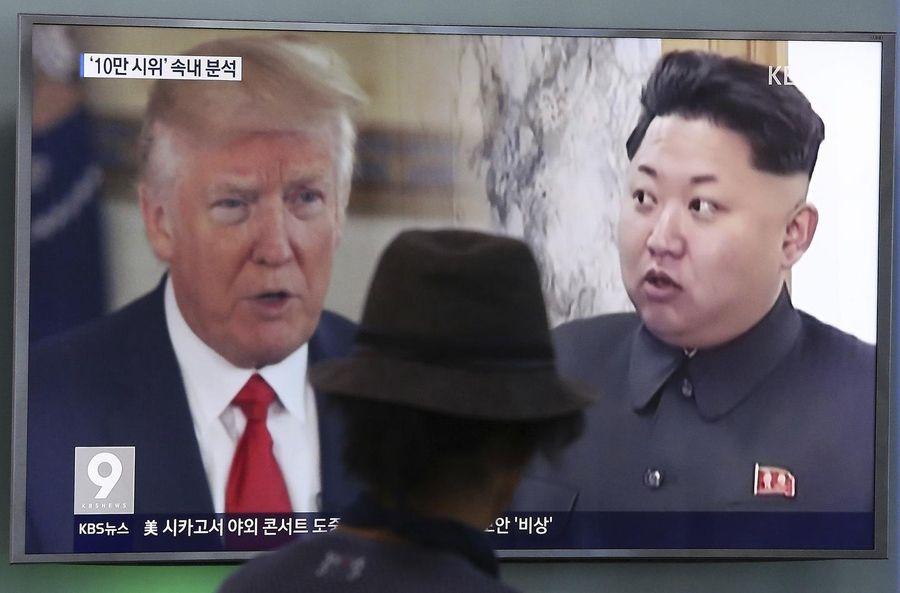
President Trump will not be making the trip to the DMZ during his two-day stop in South Korea, but his meetings with South Korean President Moon Jae-in will be important nonetheless. Indeed, Trump has an opportunity to embrace a refreshingly realist approach to the North Korean nuclear problem being brutally honest about what the U.S. can and cannot achieve on the Korean Peninsula. And as difficult as it is to admit, this requires giving up on the Kim regime’s denuclearization.
Washington’s North Korea policy across successive administrations has centered on pressuring or persuading Pyongyang to shutter its nuclear weapons program in exchange for economic or political incentives from the international community. President George H.W. Bush ordered the withdrawal of tactical nuclear weapons from South Korea in 1991 partly to reinforce the U.S. objective of keeping the Korean Peninsula nuclear-free. The gesture did not work.
In 1994, the Clinton administration tried direct negotiations with Pyongyang and even arrived at an agreement that traded shipments of heavy fuel oil, the construction of proliferation-resistant light reactors, and prospects for a normalization of relations in exchange for the closure of North Korea’s plutonium reactor. While the plutonium reactor at Yongbyon was indeed frozen for roughly eight years, the U.S. intelligence community would catch Pyongyang working on a uranium enrichment program. The accord quickly fell apart.
President George W. Bush spent roughly five years of on-and-off diplomacy within the Six-Party Talks framework, coming close to reaching an accord. That is until diplomacy broke down again over issues of transparency, access, and verification.
President Barack Obama tried diplomacy for a time, but largely gave up after newly ascendant leader Kim Jong-un violated the ill-fated “Leap Day deal” weeks after it was agreed to.
Trump appears to believe that the last four administrations were too soft on Pyongyang, too incompetent to strike a deal in America’s best interest, and too weak-kneed to push the North Korean regime to its breaking point. He has repeatedly blasted his predecessors for failing to solve the North Korean nuclear problem as if the North Korean problem is actually solvable.
Put simply, it is not.
At this late stage in the game, North Korea can at best be managed—but only if the administration realizes that the U.S. policy of denuclearization is unrealistic short of catastrophic (likely nuclear) war and likely will be as long as a Kim is ruling the country. The Kim dynasty has been a member of the nuclear club for more than a decade when it tested its first primitive nuclear device underground. With CIA Director Mike Pompeo estimating that North Korea is only several months away from acquiring the capability to launch a nuclear-tipped intercontinental ballistic missile toward a target on the continental U.S., the chances of Kim denuclearizing regardless of the pressure Washington brings to bear is slim to none.
The only viable option available to the Trump administration is to acknowledge the reality as it exists today. Moreover, the first step on that road without launching a war that everyone acknowledges would be extremely violent and bloody is through deterrence and containment.
We know deterrence is an effective strategy because it has worked for the last 72 years. If Washington could successfully deter the Soviet Union throughout the Cold War when the Kremlin possessed tens of thousands of nuclear bombs pointed at American cities and military bases, there is no reason why the U.S. could not do the same thing with a North Korea that possesses a few dozen.
Kim Jong-un—much like the Joseph Stalin and Nikita Khrushchev—may sound crazy at times and treat his people horribly, but like past Soviet and Chinese premiers, Kim is egotistical and obsessed above all else with survival and self-preservation. He does not want the regime his grandfather founded and his father sustained killed off.
A U.S.-led containment and deterrence strategy would look both similar and slightly different to the policy nine American presidents followed for seven decades followed during the Cold War.
First, a reliable line of communication would be established with Pyongyang to make it abundantly clear that any attempt to use its nuclear capability against the U.S., South Korea, or Japan would be the end of the Kim regime. If Kim Jong-un, for instance, attempts to initiate a conflict with Seoul—thinking that he can deter the U.S. military from coming to South Korea’s assistance—he will have sorely miscalculated the credibility of the U.S. alliance commitment.
Second, the Trump administration would initiate far more diplomacy with the North Koreans than they have been willing to offer in the past. Unlike in the past, dialogue would not be used to launch a comprehensive negotiation about denuclearization. Instead, it would be used for the express purposes of minimizing misunderstanding between both nations; ensuring that red lines are delivered and received clearly; and to maintain a line of communication between U.S. and North Korean military officials that could possibly be leveraged in the future for a discussion about political normalization or detente when the time is appropriate.
Third, the Pentagon will need to be certain that the U.S. Pacific Command possesses the naval and Air Force assets, anti-missile defenses, and proper alliance coordination necessary to quickly respond to a provocation in the event the North Koreans begin one. Intelligence community relationships in East Asia, including with China, will need to be more synchronized to monitor Pyongyang’s illicit export of military technology. Countries can no longer be given the benefit of the doubt on implementing U.N. Security Council resolutions, especially those seeking to combat the arms trafficking or dual-use technology exports Pyongyang will try to engage in as other revenue streams are foreclosed or reduced.
Our military and defense leaders must face facts and pursue the best policies for the U.S. based on reality, not Washington fantasy. If another round of intensive U.S.-North Korea diplomacy breaks down or does not start in the first place, President Trump ought to dust off the Cold War playbook. Deterrence is a far safer and more effective (and moral) alternative than a preventive military strike that would escalate into a full-scale and devastating (nuclear) war.
Daniel DePetris is a fellow at Defense Priorities.

Why Iran Cannot Simply Surrender
By Eric Garland • RealClearDefense
The Formation Left Us Behind
By Mark W. Castillon • RealClearDefense
Can Commanders Tell When Artificial Intelligence Is Wrong?
By Jonathan K. Corrado • RealClearDefense
The Summit as Mirror
By Stephen Blank • RealClearDefense
The False Choice That Could Get Us Killed
By Adam Strickland • RealClearDefense
Why Iran Cannot Simply Surrender
By Eric Garland • RealClearDefense
U.S. Navy Cuts Submarine Maintenance Delays by 40%
By Ethan Gossrow, Naval News
Air Force Bets on Hybrid-Electric Aircraft for Transport
By L.C. Williams, Defense One
Roosevelt Joins 2 Other Carriers in Mideast As Pressure on Iran Rises
By Stars & Stripes
Fight Now? Time to beef up III MEF
By Marine Corps Compass Points