
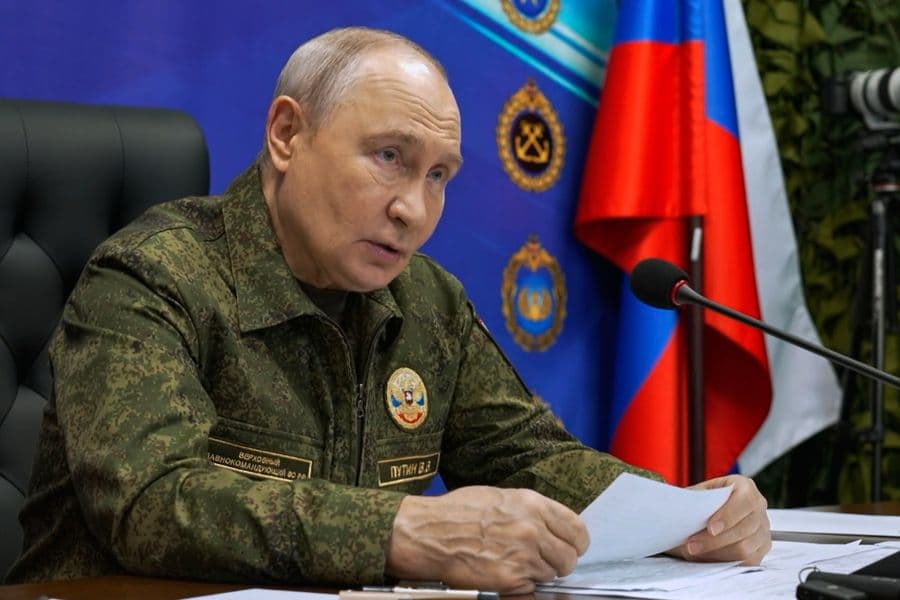
In this image taken from video provided by Russian Presidential Press Service Friday, Oct. 16, 2026, Russian President Vladimir Putin speaks to officers as he visits one of the command posts of the Joint Group of the Russian Forces, at an undisclosed location. (Russian Presidential Press Service via AP)
Putin Makes Nuclear Threats Over Kaliningrad
Last updated 10:51 AM EDT • Read time: 7m
Putin Makes Nuclear Threats Over Kaliningrad
Executive Summary:
- The Kremlin threatened to use nuclear weapons against the North Atlantic Treaty Organization (NATO) if the Alliance attempts to cut off its Kaliningrad exclave from mainland Russia following several military exercises near the oblast’s borders. NATO Secretary General Mark Rutte called on Russia to cease nuclear threats and emphasized NATO’s purely defensive nature in response.
- Kaliningrad’s regional identity and pro-European orientation, relative to the rest of Russia, have increasingly clashed with Moscow’s policies as the Russian economy deteriorates. The Kremlin eliminated regional political parties in 2001 and transformed the exclave into a heavily militarized outpost facing NATO.
- Putin’s nuclear threats over Kaliningrad appear aimed at portraying Russia as under siege while obscuring the Kremlin’s role in tensions with NATO, including its war against Ukraine and hybrid war against the European Union. Despite Moscow’s claims, NATO military action against the exclave remains extremely unlikely absent a major Russian escalation.
In late September, the Russian Foreign Ministry sent a diplomatic note to the North Atlantic Treaty Organization (NATO) threatening to use nuclear weapons against them if the Alliance attempts to “isolate” the Kaliningrad exclave from the rest of Russia following several military exercises along the oblast’s borders (The Insider, September 30). In early October, Russian President Vladimir Putin reiterated the same threat, calling nuclear weapons Russia’s “competitive advantage” against an “enemy … twice as big” at a meeting of the pro-Kremlin Valdai Discussion Club (Nastoyashee Vremya, October 1).
It is telling that Putin now refers to Europe as an “adversary.” This reflects the evolution of rhetoric over 26 years of Kremlin rule—a man who, at the start of his presidency in 2000, advocated Russia’s integration with Europe and even discussed its accession to NATO (Russia Matters, June 16, 2022).
Even after nearly five years of full-scale war against Ukraine, Putin portrays Russia solely as a “victim” of external attacks. On October 1, he said, “We have no intention of attacking anyone—neither in 2029, nor in 2030, nor in 2050. However, if we face aggression, we will be forced to respond. Citizens of European countries need to clearly understand this” (Euronews, October 3). In response to these Russian statements, NATO Secretary General Mark Rutte emphasized that the Alliance is purely defensive and called on the Kremlin to cease nuclear threats (The Moscow Times, September 30).
Putin’s statements regarding supposed NATO threats to Kaliningrad are openly hypocritical (Radio Svoboda, October 4). In addition to its actual war against Ukraine, it has launched a hybrid war against Europe, employing drone incursions, acts of sabotage at factories, and information operations.
NATO military action against Kaliningrad is extremely unlikely. Such measures would likely be possible only as a retaliatory measure if Putin and Belarusian President Alyaksandr Lukashenka seized the Suwałki Gap, the approximately 40 miles that separate Kaliningrad and Belarus along the border of Poland and Lithuania. Russian control of the Suwałki Gap would grant the Kremlin direct overland access to Kaliningrad via Belarus, and would sever the overland link between the three Baltic states and the rest of the European Union via Poland. Some observers believe that this is why there are regular Russian–Belarusian military exercises in Kaliningrad (Klops, September 12, 2025).
Putin’s threatening rhetoric may stem from a fear that sentiment inside Kaliningrad could shift against the Kremlin. Despite the crackdown on anti-war protests in Russia, such protests persist in Kaliningrad, including an act of self-immolation in February 2025 (Radio Svoboda, May 6).
In the 1990s, the Kaliningrad oblast was probably the most Europeanized region of the Russian Federation. The exclave only shares borders with EU countries, Poland and Lithuania, and a disproportionate number of its residents hold Russian “international passports,” a document required for Russians to travel abroad. Kaliningraders frequently traveled to neighboring countries, doing so far more often than they visited the rest of Russia. Such trips—whether for shopping, work, study, or tourism—fostered a more pro-European worldview.
These differences in mindset compared to other Russians were reflected in Kaliningrad’s politics. In the early 1990s, for example, the Baltic Republican Party emerged there, a regionalist movement that succeeded in getting a deputy elected to the local parliament in 2000 (Region Ekspert, November 19, 2020). As the name suggests, the party advocated transforming the Kaliningrad oblast into a republic, first as a part of Russia and later in more separatist terms, and pursuing greater European integration. It also called for restoring the city’s historical German name, Königsberg, which was held under German or Germanic rule from 1255–1946. The name since 1946 comes from Soviet official Mikhail Kalinin, who had no connection to the region and never visited.
In 2001, Russia effectively banned regional political parties by requiring them to have a nationwide organization. This hit the Kaliningrad oblast, with its distinct regional character, particularly hard. A segment of the population lost its outlet for political expression, while representatives of Moscow-centric “federal” parties viewed regionalism critically. Instead of fostering the region’s integration with Europe, Moscow began gradually transforming it into an anti-European military staging ground. In 2018, Russia permanently deployed nuclear-capable Iskander-M missile systems there (Postimees, February 5, 2018). NATO, in contrast, does not deploy nuclear weapons or nuclear-capable strike-missile systems in Lithuania or Poland.
The militarization of Kaliningrad presents a historical irony. In 1945, the Soviet Union annexed Königsberg from Germany, justifying the move as necessary to “eliminate a stronghold of militarism.” Moscow has transformed the region into a militaristic bastion. The Soviet Union moved the headquarters of the Baltic Fleet and its extensive military infrastructure to Kaliningrad. Moreover, during the Putin era, the region’s militarization has intensified. For instance, Kaliningrad University—despite now bearing the name of the philosopher Immanuel Kant, a theorist of “perpetual peace”—has become an instrument of informational warfare against the Baltic states (ICDS, August 27, 2018).
Many residents of Kaliningrad with pro-European leanings are dissatisfied with the hostility toward Europe imposed by Moscow. Most residents of Kaliningrad are descendants of people who arrived after 1945, but over several generations, they have come to regard this land as their own. A distinct regional identity has emerged in the area, emphasizing local cultural specificities and setting them apart from the “all-Russian” identity (Region Ekspert, February 13, March 7).
Kaliningrad’s economic situation, like the rest of Russia, is deteriorating. The Kremlin alleges that this economic downturn stems from European interference with supplies from Russia’s mainland. EU sanctions have affected the transit of some categories of goods between Belarus and Kaliningrad, but Lithuania continues to permit rail transit. Russia’s diminishing ability to sustain living conditions in its exclave is primarily because Russia’s civilian economy has stopped functioning normally amid rapid militarization (The Moscow Times, October 7).
Putin’s rhetoric is increasingly out of touch with reality. His recent claims regarding a massive Russian advance in Ukraine are objectively untrue (The Moscow Times, October 3). Russia suffered a net loss of territory in September. Putin’s attempt to portray Ukraine and Europe—rather than the Kremlin—as the source of Russia’s woes continues in Kaliningrad.
Vadim Shtepa is the editor-in-chief of Region.Expert (www.region.expert), the only independent media outlet on Russian regionalism and federalism. He graduated from the Faculty of Journalism of Moscow State University (1992) and Moscow School of Political Studies (2012). He is also an alumnus of the Research Course on American Federalism (University of Missouri, St. Louis, USA, 2013). Mr. Shtepa is the author of three books on the history and philosophy of Russian regionalism, as well as a regular columnist for regional projects of the Russian service of Radio Liberty (Sever.Realii and Sibir.Realii). Since 2015, he has been living in Estonia due to persecution in Russia for his political views.
This article appeared originally at The Jamestown Foundation's Eurasia Daily Monitor.

Trump's Disrupt First, Negotiate Second: Greenland in Focus
By Meda Parameswara Reddy • RealClearDefense
In Seeking Peace With Beijing, Taipei Is an Asset, Not a Burden
By Alexandru Filip • RealClearDefense
Strike First: Israel's Inevitable Doctrine for the Iranian Axis
By Lance Gordon • RealClearDefense
It’s Not President Trump but Thomas Friedman Who Should Be Ashamed
By Francis P. Sempa • RealClearDefense
Putin, Plague, and America’s Biodefense Gap
By Ryan Kane • RealClearDefense
U.S. and Japan Begin Naval Exercises Near Taiwan
By Mari Yamaguchi • Associated PressU.S. and Japan Begin Naval Exercises Near Taiwan
By Mari Yamaguchi, AP
U.S. Navy, Gecko Robotics Surge AI Maintenance Contract
By Ceder, Simkins, Navy T.
Ghost Shark XL-AUV Payload Bay Seen For First Time
By Thomas Newdick, The WarZone
Dakota Meyer Tapped As Barracks Task Force Senior Advisor
By C. Stassis, MC Times