
Stop Fearing a Strong Russia. Start Fearing a Dying One.
Last updated 06:36 AM EDT • Read time: 39m
Editorial Note: All statistical data and screenshots cited in this article are drawn exclusively from official Russian government agencies, state media, and Russian federal statistics — including Rosstat, Interfax, TASS, the Federal Treasury, and the Russian Central Bank. This is not Western analysis of Russia. This is what Russia says about itself.
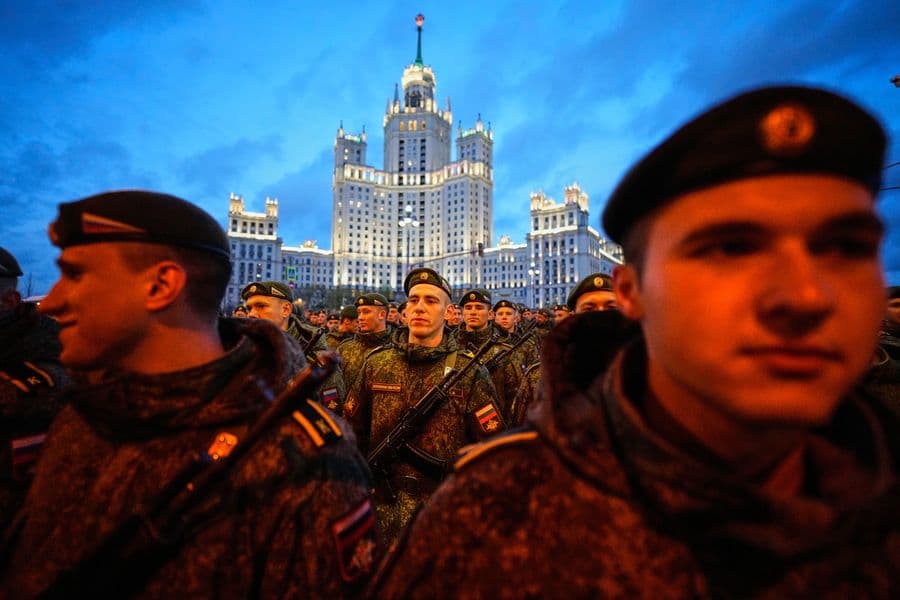
Five years ago, the Kremlin promised a three-day special military operation. On May 9, 2026, the Victory Day parade in Moscow proceeded without tanks or heavy military equipment for the first time in nineteen years — because the hardware is in Ukraine, destroyed, or protecting the bunker. Putin descended from the Lenin Mausoleum visibly encumbered beneath his coat — the outline of what appeared to be a heavy armored vest, almost certainly of Western manufacture, since he apparently no longer trusts Russian body armor. Ukrainian drones struck oil refineries deep inside Russian territory in the weeks surrounding the parade, causing significant environmental contamination in Tuapse. New cars cost three times what they did in 2014. Small businesses were told by members of the State Duma that 'only a miracle can save them.' Belarus closed its border to Russian men of military age. And Zelensky, standing in Yerevan where 5,000 Russian troops are still stationed, publicly offered to 'assist' with the aerial portion of the parade — a statement whose strategic implication was unmistakable: Ukraine now controls the airspace calculus over Russian territory.
That was the balance sheet of the three-day operation, five years on.
Western security discourse is dominated by a single fear: a powerful, aggressive Russia expanding its military reach across Europe. Billions of dollars flow into think tanks, defense budgets, and political campaigns built on this premise. But what if the fundamental premise is wrong — not because Russia is benign, but because it is collapsing? What if the most dangerous Russia is not the one that conquers, but the one that dies?
This article argues that Russia's true strategic trajectory — defined by demographic implosion, military exhaustion, economic disintegration, and financial collapse — makes a conventional military confrontation with NATO prohibitively costly and strategically irrational within any relevant near-term timeframe. And yet Western policy continues to respond to the phantom of Soviet-era Russian power rather than the weakening state that actually exists. The consequences of this misdiagnosis may prove more catastrophic than the threat it claims to address.
I. The Russian Cross: A Nation That Began Dying Before the War
In 1991, Russia's population stood at 148.5 million people. In 1992, for the first time in peacetime history, the number of deaths in Russia exceeded the number of births. Demographers named this inflection point the 'Russian Cross' — the moment when the death curve crossed above the birth curve and a sustained demographic decline became structurally embedded in Russian society. It was not caused by war, plague, or famine in the traditional sense. It was caused by systemic despair.
The collapse of the Soviet Union triggered a cascade of social catastrophes. Hyperinflation destroyed the savings of an entire generation — literally, because those savings were held in Soviet state banks that ceased to exist along with the USSR. Industrial production halted. The healthcare system degraded beyond recognition. Male mortality from cardiovascular disease, trauma, and alcoholism spiked to levels that had no parallel in developed world history. By the mid-1990s, the average life expectancy for a Russian man had fallen to 57-58 years — comparable to the poorest sub-Saharan African nations, and in some rural regions of Siberia and northern Russia, even lower. In 1994 alone, approximately 50,000 Russians died from alcohol poisoning — a single-year figure that exceeds the total American combat deaths in Vietnam.
The birth rate collapsed in tandem. Under the Soviet Union, the total fertility rate had been approximately 2.1-2.2 children per woman — roughly replacement level. By 1999 it had reached a historic nadir of 1.1 to 1.16. Young couples who found themselves in conditions of economic chaos, without stable income, without functional childcare infrastructure, without any reasonable expectation of improvement, simply stopped having children. They waited. And they waited too long.
The government's response — the 'Maternity Capital' program introduced in 2006, offering a payment of approximately 453,000 rubles (roughly $17,000 at the time) for second and subsequent children — produced a temporary statistical recovery. The fertility rate climbed to 1.78 by 2012-2015. But demographers quickly identified the mechanism: this was not a structural increase in family formation. It was a compression of deferred births — families who had already planned to have children accelerating their decision to capture the payment. Once that cohort of deferred births was exhausted, the rate resumed its decline. By 2025, Russia's fertility rate had returned to 1.37, according to Rosstat — well below replacement level and continuing to decline.
Superimposed on the demographic deficit was a three-wave emigration crisis that stripped Russia of precisely the human capital it could least afford to lose.
The first wave, spanning the 1990s and early 2000s, was primarily ethnic in character. Approximately 900,000 former Soviet citizens emigrated to Israel. Roughly 2.5 million ethnic Germans holding Russian citizenship emigrated to Germany. The intellectual and technical class of Soviet Russia left in numbers estimated between one and one and a half million people. These were engineers, scientists, physicians, and mathematicians — the human infrastructure of a functioning modern state. The Israeli technology sector was substantially built by this wave of Soviet emigration.
The second wave, following Russia's annexation of Crimea in 2014, was ideological. The young, the educated, the entrepreneurial — IT specialists, journalists, academics — began quietly departing. Between 2014 and 2021, estimates from Russia's own Higher School of Economics suggest that between 1.6 and 1.8 million people left permanently. Among them, somewhere between 100,000 and 150,000 technology professionals.
The third wave is the most devastating in absolute terms. Following February 24, 2022, between 500,000 and 800,000 people left Russia within the first months of the invasion alone. When partial mobilization was announced in September 2022, a further estimated 700,000 departed — crossing into Kazakhstan, Georgia, Serbia, Armenia, and Finland — specifically to avoid military conscription. Georgia alone received approximately 112,000 Russian arrivals in 2022. By 2026, the cumulative losses of the third emigration wave are estimated at over one million people. As with the first wave, the departing population was disproportionately young, educated, and economically productive.
A fourth wave is now forming. As of April 29, 2026, Belarus — Russia's closest ally and the last remaining land corridor through which Russian men of military age could exit without crossing a NATO border — has confirmed it is no longer allowing Russian conscription-age men to cross into its territory. The routes of exit are closing. The demographic hemorrhage that began in 2022 is entering a new, more coercive phase: Russia is not only losing its people to emigration, it is beginning to physically prevent the departure of those who remain.
The cumulative effect of these three dynamics — below-replacement fertility sustained over three decades, excess mortality from social collapse, and three waves of targeted emigration of the productive class — has produced a demographic deficit that now constrains every dimension of Russian state capacity. Russia cannot field enough soldiers, cannot staff enough factories, cannot fill enough classrooms, and cannot collect enough taxes to sustain the ambitions its leadership still publicly articulates.
II. The War's Demographic Toll: What the Kremlin Will Not Say
Western intelligence agencies, British Defense Intelligence, and independent analytical centers have converged on estimates that place Russian combat deaths well above initial projections. Mediazona and BBC Russia — counting only cases independently verified through family confirmations and official records — had documented over 213,000 confirmed names by late April 2026. Western intelligence estimates range from 250,000 to 300,000 killed, though precise figures remain classified and the Kremlin has taken active measures to suppress their disclosure. Families who receive compensation payments are required to sign confidentiality agreements. The Russian criminal code makes it a prosecutable offense to 'discredit' the armed forces — which in practice means publishing casualty figures. Whatever the precise number, the demographic and economic consequences are structural and irreversible.
The classified status of the numbers does not change their demographic consequences.
The standard military ratio of killed to wounded across modern conflicts runs between 1:3 and 1:5. Applied to a conservative estimate of 250,000 killed, total combat casualties — killed, wounded, and permanently incapacitated — are approaching or exceeding one million Russian soldiers. Of the wounded, a substantial proportion are permanently disabled: amputees, soldiers with spinal cord injuries, traumatic brain injuries causing epilepsy, diffuse axonal injuries producing permanent cognitive impairment, and severe burns. These individuals are not returning to the labor force. For demographic purposes, they are functionally equivalent to the dead.
The desperation underlying Russia's recruitment crisis has found its most candid expression in commercial advertising. Posters appearing in Russian airports and transit hubs carry the following message: 'Sign a contract with the Ministry of Defense of the Russian Federation. Get discounts. Fly cheaper.' The Russian state is now recruiting soldiers with airline discount cards. This is the human capital market of a country that has exhausted conventional incentives for military service and is reaching for whatever remains.
Post-traumatic stress disorder affects between 20 and 40 percent of combat veterans. Applied to Russia's estimated 500,000 to 700,000 combat participants, this means between 100,000 and 280,000 individuals will require sustained psychiatric intervention — in a country whose mental health infrastructure is a Soviet relic, institutionally designed to deny rather than treat psychological illness. The veterans of Ukraine will need somewhere to go. The veterans of the Soviet-Afghan war — the 'Afgantsy' — became the core recruitment pool for organized crime in the 1990s. History provides an uncomfortable template.
The demographic profile of those killed deserves particular attention. The overwhelming majority are men between the ages of 20 and 45 — the precise cohort that constitutes the reproductive and productive core of any society. Every man in this age group who dies represents not only a lost life but a lost father, a lost taxpayer, and a lost contributor to GDP. Demographic modeling suggests that the deaths of 250,000 or more men in this age bracket will eliminate over 375,000 potential future births — and that is the direct effect alone, before accounting for the disruption of partner formation and family planning across an entire generation.
The geographic distribution of casualties compounds the injustice. Russia is fighting this war with its periphery. Buryatia, Tuva, Dagestan, Bashkortostan, Chuvashia, Mari El — ethnic minority regions that were already among Russia's poorest — are losing soldiers at rates three to four times higher per capita than Moscow or St. Petersburg. Sverdlovsk's regional ombudsman alone received over 16,000 appeals in 2025 from families searching for missing soldiers. The government has quietly eliminated benefits for 'war heroes' — free childcare, educational subsidies — because the budget can no longer sustain them.
III. The Economy: Wartime Boom, Structural Collapse
In 2024, the World Bank reported that Russia had overtaken Germany to become the world's fourth-largest economy by purchasing power parity. This statistic was widely cited as evidence of economic resilience. It was deeply misleading. By nominal GDP — the measure that reflects a country's actual weight in the global economy — Russia's $2.2 trillion economy is less than half the size of Germany's $4.5 trillion. Italy, with one-quarter of Russia's population, surpasses Russia in nominal terms. The 'fourth largest economy' claim is a statistical artifact dressed up as geopolitical reassurance.
Between 2014 and 2025, Russia's economy grew at an average annual rate of approximately 1.5 percent. Over the same period, prices rose by 77 percent. Russians in 2025 were poorer in real terms than they were in 2014 — before a single Ukraine-related sanction was imposed. Of 53 developed economies ranked by economic efficiency, Russia places 51st. Employment in the machine-building sector has fallen from 4 million to 440,000 — a nearly tenfold decline. Light manufacturing employment has fallen by two-thirds. Growth sectors are couriers and security guards.
The war produced a short-term stimulus effect — 'military Keynesianism' that generated growth statistics masking underlying deterioration. Russia's Central Bank held interest rates at 21 percent to control the resulting inflation: a wartime emergency rate that simultaneously made business credit impossible and collapsed the mortgage market. Real estate transactions in the Moscow region fell 44 percent in January 2026. Housing construction delays among Russia's five largest developers quadrupled.
By late 2025, the military stimulus was exhausted. Russia's federal budget deficit in 2025 reached 5.63 trillion rubles — expenditures of 42.9 trillion against revenues of 37.3 trillion, according to the Federal Treasury. The broader consolidated budget deficit — encompassing federal, regional, and extra-budgetary funds — reached 8.29 trillion rubles, 2.6 times the consolidated deficit of the previous year. Regional budget deficits alone grew 5.2 times year-on-year. Approximately 40 percent of the federal budget was allocated to defense and security — a proportion that exceeds Soviet-era military spending ratios at the height of the Cold War. By January 2026, GDP had contracted by 2.1 percent. Russia's Centre for Macroeconomic Analysis warned in March 2026 that the economy was 'one step away from stagflation.' The former Deputy Chairman of the Central Bank stated publicly that if Russia entered recession in 2026, collecting planned tax revenues would be 'impossible.'
The sanctions architecture has progressively tightened. The 2025 expansion to include Gazprom Neft, Surgutneftegas, Russian metals, gold, and fertilizers — combined with the designation of approximately 200 'shadow fleet' tankers — has disrupted Russia's oil export infrastructure. India and China have reduced purchases not out of principle, but out of fear of secondary sanctions exposure. Russian Urals crude now sells at an $8-12 discount to Brent, generating revenues of roughly $58-65 per barrel at a moment when economists calculate the budget requires $80-90 per barrel to remain solvent. Meanwhile, as Barron's reported in March 2026, the Iran war is driving global oil prices upward — but Europe is responding by accelerating its shift to American LNG. Russia's primary strategic lever — energy dependence — has structurally collapsed.
The human evidence is visible in Russia's own official data. Rosstat reported in February 2026 that Russians were spending 39 percent of their income on food — a 16-year high. Alfa-Bank's chief economist noted that this figure is 'characteristic of countries with lower income populations.' In the United States, the equivalent figure is 13 percent. In 2025, Russia registered 173,000 new businesses — a 14-year low — while 233,000 were liquidated. The national railway monopoly RZhD was described in February 2026 as having 'effectively gone bankrupt.' The National Wealth Fund is preparing to halt all state project financing. In Novosibirsk, road repairs have been suspended. Teachers in ten regions have not received supplementary payments. Bus drivers in Tuva — employed by a 100 percent state-owned enterprise — went on strike after failing to receive January salaries.
The inflationary pressure extends across the entire consumer economy. According to Autostat data, the average price of a new car in Russia has risen 216 percent since 2014 — from 1.2 million to 3.79 million rubles. Used car prices have increased 210 percent over the same period. The departure of Western automotive brands following the 2022 invasion, replaced by Chinese manufacturers operating without competitive pressure, has produced a market in which Russians pay premium prices for inferior products. This is the consumer face of sanctions and military mobilization: not dramatic scarcity, but steady, grinding impoverishment across every major category of household expenditure. Meanwhile, a deputy chairman of the State Duma's economic policy committee stated publicly on April 29, 2026, that small businesses in Russia have no options remaining — that 'only a miracle can save them.' This assessment came not from a Western critic but from a member of Russia's own parliament.
A survey by the Public Opinion Foundation in early 2026 found that 31 percent of Russian entrepreneurs were considering closing or selling their businesses — matching the mobilization-shock peak of late 2022 and more than double the pre-war baseline.
The April 2026 Moscow Economic Forum provided the most candid official assessment. Academician Robert Nigmatulin of the Russian Academy of Sciences delivered what observers described as a 'glasnost moment': 'We are in trouble.' He warned of potential double-digit GDP contraction. He noted that some Russian regions are outperformed economically by China's poorest provinces. His summary of three decades of resource policy: 'Everything goes up the pipe.' This was not a Western critic. This was a member of Russia's Academy of Sciences, at an official forum in Moscow, telling the Russian establishment they were running out of time.
The arrest of Alexander Gavrilov, Director General of Krasmash — the Krasnoyarsk machine-building plant that produces Russia's Sarmat intercontinental ballistic missiles — on embezzlement charges is a detail that deserves more attention than it has received in Western coverage. Krasmash is not a peripheral defense contractor. It is the production facility for Russia's most advanced strategic nuclear delivery system. The arrest of its director on financial crimes, amid broader reports of defense sector corruption, raises questions about the integrity of Russian strategic weapons programs that go well beyond personnel management.
Russia's statistical management of its own crisis has entered new territory. In May 2026, Russian economists reported that the government had altered the methodology for calculating the Gini coefficient — the standard international measure of income inequality — in a manner that produced more favorable results. The headline, reported without apparent irony in Russian financial media, read: 'Inequality Has Become More Equal.' Meanwhile, retail sales of bottled water fell 14 percent in the first four months of 2026, as Russian households switched to tap water filtration systems they could not previously afford to neglect. These two data points — one measuring how the state manages perceptions of poverty, the other measuring how ordinary Russians actually experience it — capture the gap between official narrative and lived reality more precisely than any macroeconomic model.
Russia's economic management has fallen to two technocrats tasked with an impossible assignment. Elvira Nabiullina, the Central Bank governor, holds interest rates at levels that strangle private credit in order to contain inflation generated by military spending she cannot control. Even after modest reductions, the key rate remains at 14.5 percent — a figure that makes productive borrowing economically irrational for most businesses and drives household savings into bank deposits rather than consumption or investment. Anton Siluanov, the Finance Minister, produces budget documents and reassuring formulations that attempt to present a war economy as something administratively manageable. Both are competent professionals operating within a system that has structurally broken the conditions under which competent professionals can succeed. Nabiullina cannot simultaneously finance a war and control inflation. Siluanov cannot balance a budget that allocates forty percent of expenditure to defense and security. The gap between their public statements and the data their own institutions publish has become one of the most reliable indicators of how far Russian economic reality has diverged from Russian official narrative.
IV. The Military Arithmetic: Why NATO Is Not the Next Target
Russia entered Ukraine at maximum sustainable military commitment without general mobilization. After three years of attritional warfare, it has consumed the majority of its Soviet-era equipment stocks, expended enormous quantities of munitions, and sustained total combat casualties approaching or exceeding one million — killed, wounded, and permanently incapacitated. The military that would hypothetically confront NATO is not the 2022 invasion force. It is an institution hollowed out by industrial-scale attrition, led by officers who survived through political proximity rather than military competence.
The demographic deficit makes the arithmetic irrefutable. Russia cannot generate the additional soldiers necessary to open a second front against an alliance with significantly superior combined conventional capabilities — in GDP, technology, population, and industrial capacity — across every dimension that sustains prolonged military conflict. General mobilization — the only mechanism that could change this equation — would almost certainly trigger the political, economic, and financial crisis the Kremlin has spent three years carefully managing. It is an option available in theory and catastrophic in practice.
Russia's partners have contributed to military sustainability but cannot substitute for structural weakness. Iran provided Shahed drones. North Korea provided artillery ammunition and reportedly soldiers. China provided dual-use technology and machine tools. These contributions kept the war machine functioning. They cannot regenerate experienced officers who are dead, armored vehicles that have been destroyed, or the demographic cohort of 20-45 year old men who have been killed, wounded, emigrated, or permanently traumatized.
China's role in this equation deserves particular analytical attention. Beijing is not Russia's ally in any meaningful strategic sense — it is Russia's creditor and, increasingly, its captor. According to Bloomberg, Russia's dependence on China for sanctioned technology imports has reached 90 percent. Chinese-manufactured vehicles now dominate the Russian market under Russian brand names — rebranded products at premium prices, in a market stripped of competitive alternatives. Russia's Siberian forests are being logged at industrial scale for Chinese export, with Tomsk, Krasnoyarsk, and Irkutsk regions bearing the environmental cost. China purchases Russian energy resources at significant discount, sells manufactured goods at premium, and systematically accumulates economic leverage over a state that has no alternative partners of comparable scale. Russia is not being supported by China. It is being absorbed by it — gradually, economically, and without a shot fired. A Russia that survives the current war will emerge as a junior partner in a Chinese-led Eurasian order, its sovereign decision-making capacity substantially diminished. This is the strategic outcome that Western policy, by failing to offer Russia viable alternatives, is inadvertently accelerating.
Kazakhstan, which has purchased Russian electricity annually to cover its domestic deficit, announced on May 5, 2026, that it plans to end Russian electricity imports entirely by 2027, citing the development of its own generating capacity. The announcement, carried by TASS — Russia's own state news agency — represents another data point in the contraction of Russian economic influence across the post-Soviet space.
Kazakhstan announced on May 5, 2026, that it plans to end Russian electricity imports by 2027, citing development of its own generating capacity. The announcement was carried by TASS, Russia's own state news agency — another data point in the contraction of Russian economic influence across the post-Soviet space that Moscow once treated as its exclusive strategic backyard.
The internal stress on Russia's elite structures has reached levels that European intelligence services are now monitoring with particular urgency. Ruslan Tsalikov, the former First Deputy Minister of Defense and one of Sergei Shoigu's closest associates, has been detained — a move that analysts interpret as a violation of the implicit codes of elite protection that have governed Kremlin politics for two decades. Ten senior military officials were placed under enhanced personal security following a heated internal meeting — a detail reported by Western media citing Kremlin-adjacent sources, and a detail that speaks volumes about the internal atmosphere. European intelligence assessments have flagged the possibility of destabilization scenarios involving figures from Shoigu's networks. These are not the dynamics of a stable authoritarian system managing a controlled war. They are the dynamics of an elite that is fracturing under pressure.
In late April 2026, a case emerged that represents a qualitative escalation in elite defection. Denis Butsaev — former Deputy Minister of Natural Resources and Environment and former head of Russia's federal waste management operator, a government appointment at the level of deputy prime minister — fled Russia via Minsk and Tbilisi, subsequently arriving in the United States. His departure followed his dismissal on April 22 amid a corruption investigation involving billions of rubles in misappropriated funds at the federal waste management authority he had led. It was the first confirmed flight of an official at this level of government appointment since the war began. The route he took — through Belarus and Georgia — reflects the same corridors that hundreds of thousands of ordinary Russians have used since 2022. The difference is the rank of the traveler. When officials appointed at the level of deputy prime minister begin calculating that their futures lie outside Russia rather than within it, the question of elite cohesion — on which the system's survival depends — acquires a new and concrete dimension.
The Financial Times, citing sources with direct personal knowledge of Putin, has reported that the Russian president now spends weeks at a time in hardened bunker facilities without emerging. FSB security protocols around his person have been substantially tightened. Members of his immediate personal staff — photographers, cooks, security personnel — have had their mobile phones, internet access, and use of public transportation restricted. A video from March 8, 2026, that circulated widely on Russian social media showed Putin in an apparent coughing episode that state television chose not to edit — an oversight that would have been unimaginable in the controlled media environment of even two years ago. The Kremlin's propaganda apparatus, whose editors once cut every unflattering frame, is showing signs of institutional fatigue. In the six days surrounding the parade, Ukrainian drones struck more than 26 Russian regions according to RBC, including Leningrad, Novgorod, the Moscow region, Nizhny Novgorod, Kazan, and Bashkortostan. The war Russia launched to keep NATO from its borders has brought the front line to within striking distance of its own capital.
The symbolic capstone of this military exhaustion was delivered on May 9, 2026. Russia's Victory Day parade in Moscow — the centerpiece of Kremlin political theater, the annual demonstration of military power that Putin deployed for nineteen consecutive years to project strength — proceeded without tanks, armored vehicles, or heavy military equipment. In the days before the parade, Putin telephoned Donald Trump — his initiative, not Washington's — to ensure that Ukraine would refrain from striking Moscow on May 9. The leader of a nuclear-armed state that launched a war to project strength was making phone calls to protect his own ceremonial parade from drone attack. The Kremlin spokesman Dmitry Peskov offered two explanations for the absence of heavy equipment, neither convincing: 'security concerns' — an argument that collapses since armored vehicles are harder to destroy with drones than exposed human beings — and that the current year is not a 'jubilee' year, a definition that would render nearly every recent year a jubilee. The foreign dignitaries present reflected Russia's shrunken diplomatic world: Lukashenko, the president of Uzbekistan, and a handful of Serbian representatives. Twenty years ago, George W. Bush stood on that reviewing stand. A regime that cannot field tanks for its own Victory Day parade is not a regime preparing to open a second front against NATO.
The treatment of Russia's actual World War II veterans — those few thousand who remain alive — completes the picture. Reports from across Russian regions on May 9, 2026, documented the official gifts distributed to veterans in state ceremonies: towel sets, bed linen, microwave ovens. In one region, 200,000 rubles were spent on ordinary carnations. In Chita, the parade featured the wives and mothers of soldiers killed in Ukraine — a ceremony in which the absent were more present than the living. Meanwhile, the 'veterans' seated beside Putin on the reviewing stand appeared to be in their mid-seventies — an impossibility for genuine World War II combatants, who would need to be at least 97 years old today to have served at age 16 in 1944. The regime that built its political legitimacy on the mythology of the Great Patriotic War has run out of actual participants — and has quietly substituted younger stand-ins in their place.
There is a further irony that deserves stating plainly. Russia's invasion created precisely the security architecture it claimed to be preventing. Finland and Sweden — nations that maintained strategic neutrality through the entirety of the Cold War — joined NATO because of what Russia did in Ukraine. Poland has become one of the highest per-capita defense spenders in the world. The strategic map of northern Europe has been fundamentally and permanently altered against Russia's interests — by Russia's own decision. This is not strategy. This is failure.
V. The Nuclear Question: Deterrence or Theater?
Russia possesses approximately 6,000 nuclear warheads. The threat of their use has paralyzed Western decision-making at every critical juncture. The strategy is explicit — 'escalate to de-escalate': use the threat of nuclear escalation to deter conventional adversaries and extract political concessions. The strategy has worked. Western governments have repeatedly limited military assistance to Ukraine, declined to authorize the use of Western weapons against Russian territory, and moderated their strategic objectives.
But there is a question Western policymakers have been reluctant to ask publicly: how many of those 6,000 warheads are actually operational?
Nuclear weapons are not static deterrents. They require continuous maintenance, component replacement, and testing. Tritium — a hydrogen isotope essential to thermonuclear warhead function — has a half-life of 12.3 years, meaning warhead yield degrades measurably over roughly a decade without replacement. Electronic components degrade. The specialized scientific and engineering workforce required to sustain a nuclear arsenal is precisely the category of human capital that has been departing Russia in the three emigration waves described above.
A country that cannot repair roads in Novosibirsk. That cannot pay teachers in ten regions. That cannot prevent the bankruptcy of its national railway. That has lost over a million of its most productive citizens to emigration. That is spending 40 percent of its federal budget on defense while watching GDP contract. This country is also maintaining 6,000 nuclear warheads in full operational readiness. The premise deserves scrutiny.
This is not a claim that Russia's arsenal is non-functional. Even a fraction of Russia's declared arsenal — if only ten percent of warheads remain fully operational — represents an existential threat capable of destroying civilization. This analysis does not contest that reality, and nothing in what follows should be read as minimizing it. What it does contest is the assumption that the arsenal's full operational readiness across all 6,000 declared warheads can be taken as given, given the institutional and economic conditions that have prevailed for three decades and have accelerated sharply since 2022. The number functions in Western strategic discourse as an unexamined axiom. It deserves the same analytical scrutiny applied to every other dimension of Russian state capacity — not to minimize the threat, but to understand it accurately. Deterrence built on inflated assumptions of adversary capability is not prudent — it is a subsidy to coercion.
What is clear is that Russia's nuclear signaling has functioned as a highly effective mechanism of political coercion in the current conflict — regardless of the actual operational status of individual warheads. Deterrence works on perception, and Russia has managed perception with considerable skill. The threat of first use against NATO is credible not because it is rational in strict strategic terms, but because a leadership facing existential pressure may not behave rationally — and Western governments have correctly internalized this risk. What deserves challenge is not the reality of nuclear deterrence but the extent to which nuclear signaling has been allowed to function as a blanket veto on all Western conventional action — a far broader application than deterrence theory justifies. The Soviet Union issued nuclear threats throughout its existence. It did not use nuclear weapons. When the Soviet system collapsed in 1991, the nuclear arsenal did not save it. These are data points, not guarantees — but they are data points that Western policy has been too reluctant to incorporate.
VI. The Real Threat: Irrational Action by a Cornered State
The genuine danger presented by Russia in its current trajectory is not the one that dominates Western security planning. It is not tanks crossing into the Baltic states. It is the behavior of a nuclear-armed state whose leadership perceives itself as facing terminal decline.
A regime that sees military defeat as inevitable may calculate — incorrectly but not irrationally from its own frame — that tactical nuclear use, or the credible threat of it against a specific target, could reset the strategic situation. A regime losing its economic base may conclude that the domestic political consequences of visible defeat outweigh the risks of catastrophic escalation. These are not the calculations of a strong Russia. They are the calculations of a dying one — and they are substantially more difficult to deter through conventional means.
The hybrid threat manifestations are already documented: sabotage operations against undersea cables and pipelines across multiple European countries, cyberattacks on critical infrastructure, support for radical political movements within NATO member states, and disinformation operations designed to fracture alliance cohesion. None of these actions triggers Article 5. All of them create chaos, pressure, and domestic political division at scale. This is the operational template of a state that cannot win conventionally but can still impose costs and confusion — and it will intensify as Russia's conventional position deteriorates further.
The analytical implication is important: the West should be planning not for a strong Russia that conquers, but for a weakening Russia that lashes out. Deterrence of strength requires conventional military readiness. Management of a collapsing nuclear-armed state requires something more sophisticated: credible red lines on the one hand, and viable off-ramps on the other.
VII. The Policy Failure: Investing in the Wrong Russians
Western governments have spent considerable resources since 2022 supporting the 'Russian democratic opposition' — media organizations operating from Riga, political figures based in Berlin, Prague, and New York, civil society structures funded by European and American foundations. The stated rationale is that these organizations represent the democratic Russia that will eventually replace the Putin system.
The strategic assessment requires honesty. Mikhail Khodorkovsky operates from London. Mikhail Kasyanov from Brussels. Garry Kasparov from New York. The Meduza editorial team from Riga. These are not irrelevant individuals — they produce genuinely valuable journalism and analysis. But they remain geographically and politically disconnected from internal Russian power structures. They have no operational presence inside Russia, no meaningful organizational infrastructure within Russian territory, and no demonstrated capacity to mobilize the 140 million Russians who remain inside the country. Their path to political relevance depends entirely on the prior collapse of the system they seek to replace — a collapse they are structurally unable to accelerate from abroad.
The state of Russian political legitimacy can be measured in a single episode. A Telegram poll asking Russians which party they would support if elections were held tomorrow began with 85 percent opposing United Russia and 3 percent in favor. Russian security services intervened with coordinated bot networks to artificially inflate the ruling party's numbers. The final result, after this operation, showed United Russia at 50 percent — still unable to manufacture a convincing majority despite the intervention — with 30 percent of respondents voting 'against all parties.' A regime that requires an intelligence operation to achieve a statistical majority in an anonymous online poll, and still cannot reach it, is not a regime that commands genuine political legitimacy.
The state of Russian political legitimacy was captured in a single episode. A Telegram poll asking Russians which party they would support if elections were held tomorrow began with 85 percent opposing United Russia and 3 percent in favor. Russian security services intervened with bot networks to artificially inflate the ruling party's numbers. The final result showed United Russia at 50 percent — still unable to manufacture a convincing majority despite the intervention — with 30 percent voting 'against all parties.' A regime that requires an intelligence operation to achieve a statistical majority in an anonymous online poll, and still cannot reach it convincingly, is not a regime that commands genuine consent. It is a regime that has learned to simulate it.
The historical record is unambiguous. The Soviet Union did not collapse because Western-funded dissidents convinced Russians to revolt. It collapsed because the internal elite concluded that the system was no longer sustainable and withdrew their support. The German Democratic Republic did not end because of exile politics — it ended because party functionaries opened the Berlin Wall. Milosevic did not fall because of diaspora pressure — he fell because Serbian oligarchs and security service factions withdrew their support. Authoritarian systems end when internal elites defect.
The Kursk episode of 2024 is definitive. When Ukrainian forces occupied a portion of Kursk Oblast — Russian territory held by a foreign army for the first time since World War II — the opportunity was unprecedented. Ukrainian forces controlled that ground for months. Not a single leader of the Russian democratic opposition crossed into that territory to organize, to agitate, to demonstrate to Russian citizens that an alternative Russia was possible. One opposition figure, Ilya Ponomarev, boasted from Kiev that he had contributed to planning the operation — collecting political credit from a safe distance, positioning himself for greater access to funding sources. This episode encapsulates the fundamental problem: the Russian opposition is not an opposition. It is a diaspora lobby, funded by international organizations and Western governments, living comfortably abroad, and constitutionally incapable of taking the risks that actual political change requires.
History is unambiguous on this point. The leaders who drove transformative political change in closed or authoritarian systems did so from within — accepting the personal consequences that internal opposition demands. Nelson Mandela spent 27 years on Robben Island. Vaclav Havel went to prison. Lech Walesa stayed in Gdansk. Aung San Suu Kyi endured fifteen years of house arrest in Rangoon. Kim Dae-jung faced a death sentence before becoming South Korea's president. None of them managed their opposition from a European capital. None collected international organization salaries while their compatriots bore the costs of resistance. The exile who returns and accepts the consequences has authority. The exile who remains abroad and issues statements has a platform. These are not the same thing — and conflating them has cost Western policy dearly.
This has direct implications for Western resource allocation. The money currently flowing to the exiled Russian opposition would produce more strategic return if redirected toward engagement with the actual decision-making structures inside Russia: the oligarchic class whose wealth is frozen in Western accounts and whose families live abroad; the siloviki who see the economic data daily and understand what it means for their personal positions; the regional elites of Bashkortostan, Tatarstan, Buryatia, and Dagestan, whose communities bear a disproportionate share of the war's human cost. These are the people who will determine Russia's future — not because they are admirable, but because they have agency.
The internal actors who matter most are not the liberal intelligentsia of Moscow and St. Petersburg, but the regional elites of Russia's ethnic republics — and their situations vary dramatically. Tatarstan and Bashkortostan, historically the most economically developed of Russia's non-Russian regions, have long maintained quiet assertions of cultural and administrative distinctiveness. Their elites watch the war's demographic toll on their populations — disproportionately mobilized, disproportionately killed — with a calculation that is not purely ideological. Dagestan, the most diverse and restive of the North Caucasian republics, saw open street protests against mobilization in September 2022 — the most visible public resistance anywhere in Russia. These are not abstract political movements. They are communities with specific grievances, specific losses, and specific leaders who must eventually answer to their constituents.
Chechnya represents a category apart. Ramzan Kadyrov has constructed within the Russian Federation a personal fiefdom with its own military force, its own ideological framework, and its own implicit foreign policy. The Chechen fighters deployed to Ukraine operate under Kadyrov's command structure, not Moscow's chain of command. Their loyalty is personal, not institutional. Two devastating wars against Russian federal forces within living memory have not been forgotten — they have been temporarily submerged beneath a transactional arrangement between Kadyrov and Putin that is personal in nature and therefore non-transferable. The question of what Chechnya does in a post-Putin Russia — or in a Russia whose central authority has been substantially weakened by economic collapse — is one that no serious analyst of Russian stability can answer with confidence. It is, however, a question that every serious analyst of European security should be asking with considerably more urgency than is currently visible in Western policy discussions.
Simultaneously, Western policy must abandon the nuclear appeasement reflex. Every time the West accepts Russian nuclear blackmail as a veto on conventional action, it confirms the strategy and incentivizes its repetition. The appropriate response to a bluff — and the evidence in this article suggests that the scope of nuclear signaling has expanded well beyond what strict deterrence requirements would justify — is not to fold every hand.
VIII. Russia's Future: Three Scenarios to 2035
The trajectory described in this analysis does not have a predetermined endpoint. Three scenarios deserve serious consideration.
Managed Decline with Continuity. The Putin system, or its functional successor, survives by progressively cannibalizing state assets, repressing internal dissent, and accepting a lower-level equilibrium of military stalemate and economic contraction. Russia becomes a larger Belarus — sanctions-limited, resource-dependent, politically closed. This is the most likely near-term scenario. It requires continued Western cohesion in maintaining sanctions and supporting Ukraine — which is far from guaranteed.
Internal Collapse and Fragmentation. The accumulated weight of demographic decline, economic failure, military exhaustion, and regional resentment produces a political crisis that the existing system cannot manage. Elite defection accelerates. Regional authorities assert autonomy. The federal center loses coercive capacity. The economic indicators of early 2026 suggest this scenario is no longer purely theoretical. A Russia that fragments presents catastrophic risks, including questions about nuclear command and control that would make current nuclear anxiety look manageable by comparison.
Negotiated Transition. Internal elites, recognizing that the current trajectory is incompatible with their own survival, negotiate an end to the Ukraine war and begin a process of institutional reform that gradually reintegrates Russia into the global economic system. This scenario requires Western interlocutors willing to engage with Russian elites who are not admirable by any liberal democratic standard — which is precisely why Western governments have found it politically difficult to pursue. It is nonetheless the scenario most likely to produce a stable outcome for European security over the following decade.
Conclusion: The Courage to See Clearly
The Russia that threatens European security in 2026 is not the Russia of Western nightmares — a resurgent superpower with inexhaustible resources and remorseless strategic intent. It is something simultaneously less dramatic and more dangerous: a state in systemic decline, armed with nuclear weapons and governed by a leadership that has staked its survival on a narrative of strength it can no longer substantiate with economic, demographic, or military reality.
Russia's own official data — its state statistics agency, its Federal Treasury, its Central Bank, its Academy of Sciences — tells this story with a clarity that Western intelligence assessments rarely match. When an academician at an official Moscow forum tells the Russian establishment 'we are in trouble,' when the consolidated budget deficit grows 2.6 times in a single year, when the national railway is effectively bankrupt, when 39 percent of household income goes to food — these are not Western propaganda. These are the measurements of a state consuming itself.
The policy implications are uncomfortable but unavoidable. The West must stop responding to the Russia of 1980 and start engaging with the Russia of 2026 — a state that retains nuclear weapons, energy resources, and a repressive apparatus, but whose demographic, economic, and military foundations are eroding in ways that make sustained great-power competition increasingly untenable. It must stop funding comfortable opposition figures in European capitals and start developing channels to the elites who actually hold power inside Russia. It must stop treating nuclear threats as an unconditional veto on Western action and start distinguishing between existential deterrence — which remains real — and nuclear coercion, whose scope has been allowed to expand well beyond what deterrence theory requires.
The strategic question that follows from this analysis is not merely diagnostic. It demands a practical answer: what should the West actually do when a wounded, nuclear-armed bear is cornered?
That question is addressed directly below. The answer begins with clarity about what the West is actually dealing with — not the bear that charges, but the bear that is cornered, wounded, and still armed.
IX. The Strategy: Between Abandonment and Annihilation
The obvious question follows from everything argued above: what should the West do when a wounded, nuclear-armed bear is cornered? The answer requires rejecting two deeply flawed instincts that have alternately dominated Western policy toward Russia.
The first instinct is retreat — stepping back and hoping the bear collapses under the weight of its own wounds. This was, in many ways, the Western approach after the dissolution of the Soviet Union. Russia was left to manage its internal collapse alone while oligarchic predation, institutional decay, and strategic humiliation created the conditions from which Vladimir Putin eventually emerged. Strategic neglect did not produce a democratic Russia. It produced a revanchist one. Abandonment, the historical record shows, does not generate stability. It generates resentment — and resentment, in a nuclear-armed state, generates danger.
The second instinct is reckless escalation — continuously inflicting damage without any political framework for what follows. Cornered nuclear powers do not behave predictably. Policies built purely around humiliation, without off-ramps or transition planning, can generate precisely the catastrophic miscalculation that Western strategy is designed to prevent. A leadership that believes it has nothing left to lose is a leadership that becomes genuinely dangerous in ways that go beyond conventional military threat.
The correct strategy lies between abandonment and annihilation.
The West must maintain pressure where pressure works: rigorous sanctions enforcement, sustained military support for Ukraine, credible deterrence against further territorial aggression, and aggressive defense against the hybrid warfare operations — cable sabotage, cyberattacks, disinformation, political interference — that constitute Russia's current primary tool of strategic coercion. On these fronts, there is no case for concession. Pressure that is working should not be relieved.
At the same time, the West must build credible off-ramps for the internal Russian elites who may eventually conclude that the current system is unsustainable — and who will need a viable alternative to rally around when that conclusion crystallizes. A collapsing nuclear state requires not only containment and deterrence but managed transition planning. This means maintaining channels of communication with Russian institutional actors, preserving the architecture of potential reintegration, and resisting the emotional triumphalism that treats Russian collapse as inherently desirable rather than inherently dangerous.
The goal should not be Russia's destruction. The goal should be preventing a desperate regime from concluding that catastrophe is its only remaining option — because a regime that reaches that conclusion, in possession of even a fraction of a nuclear arsenal, presents dangers that dwarf any outcome achievable through managed transition.
A wounded bear is dangerous.
A wounded bear that believes it has no exit is far more dangerous.
The most dangerous moment in this story has not yet arrived. It will come when the regime itself reaches the same conclusion.
Emzari Gelashvili is a former Member of Parliament of Georgia and former senior official across Georgia's Ministry of Defense, Ministry of State Security, and Ministry of Internal Affairs, with a career focus on countering Russian and Iranian intelligence operations. He publishes geopolitical and national security analysis at emzargelashvili.substack.com.
The Unfinished Reform
By Mark W. Castillon • RealClearDefense
Winning the Data Advantage
By Turin Pollard • RealClearDefense
The Pentagon’s Quantum Race Needs a Warfighter’s Scorecard
By Burak Oktenli • RealClearDefense
The F/A-XX and the AIM-260 Reclaim the Perimeter
By Bruce Allen Lubbering • RealClearDefense
Iranian Cyber Operations
By Michael Groen • RealClearDefense
Winning the Data Advantage
By Turin Pollard • RealClearDefenseThe F/A-XX and the AIM-260 Reclaim the Perimeter
By Bruce Allen Lubbering • RealClearDefenseWinning the Data Advantage
By Turin Pollard, RealClearDefenseThe F/A-XX and the AIM-260 Reclaim the Perimeter
By Bruce Allen Lubbering, RCD
F-22 Pilot Directs CCA in Flight as ‘Airborne QB’
By Stephen Losey, Air & Space Forces