
Cold War 2.0 and the New American Century
Last updated 09:29 PM EDT • Read time: 6m
As Russia's invasion of Ukraine drags on, over 3 million refugees have fled Ukraine in the last 7 weeks alone. The UN estimates that if it becomes a protracted conflict, over 10 million people could be displaced and has become the largest refugee crisis in Europe since the Second World War. Even in 2015, at the height of the migrant crisis, European countries struggled to handle 1.3 million refugees from Africa and the Middle East over 12 months. Needless to say, in just a few weeks, Russia's invasion is permanently changing global security.
At the same time, with the flurry of sanctions, travel bans, airspace restrictions, mass arrests within Russia, and more, a new Iron Curtain is descending upon Europe. The Cold War between the West and Russia, which was thought to have ended in 1991, may have instead only taken a 30 year break before beginning its second phase.
The next decade, however, is likely shaping up to be a struggle between authoritarianism and democracy— with China and Russia leading autocrats and dictators while America leads free nations around the world.
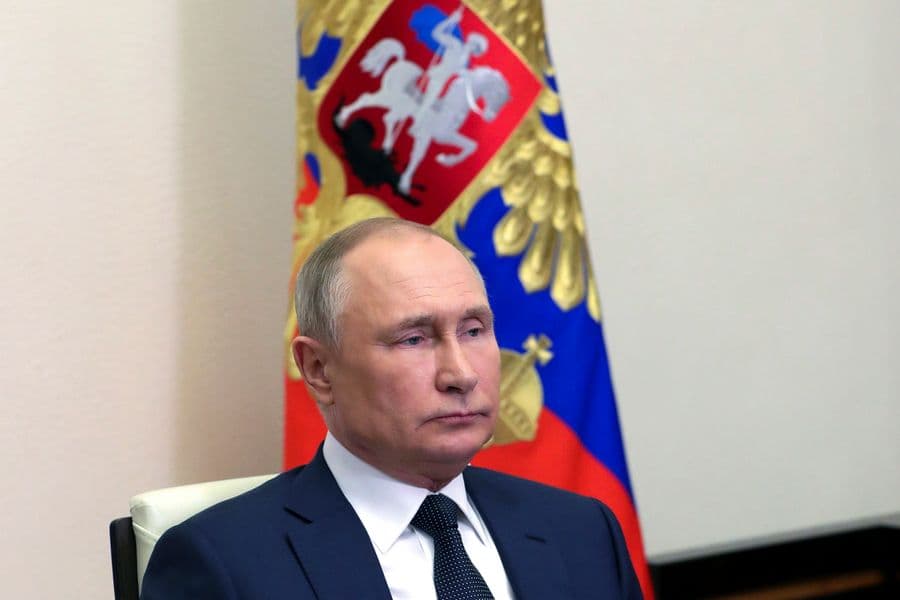
Our leaders must not be under any naive illusions; Vladimir Putin will not negotiate in good faith in Ukraine or with any other country. This is the former KGB officer who, over the course of 20 years in power, has had anyone who has been an obstacle or impediment to his control poisoned, assassinated, imprisoned, or exiled.
Despite his repeated lies, Putin invaded Ukraine to redesign the European and global security order. He may achieve that, just not the way he wanted. Instead of becoming one of the dominant players in Europe, he’s instead made Russia a vassal of China.
Chairman Xi Jinping, who has only shown lukewarm support for Putin’s invasion, is more than happy to buy Russian oil at rock bottom prices and see Russia’s military hollowed out along the Russian-Chinese border—areas in the far east China has long wanted returned from Russia.
Now is the time we need to be thinking about what role the United States is going to play in the new Cold War. But the old Obama State Department quip of “don’t mess things up” seems to be the reactive and prevailing strategy today.
Perhaps that is why it is so frustrating, as a former intelligence officer, to see the U.S. lack a clear foreign policy vision—in Ukraine or globally. Say what you will about President Trump’s “America First” foreign policy, at least we knew what the goal was when executing our duties.
Instead, we only have vague ideas of multilateralism and cooperation coming from the White House. But those are not an ends in themselves; they are only tools to accomplish some further goal.
In the short term, President Biden could pressure Russia to end its invasion by threatening that Russia has one week to come to an agreeable resolution with Ukraine or the U.S. will begin sending whatever types of weapons and airplanes into Ukraine as we see fit.
At present, Ukraine is handicapped with weapons and supplies only designed to stop enemy advances; it is not equipped to drive out Russian forces from Ukraine. That is why American support and leadership are so consequential. With the threat of American offensive weapons in Ukrainian hands, Putin has a great reason to cut his losses now or face the prospect of his already embarrassingly underperforming military being wiped out as they run for the Russian border.
In the medium term, we must acknowledge that unless some black swan event happens and Putin is deposed in a palace coup, he is likely to remain in place for the foreseeable future.
As long as Putin remains the Russian president, economic sanctions should only be tightened. Currently, Russia supplies 200 billion cubic meters of gas to Europe per year. Now, however, we have the opportunity to revolutionize the European energy market by providing American energy building and investing in new oil and natural gas terminals.
Even Ukraine could become a major supplier to Europe. It has vast untapped oil reserves and, if it had the investment and equipment, would be the 14th largest oil producing country on the planet, just behind Iraq. It also would be Europe's second petrol-state after Russia and could be a strategic gold mine for Europe security if our leaders take the initiative.
Long term, to prevent Russia from going bankrupt, Putin is likely to shift his focus and Russia's economic activity to the East. Today, China only purchases 38 billion cubic meters of gas from Russia. But in the next few years, China, India, and Pakistan will likely increase their dependence on Russian oil and become Russia's primary energy market. But with its dwindling population and reversion to a command economy, Russia will become reliant on China to have a seat at the international table.
To contend with Russia’s shift to the East, the U.S. will have to prioritize its own alliances. The Quadrilateral Security Dialogue of the U.S., India, Japan, and Australia certainly presents options for the U.S. to constrain China as well as prevent India from becoming too dependent on Russian resources.
Additionally, NATO must remain a cornerstone of American security. The alliance certainly has proven its resolve against Russian aggression and may even admit Sweden and Finland as a result. This could be only the beginning of a free world united in purpose against dictatorial regimes.
On the other hand, if it is to continue, the UN will have to undergo significant reforms. It has shown itself to be an anachronistic institution. Some have even claimed the UN Charter is not worth the paper it is written on, given its near-complete irrelevance during Russia's invasion.
Our current reactive and timid foreign policy cannot continue. The U.S. cannot sit by and pretend “not messing things up” is a smart course of action when America’s adversaries spend every waking moment creating ways to rewrite the global rules based system. We have an opportunity to create a New American Century where freedom, individual rights, and the dignity of each person can vanquish tyranny, authoritarianism, and the corrosive ideology that might makes right.
Matthew Shoemaker is a former DIA intelligence officer.

Putin, Plague, and America’s Biodefense Gap
By Ryan Kane • RealClearDefense
From Hormuz to the South China Sea: Defending Freedom of Navigation in Contested Waters
By David F. Lasseter • RealClearDefense
Checklist for Modern Conflict Readiness
By Sergey E. Ivashchenko • RealClearDefense
AUTOWARCOM Is Heading for a Command-and-Control Collision
By Michael Carvelli • RealClearDefense
The Unfinished Reform
By Mark W. Castillon • RealClearDefense
U.S. and Japan Begin Naval Exercises Near Taiwan
By Mari Yamaguchi • Associated PressFrom Hormuz to the South China Sea: Defending Freedom of Navigation in Contested Waters
By David F. Lasseter • RealClearDefense
National Guard Soldier Shot While Breaking Up Fight in Washington D.C.
By Military.com
‘No Marine Fights Alone’
By Gidget Fuentes, USNI News
Sea Services Weigh How to Embrace Autonomous, Attritable Tech
By Reeves, NatDef