
Flashpoint Ukraine: Biden Should Sit This One Out
Last updated 09:18 PM EST • Read time: 6m
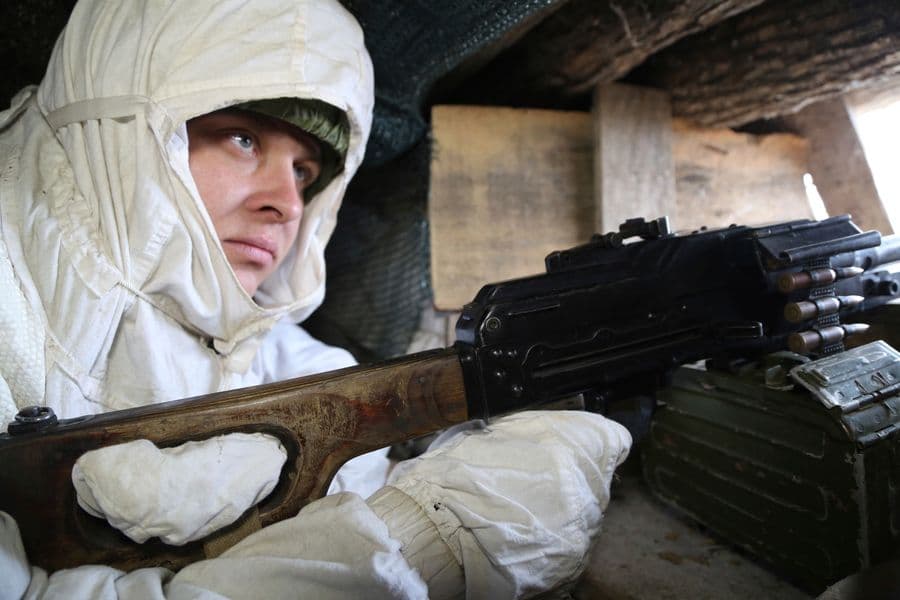
President Biden recently told President Putin that the U.S. would respond with strong economic measures should Russia invade Ukraine but sensibly made clear that the U.S. would not send troops to defend it. Reports indicate that Russia is building up troops near its border with Ukraine, which could be a prelude to an invasion of the ex-Soviet state. Biden is behaving strategically by ensuring that the U.S. sits this one out in terms of direct military involvement for a number of reasons. All of these reasons are based on the principles of realpolitik, which is, unfortunately, the new reality in the current geopolitical landscape.
The first reason is, quite simply, the rise of China. The U.S. doesn’t have the luxury of exhausting military capability for altruistic causes while at the same time deterring a rising and increasingly aggressive China. China’s rapidly expanding military poses a significant threat to the Indo-Pacific region and Taiwan, which the U.S. is dedicated to defending – albeit with a degree of ambiguity. If Taiwan falls to China, the global implications are daunting as the entire U.S. alliance system could collapse, as allies lose confidence in U.S. protection. China would also gain a forward operating capability to control the region. U.S. military involvement in Ukraine will exhaust forces required if China moves against Taiwan. The U.S. is not in a position to fight both Russia and China simultaneously. China is well aware of U.S. limitations and could see U.S. forces bogged down in Ukraine as a golden opportunity to strike and claim its prize, ‘reunification’ with Taiwan. President Xi is building up his forces to the point where an invasion of Taiwan is not just a possibility but a probability. The U.S. needs to reserve its military for this eventuality.
The next reason is cost-benefit analysis. As stated, if Taiwan were forcibly ‘reunified’ with Mainland China, U.S. interests would be significantly affected through the possible collapse of its alliance system as we know it. In this event, Japan, South Korea, and possibly even Australia would seriously contemplate acquiring nuclear weapons, making the region a tinderbox. On the other hand, a Russian invasion of Ukraine, as we saw in 2014 when Crimea was annexed, would not have the same consequences. The U.S. alliance system would remain intact, and U.S. interests wouldn't be seriously impacted. From the vantage point of the U.S., the cost of American lives would not be worth the benefit of facing off against Russian forces to save Ukrainian territory. The international relations liberalist in me feels at odds with the prospect of a nation losing its sovereignty to an aggressive dictator such as Putin and the strong not intervening militarily, but in this case, the costs are too high when there are more serious threats on the horizon. This is not to say that the U.S. shouldn’t assist Ukraine. The U.S. can and should support Ukraine without direct military engagement.
There are alternative and more effective methods of fighting Russian aggression. These include tough sanctions and, more importantly, mass military aid to Ukraine. Sanctions against Putin’s regime should continue, and the U.S. should increase the supply of arms to Ukraine. Military aid to Ukraine must include the delivery of equipment that will be most effective against Russian incursions, such as the Javelin anti-tank missiles already supplied, and air defense weapons such as Stinger man-portable missiles, which were of great use against Soviet airpower during the Soviet invasion of Afghanistan. The Polish Grom or updated Piorun man-portable air defense system are other viable options that would also assist in complicating a Russian invasion. The U.S. should stop short of supplying medium-range and more strategic end weapon systems such as the Patriot air defense system, as the aim is to bog down Russian forces rather than provoke a full-scale use of overwhelming force. Systems such as the Patriot could be perceived as a threat to Russia itself, leading to escalation. By supplying tactical weapons that can be easily operated and carried by Ukrainian ground troops, the Russians would be subjected to an operating environment where taking ground is arduous and risky. This strategy would weaken the Russian army. Supplying equipment rather than troops poses little to no risk to the U.S. with relatively minimal cost. It accomplishes the objective of assisting a sovereign state facing aggression and impacting the calculus of Russian military planners.
The next reason puts the analyst in the mind of Putin. The mind of an adversary is always a critical place to be with strategic planning and risk mitigation. Putin views Ukraine as his sphere of influence and fears further Eastern expansion of NATO. This fear led to the annexation of Crimea in 2014, as Putin couldn’t strategically afford to lose his Black Sea naval base at Sevastopol, nor could he allow the opportunity for NATO to expand to the Ukrainian-Russian border. Fear can lead to actions, including the use of nuclear weapons. If NATO were to push into Ukraine, there is a possibility that Putin could use non-strategic nuclear weapons if he believes his national security or territorial integrity is at stake. While the threat of nuclear weapon use can be countered through deterrence and should not be a reason in itself for inaction by the U.S., the stakes are higher for Russia. The U.S. needs to ask itself, ‘is military involvement in Ukraine of such national interest that nuclear weapon use is acceptable?’ The answer is most certainly ‘no’. Conversely, Ukraine is on Russia’s doorstep. As such, nuclear weapon use may certainly be an option that Putin views as acceptable.
The U.S. must choose any armed intervention wisely. Facing off against Russia for little to no benefit is not a wise use of resources and most certainly not worth U.S. lives. Ukraine is not a vital U.S. interest, and the deployment of U.S. troops in combat would only act to weaken the U.S. and NATO. Putin's Russian invasion of Ukraine would also be a major miscalculation as it would embroil Russia in a long war with a hostile population, result in further economic sanctions, and embolden NATO to fortify its borders, thus increasing the threat that Putin is attempting to mitigate. Putin is not the strategic mastermind he is often portrayed to be. His actions since 2014 have only pushed Ukraine closer into the NATO and EU camp. A further invasion of Ukraine will only weaken Russia. The U.S. can fight Putin without having to resort to direct military engagement and hence save its troops for the real fight that is sure to come.
Adam Cabot has a Masters in International Relations and is currently researching nuclear strategy. He has vast experience in the International Security field.
The Unfinished Reform
By Mark W. Castillon • RealClearDefense
Winning the Data Advantage
By Turin Pollard • RealClearDefense
The Pentagon’s Quantum Race Needs a Warfighter’s Scorecard
By Burak Oktenli • RealClearDefense
The F/A-XX and the AIM-260 Reclaim the Perimeter
By Bruce Allen Lubbering • RealClearDefense
Iranian Cyber Operations
By Michael Groen • RealClearDefense
Winning the Data Advantage
By Turin Pollard • RealClearDefenseThe F/A-XX and the AIM-260 Reclaim the Perimeter
By Bruce Allen Lubbering • RealClearDefenseWinning the Data Advantage
By Turin Pollard, RealClearDefenseThe F/A-XX and the AIM-260 Reclaim the Perimeter
By Bruce Allen Lubbering, RCD
F-22 Pilot Directs CCA in Flight as ‘Airborne QB’
By Stephen Losey, Air & Space Forces