
Ukraine's Drone Strike: Redefined Brinkmanship in Modern War
Last updated 07:21 AM EDT • Read time: 10m
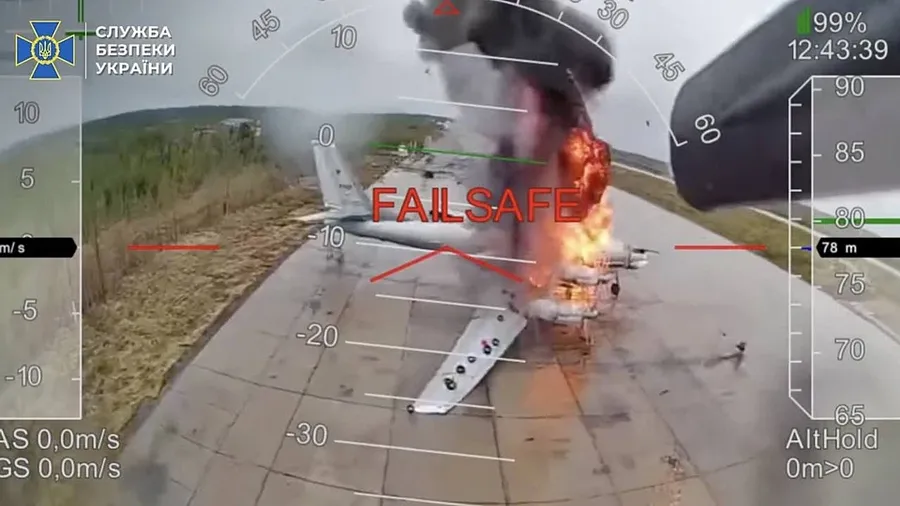
In the early hours of June 1, 2025, Ukraine launched a bold, coordinated drone assault deep into Russian territory, dubbed Operation Spider’s Web. The targets were not tactical vehicles or frontline troops, but the core of Russia’s long-range strike capability. Ukrainian sources estimate that around 40 aircraft were destroyed or disabled, including Tu-95 and Tu-22M3 bombers, cornerstones of Moscow’s strategic air deterrent. Satellite imagery showed charred runways, cratered tarmacs, and entire hangars reduced to rubble. The operation reportedly cost Ukraine less than $2 million. The damage to Russia: potentially $7 billion, with some analysts estimating that 20 to 25 percent of its strategic bomber arsenal was eliminated in a single night.
It was one of the most audacious operations of the war. It was made possible because both President Volodymyr Zelensky and President Vladimir Putin command their militaries with near-total authority. Putin, as an autocrat, faces no democratic checks. Zelensky, while democratically elected, governs under martial law with centralized wartime powers. In this moment of existential conflict for Ukraine and high-stakes confrontation for Russia, both men are unbound by the usual constraints of democratic politics. Both possess the authority and the burden to make high-risk decisions that could reshape the trajectory of the war.
Zelensky’s decision to authorize this deep strike into Russian territory was one such decision. It was not just militarily significant. It was a signal, a strategic statement that Ukraine can reach the heart of Russian power on its own terms and with its own tools. It did not rely on NATO weapons or foreign advisors. It was Ukrainian-built, Ukrainian-planned, and Ukrainian-executed.
And it marked a turning point in the war’s political logic. Because more than anything else, this operation was an act of calculated brinkmanship.
The Theory of Brinkmanship
Brinkmanship, popularized during the Cold War, is the deliberate act of pushing a confrontation to the edge of disaster in order to compel an adversary to concede and secure a favorable political outcome. It evolved alongside nuclear deterrence theory, particularly the doctrine of Mutually Assured Destruction (MAD), which redefined war as a psychological contest of risk, nerve, and resolve. For the first time, entire populations began to grasp that war could reach them directly, and the potential cost was existential. This forced the average citizen to confront national security not as an abstract concern, but as a matter of survival.
The Cold War’s nuclear strategists, figures like Thomas Schelling, articulated a logic of controlled escalation: apply force just below the threshold of catastrophe to force concessions or deter further aggression.
What Ukraine demonstrated this week is an evolution of that logic for the 21st century, a post-Cold War version of brinkmanship that incorporates shadow wars and asymmetric capabilities. In this case, a state vastly outmatched in economic and military resources took a bold move to seize strategic initiative.
Why the Operation Matters
As the Prussian military theorist Carl von Clausewitz observed, “War is not merely an act of policy but a true political instrument, a continuation of political intercourse, carried on with other means.” Ukraine’s drone strike was not designed to seize territory or deliver a short-term tactical victory. It was a major military accomplishment, but more than that, it was intended to reframe the political terms of the war—to assert initiative, shift perception, and challenge Russia’s assumption of strategic sanctuary.
The targets struck were not just military assets. They were symbols of Russian power. The Tu-95 and Tu-22M3 bombers destroyed or disabled in the operation form a core part of Russia’s strategic assets and long-range strike capabilities. These platforms are limited in number, expensive to replace, and essential to Moscow’s posture in both nuclear and conventional terms. Their destruction delivers not only material loss, but psychological shock.
The method of attack underscored the message. The strike was not carried out with NATO weapons or foreign assistance. It was Ukrainian in every dimension—planned, produced, and executed by Ukrainian forces using drones developed domestically, launched from inside Russian territory with reportedly the use of Russian citizens, and guided through electronic deception and pre-programmed GPS. The drones overwhelmed Russian air defenses through swarm tactics and hit their targets simultaneously. No Ukrainian lives were lost. No foreign hands were involved. Every element projected competence, ingenuity, and independence.
The cost of the strike is estimated at under $2 million. The damage inflicted—potentially over $7 billion. But this was never just about cost asymmetry. It was about signaling will. The fact that Ukraine chose this moment to act, when international support is under strain, its own society exhausted, and Russia still wielding the threat of escalation, matters more than any individual loss or gain. This was not a desperate lunge. It was a calculated strike, authorized at the highest level, to remind the world that Ukraine still holds the initiative.
But the most remarkable aspect isn’t what was destroyed. It’s who decided to destroy it. Zelensky authorized the strike, knowing the stakes.
A Calculated Act of Political Will
Clausewitz warned that the use of force must always be constrained by reason and guided by political judgment. That is precisely what made this operation so extraordinary. Zelensky did not act impulsively. He acted with confidence. He exercised deliberate, sovereign command, calculating the risks, accepting the consequences, and proceeding anyway.
He authorized a strike on a legitimate military target central to Russia’s ability to wage war: its strategic air forces. At the same time, he took care to avoid civilian areas, nuclear escalation thresholds, and provocations that might spiral out of control. This was escalation by design, not by accident. It was bold but rational, risky but strategically constrained.
Zelensky had to weigh several critical risks: Would this provoke a disproportionate Russian response? Would Western allies, already strained, view the strike as destabilizing? Would a war-weary Ukrainian public see it as reckless adventurism? But he moved forward—because war requires leadership willing to act under conditions of uncertainty, and because the alternative was ceding the initiative back to Moscow.
The decision reflected not desperation, but resolve. Zelensky used the extraordinary wartime powers available to him under martial law not to consolidate political control, but to take responsibility for a high-risk, high-reward act of national defense. That distinction matters. It is what separates authoritarian recklessness from democratic wartime leadership.
In the language of strategy, this is what political will looks like: action taken not because the path is certain, but because the stakes demand it.
Putin's Nuclear Blackmail Meets Asymmetric Resolve
Since the outset of the invasion, Vladimir Putin has wielded nuclear threats not as a last resort, but as a central feature of his strategy. He has warned of “catastrophic consequences,” hinted at World War III, and invoked the specter of nuclear retaliation whenever Ukraine or its allies threatened to shift the battlefield dynamic. These threats have served a clear purpose: to intimidate NATO, restrain Ukrainian escalation, and preserve Russian freedom of maneuver.
But brinkmanship works in both directions.
For more than two years, Ukraine was held to externally imposed constraints. Western governments prohibited the use of their donated weapons to strike targets inside Russian territory, even as Russia launched missiles from those very bases. That policy began to shift in May 2025, after Moscow launched its largest missile and drone assault on Kyiv since the early days of the war. In response, the U.S., U.K., and other allies began easing restrictions, allowing Ukraine to use select Western systems against targets inside Russia, albeit with strict limitations.
Ukraine, however, didn’t wait for permission. It didn’t need to.
Operation Spider’s Web was entirely Ukrainian. It was planned, funded, and executed without foreign systems. It didn’t rely on U.S. intelligence or NATO logistics. It was a demonstration of indigenous capability: drones launched from inside Russian territory, guided by Ukrainian operators, striking one of the most sensitive pillars of Russia’s military power.
And critically, it proved something larger: that Russia’s nuclear shadow is not impenetrable. Ukraine’s operation was not to mirror Russian terror, but to use asymmetric tools to impose costs without violating legal norms or risking uncontrolled escalation.
In doing so, Ukraine challenged not only Russian targets but also the very logic of Putin’s nuclear blackmail.
Autocracy vs. Democracy in Brinkmanship Calculus
Brinkmanship is not practiced in a vacuum. It is shaped, and often constrained, by the political environment in which a leader operates.
Vladimir Putin, as an autocrat, faces no real checks. There is no independent press, no meaningful opposition, no electoral accountability. He can absorb battlefield failures, inflict economic pain, and sustain high casualties without fear of political reprisal. His propaganda machine ensures domestic insulation. In strategic terms, he operates with near-total freedom of action.
Volodymyr Zelensky leads a democracy, but one transformed by war. Since Russia’s full-scale invasion, Ukraine has been under martial law. Elections are suspended. Civil liberties are limited. Political debate continues, but under the pressures of existential conflict. In this environment, Zelensky holds extraordinary wartime powers. While he remains far more accountable than Putin, his current authority allows for decisive action without the normal friction of democratic bureaucracy.
This convergence matters. In the calculus of brinkmanship, both leaders now possess similar levels of centralized command authority. But the context in which they wield that authority could not be more different.
Putin leverages fear and repression. Zelensky governs through trust, wartime legitimacy, and the support of a population that has suffered devastating losses. Ukraine’s population has shrunk from 41 million in 2022 to an estimated 28 million. GDP has contracted by more than 30 percent. Cities lie in ruins. Millions are displaced. Yet Ukraine’s government functions. Its alliances endure. And its people remain committed to resisting occupation.
That is what makes Zelensky’s decision to authorize a high-stakes deep strike so significant. While he leads a democracy, it is one operating under martial law. He faces less internal political blowback than leaders in peacetime democracies, but not none. And he remains under intense scrutiny from Ukraine’s allies, whose support is indispensable. Still, he chose a bold operation knowing it carried serious strategic risk. That is the mark of resolve. Not recklessness, but the courage to act amid uncertainty.
Toward Peace or Prolongation?
So what does this strike mean for the future of the war?
Does it escalate the conflict? Possibly. Does it bring peace closer? Paradoxically, perhaps yes. As Sir Lawrence Freedman has long argued, strategy is not about following a rigid plan. It is about adapting to shifting realities to change an opponent’s behavior.
Ukraine’s strike forces Moscow to confront a new strategic reality: its homeland is no longer safe. Its strategic air command, once thought untouchable, is now demonstrably vulnerable. Just as the destruction of the Black Sea Fleet forced Russia to reposition assets and alter its naval posture, this strike compels a similar reassessment of its air-based deterrent. The psychological monopoly on escalation that Putin has wielded for over two years has been broken.
Whether that leads to renewed diplomacy or hardened escalation remains to be seen. But one thing is certain: Ukraine now possesses initiative, not just in tactics, but in shaping the political battlefield.
A Redefined Cycle of Brinkmanship
What Operation Spider’s Web proved is that brinkmanship is not the sole tool of great powers. A smaller state, with ingenuity, resilience, a mastery of asymmetric and hybrid warfare, and strategic vision, can also walk to the edge and do so responsibly.
This drone strike should be studied not only for its tactical brilliance, but for what it represents in international relations. It marks the next evolution in the practice of brinkmanship and American and Western diplomats should change their understanding of the political conditions that influence their efforts to create lasting peace.
John Spencer is chair of urban warfare studies at the Modern War Institute and host of the Urban Warfare Project Podcast. He served twenty-five years as an infantry soldier, which included two combat tours in Iraq. He is the author of the book Connected Soldiers: Life, Leadership, and Social Connections in Modern War and coauthor of Understanding Urban Warfare.
Vincent Viola is the former Chairman and CEO of the New York Mercantile Exchange. He is the founder of the Madison Policy Forum.
Is It Déjà vu All Over Again: The 2012 Report on Global Zero
By Peter Huessy • RealClearDefense
As Private Investment Pours Into Defense, the Clock Is Ticking
By Elaine McCusker • RealClearDefense
The First Test of Peace Lies in Ukraine's Borderlands
By Dennis T. Cosgrove • RealClearDefense
The VFW’s Gambling Addiction Victimizes Veterans
By Jack Yoest • RealClearDefense
Superintelligence Exposes a Gap in the Law of Delegated Authority
By Sue Ghosh Stricklett • RealClearDefense
When Your Navy is too Small, the Bill Comes Due Bigly
By CDR Salamander
Quo Vadis MCU?
By Marine Corps Compass Points
When the Network Goes Dark, Who Controls the Battlefield?
By Jonathan K. Corrado • RealClearDefense
Air Force Should Buy 250 Blended-Wing Tankers, as 2027 Demo Looms
By A&SF Mag.
Long Deployments to Be Navy Standard For Next Couple Years
By Mongilio, USNI News