
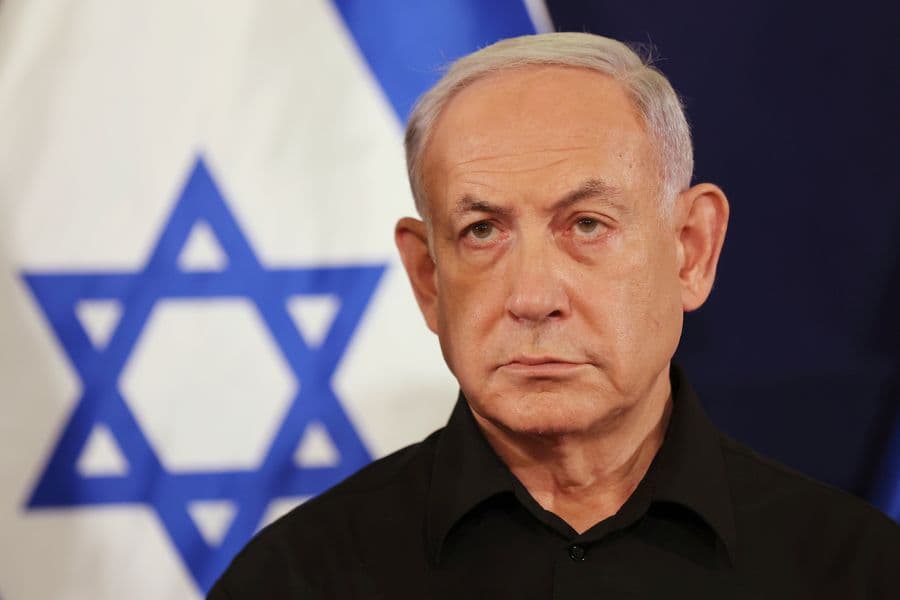
Netanyahu Reaps the Whirlwind
Last updated 01:00 AM EST • Read time: 6m
In the immediate lead-up to Netanyahu's ground invasion of the Gaza Strip, almost no one thought it was a good idea. And just about no one wants it now either. Land invasion aimed at regime change is an unpredictable, dangerous attempt at an existential war against a resistance movement embedded in a population, and it carries tremendous risks for Israelis and the Global North, as well as obviously unimaginable costs for Palestinians and significant danger and fear for hundreds of millions of other people in the Middle East. This war most clearly serves the interests of Benjamin Netanyahu.
Wars generate a natural rally-round-the-flag effect and of course Israelis support their hundreds of thousands of soldiers who are now fighting in Gaza, as do most media and political institutions in the Global North. But as far as their preferred options are concerned, Israelis were against this invasion already by the time it started. Forty-nine percent of Israelis polled opposed this immediate land invasion, significantly weighing the risk to Israeli hostages, the economy, and the possibility of escalation. Only 29% were in favor. It is clear that since then as well, freeing the hostages has remained the top priority, alongside anxiety about what longer war would mean for Israel's reputation, economy, relationships with the outside world, and of course the question of who has to govern and patrol Gaza. In recent polling, 66% of Israelis say they support ceasefires for the return of their hostages.
Palestinians of course are suffering terribly under the state of war, with probably tens of thousands already killed or on the way to an early death and probably many tens of thousands more maimed for life. Naturally millions are traumatized by this new war, both Palestinians and Gaza and Palestinians in the West Bank who were dealing with waves of violence, dozens of attacked or even ethnically cleansed villages, and settler militia harassment. It is also worth noting that Palestinians in the West Bank are not under Hamas and even Gazans themselves did not support and had no choice in beginning this conflict. A plurality of 44% -- *not* a majority of Palestinians voted for Hamas in one election 18 years ago before about half the population of Gaza was even born. Since then, Hamas has polled badly, usually around 35%. Hard-right Netanyahu-aligned parties, in contrast, have won 8 elections in Israel, briefly losing power only because some hard-right politicians couldn´t stand Netanyahu anymore. Hamas actually took over control of Gaza in a coup in which it killed Palestinians, and it has killed thousands to keep power.
Hamas is significantly sustained not by Palestinian support, but by Israeli and Qatari policy. It has been strengthened and kept in place partly by Netanyahu, who allowed half a billion dollars of money from Qatar every year to enter Gaza to strengthen Hamas and keep Palestinians divided, preventing the Palestinian state from coalescing, as the full spectrum of Israeli media report. This strategy seems to have backfired, leaving Netanyahu with an 8% approval rating. Like the United States which funded, armed, and engaged extensively with future enemies like Al-Qaeda, the Taliban, and Saddam Hussein, Netanyahu played with radical Islamic terror as a gambit in his power games. He will not and could not pay the price for it in this life.
The ramifications of this crisis spill far beyond the borders of Israel Palestine. In neighboring Egypt, 110 million people who already fear for their fragile economy watch with apprehension at the possibility of two million refugees. In Iraq, Syria, Yemen, Lebanon, Iran, Saudi Arabia, around 200 million more people fear war. Needless to say, numerous U.S. foreign policy, military, and economic interests are threatened as well. U.S. forces in Syria and Iraq have faced 66 attacks injuring 60 troops and many U.S. workers have been evacuated throughout the region. Israel´s extensive bombing of civilians – destroying or damaging half of the housing and killing thousands of children under 12 years old causes serious harm to U.S. relations with the homelands of the world´s roughly 2 billion Muslims.
Many political and media interests in the West seem to flexibly bend to accommodate Netanyahu's maximalist and vague war objectives, but the American public and other Western publics are very skeptical. Over two-thirds of Americans support an immediate ceasefire in Israel-Palestine but only 4% of American representatives. Only 31% support arming Israel, while 43% are against. Neither Americans, Israelis, Palestinians, nor anyone else really wants an existential war against a terrorist network embedded in tunnels underneath an urban stretch of two million people.
Escalation and an existential war against the Hamas regime most clearly serve the very specific interests of Netanyahu and his most extreme supporters. Seventy-six percent of Israelis want Netanyahu to resign, as he failed to detect or protect against a massacre of more than a thousand of their citizens and crashed their economy by demolishing tourism and disrupting the tech sector with mobilization. The army was deployed far away from the border, developing the settler projects of Israel's extremist far right. As soon as the war is over, it seems likely Netanyahu´s long career of unscrupulous corruption and violent politics will also come to an ignominious end, as it should.
Netanyahu is a figure unrecognizable in American politics – the political right in the U.S. could never win 8 elections in a row, and we would never imagine a scenario in which half the residents of the land have no vote in the dominant government, as is the case in Israel-Palestine. In almost 250 years of American history, only FDR served more than 8 years – a period of time in which he made us the arsenal of democracy and helped shatter Nazism, presided over enormous economic regrowth, built the structures of the modern American welfare state, and became an unparalleled hero of Western democracy. Netanyahu, in contrast, has led his country into disaster. We should not see him as an ally or protecting his regime as necessary.
Western politicians and media – unlike our populations – are fixated on aiding Israel, but make no mistake: the violent transformation of Israeli society under Netanyahu is bad for Jews, bad for Israelis who care about democracy and women´s rights, and bad for the Middle East. Netanyahu led rallies calling for “death to Rabin,” his predecessor as prime minister who led the peace process and was murdered by an Israeli right-wing extremist. Netanyahu´s minister of security, Itamar Ben-Gvir, openly promised Rabin´s assassination. Netanyahu´s regime began and hopefully will end in a scourge of blood. Netanyahu of course would prefer it not end. As is so often the case with cynical politicians, war offers Netanyahu a space to improvise, sideline democratic processes and protests and oversight, award land, power, and wealth to allies, flexibly dictate policy, persecute minorities, and extend his time in power.
President Biden could end the war with a phone call, and he should. Of course, someone will have to untangle many difficult security questions. That someone should not be Netanyahu, a man whose course for Israel has been a catastrophe.
David S. Fehr is a tour leader who works in Israel-Palestine, working for a peace organization.

ICE Is Not a Four-Letter Word
By Meda Parameswara Reddy • RealClearDefense
The U.S. Can Draw Down in the Middle East Without Going Blind
By Cudi Zerey • RealClearDefense
America Needs a Joseph Directive
By Jeff Ballabon • RealClearDefense
Partnering Decides Whether Flexible Military Construction Can Work
By Matt Russell • RealClearDefense
Eight Months of Epic Fury and Still No Internal Alternative
By Stephen D. Cook • RealClearDefense

GE Aerospace to Supply Engines for Two US Navy Flight III Destroyers
By Defense Post
U.S. Air Force Asks Industry for New Cruise Missile for Ukraine
By Michael Peck, DNews
First Flight II San Antonio-class Amphib Completes Builder’s Trials
By Mongilio, USNI N.
LGM-35 Sentinel ICBM on Track for 2030
By Kris Osborn, Warrior Maven
On American Destroyers, Avoid a Self-Inflicted Wound in Spain
By Defense News