
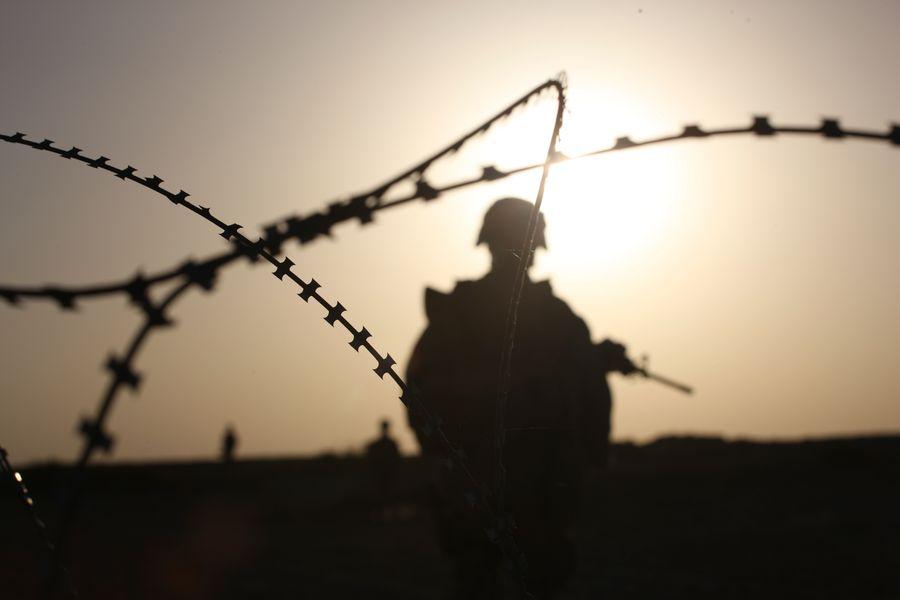
The Costs of War Are Too High
Last updated 04:58 PM EDT • Read time: 6m
A recent study conducted by the Costs of War Project estimates that, by the Fiscal Year 2020, the United States government (or, more accurately, the U.S. taxpayer) will have spent $6.4 trillion on fighting the so-called "Global War on Terror." This includes not only the costs of ongoing military operations but also the follow-on costs of caring for wounded veterans. According to Neta Crawford, the true costs of the ongoing War on Terror have been well hidden from the American people through skillful accounting legerdemain. Their determination was that by FY2020, “an estimated $5.4 trillion in appropriations in current dollars and an additional minimum of $1 trillion for U.S. obligations to care for the veterans of these wars through the next several decades." The analysis also included expenditures related to America's post-9/11 wars from the Departments of State and Homeland Security.
What does the United States have to show for it? The United States has not won in either Afghanistan, where the al Qaeda attacks on 9/11 originated, or in Iraq. The Middle East has become a political tinderbox: Islamist forces are bolder and more diffuse now than they were on September 10, 2001. These are all direct results of Washington’s myopic obsession with the Greater Middle East and countering terrorist threats, even those that don’t threaten the United States or its citizens directly.
The September 11, 2001 attacks were the most devastating attacks on the United States in its 241-year history. Yet, these attacks were perpetrated by an amorphous, stateless terrorist organization, al Qaeda. They were not conducted by a nation-state. Al Qaeda may have received some material support from high-ranking citizens of foreign states. But they did not operate on the orders of foreign governments. Washington had no idea had to deal with such a stateless threat. So, it was relegated to law enforcement. Due to this, Washington missed the warning signs in the months and years leading to 9/11. Washington, when caught unawares, switched from strategic apathy to overreaction in the name of counterterrorism.
The United States should have waged an ideological war against Islamism or jihadism. Its specific foe—the group that attacked New York City and Washington, D.C. on 9/11—was the Usama Bin Laden-led stateless terrorist group known as al Qaeda. Instead, Washington began its response to 9/11 by pursuing al Qaeda in Taliban-controlled Afghanistan. Yet, Washington quickly moved its attention away from punishing those who perpetrated the attacks to waging an impossible moral crusade to convert Afghanistan into Arizona.
Between failing to recognize the true enemy, al Qaeda and its revolutionary Islamist ideology and then distracting itself with expanding the conflict to include states that sponsor terrorism, the former George W. Bush Administration was ensuring that the United States would be engaged in a forever war, everywhere. Thus, $6.4 trillion has been spent on one issue since 2001. If aliens from Mars were to land and look at the Costs of War study, they would assume two things: first, the American economy is limitless in size and, second, that global terrorism was the only threat facing the United States.
Of course, both assumptions would be wrong. And, so it is with Washington’s wasteful spending on the War on Terror. Due to Washington’s obscene overreaction to the threat, the United States risks losing its once-unquestioned dominant position throughout the Greater Middle East. Following 9/11, all that the George W. Bush Administration needed to do was a simple, bloody, punitive raid into Afghanistan meant to destroy al Qaeda and force the ruling Taliban to pay fealty to the more powerful United States. This was how the initial U.S. military intervention into Afghanistan looked: a relatively small number of U.S. Special Forces, C.I.A. paramilitary teams, copious airpower, and the assistance of local forces kicked the snot out of al Qaeda while bloodying the Taliban’s proverbial noses.
While Washington failed to adequately provide resources for the fateful Battle of Tora Bora wherein Bin Laden and his cadre were cornered by a small band of heroic American commandos and their shifty Afghan “allies,” ultimately, there was little need to both expand the U.S. military’s presence in Afghanistan while committing to a bizarre nation-building exercise. After 20 years and $6.4 trillion later, the United States is at the point of entering into a negotiated settlement in which the Taliban return to power—which is exactly where Washington was in 2002, as the journalist Steve Coll recounts in his recent book Directorate S: The C.I.A. and America’s Secret Wars in Afghanistan and Pakistan.
The Western military theorist, Carl von Clausewitz, frequently spoke of "the culminating point of victory" in which "one side has achieved the maximum possible military advantage relative to the available resources and political aims." Clausewitz cautioned his readers about exceeding that culminating point. He worried that "battlefield gains will become increasingly marginal relative to the costs incurred and, if it presses too far, the attacking side risks major setbacks and even catastrophic defeat.” Clearly, Washington has reached the paradoxical position of having outspent its rivals in the Global War on Terror and still not having achieved victory over those less-well-funded foes. In fact, Washington now risks losing its vaunted dominance in the Greater Middle East, the more it spends.
Going forward, especially as other budgetary priorities take precedence over defense spending (from 2020-2022, the largest cohort of Baby Boomers are expected to retire and begin drawing from already-strained social security accounts), the Pentagon will have to learn to prioritize far better than it has in the past. No longer can Pentagon officials simply expect that all of their needs will be met—and then some. Instead, they will need to take a strict budget and plan for contingencies accordingly. America faces serious threats, including terrorism. Yet, it is the supreme tragedy of exorbitant wealth (and horrible political leadership) that so much money was wasted—for so long—on a “strategy” as absurd of trying to “win” a war against a military tactic, such as terrorism.
Brandon J. Weichert is a geopolitical analyst who founded The Weichert Report and is a contributing editor at American Greatness as well as a contributor at The American Spectator. A routinely syndicated columnist, Weichert holds an M.A. in Statecraft and National Security Affairs from the Institute of World Politics in Washington, D.C. and is a recovering Congressional staffer. He can be reached via Twitter @WeTheBrandon.
Counterterrorism and the Growing Convergence in Homeland Security and Homeland Defense
By Austin Doctor • RealClearDefense
The Future of Space Power Depends on Integration
By Damian DiPippa • RealClearDefense
America Should Unleash Cyber Privateers
By Jacob Schelp • RealClearDefense
America Invented the Battery, but China Controls the Factory
By William Crane • RealClearDefense
A Defense Win for Americans and Israelis in Arkansas
By Bradley Bowman • RealClearDefense
F-16s Build on Iran Combat Lessons to Prepare for China Threat
By Rebecca Grant • Lexington Institute
Key Space Force Satellites Can’t Talk to Each Other
By T. Hitchens, Breaking Defense
Blue Angels Pilot Scott Laux Removed for Failing To Uphold Standards
By Johnson, PNJ
The Future of the Ground Reconnaissance Enterprise
By Joe Albano, The Connecting File
The Future of the ARG/MEU
By William Yale, Proceedings