
Art and War with a Master Storyteller
Last updated 05:29 PM EDT • Read time: 10m
A novelist writes to move someone.
He begins by probing his own feelings—the things he loves and the things he hates. The things that pique his interest and pierce his heart; the things he fears but will never admit. He distills these insights into a story about life, and through his words seeks to induce a feeling in the reader, to make the reader love or hate or identify with people who do not exist. The novelist entertains, delights, grieves, and consoles us. Ultimately, the great novelists cause us to reflect on our own lives and, on occasion, to change them.
By this measure, Steven Pressfield is a great novelist. Pressfield is the author of more than 10 nonfiction books, several Hollywood films, and, with the publication of The Arcadian this month, 12 novels. From his pen has flowed millions of dollars in sales of books and movie tickets. But it was one book – Gates of Fire (1998) – that cemented his legacy.
Steven Pressfield
Pressfield Collection
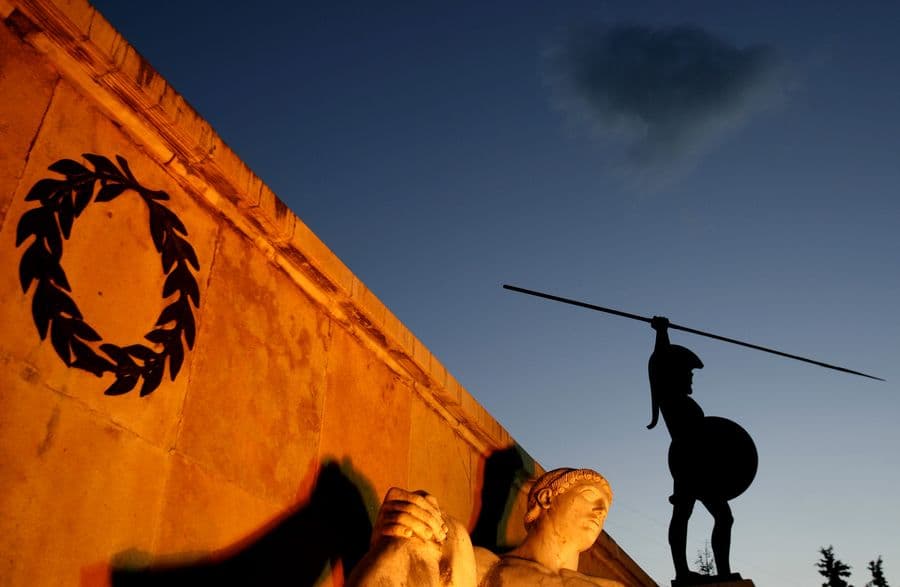
The work of historical fiction brings to life the legendary tale of 300 Spartans who fought at the Battle of Thermopylae in 480 BC. Nearly all 300 Spartans died at Thermopylae, alongside hundreds of Greek allies, in a deliberate last stand against the Persian army. The novel’s tone is gritty, visceral, and impassioned—how men are forged into warriors who fight their final battle for glory rather than survival. Gates of Fire quickly became a favorite among young men and fans of military fiction.
For more than two decades, instructors at the military academies have assigned the book to their students. Soldiers and Marines have carried it to the battlefield. It has inspired young Americans to fight for their country, just as the Spartans fought for theirs. The widespread and long-lasting readership, which probably numbers in the millions, surprised even its author. He said he assumed nobody but himself would be interested in the story, but its power compelled him to write the book anyway.
“No one is more amazed than I that Gates of Fire has sold a million copies,” Pressfield said.
His new novel continues to explore the warrior archetype, this time through an immortal mercenary who is hired to fight against Portuguese invaders in 16th century Spain. While Gates of Fire probed ideas about why men fight for certain causes and how they prepare for battle, The Arcadian follows the mystical journey of one man and asks whether a warrior can ever stop fighting. I spoke with the master storyteller – about his work and inspirations – by telephone.
A great American writer told me his greatest regret is that he did not write more novels. You’re 82. You’ve written 12 novels, including the classic Gates of Fire. You’ve written successful nonfiction and screenplays, too. Millions of people have read your work. Why are you still writing fiction?
It’s just in my blood. It’s the only thing that keeps me at peace with myself. I’ve worked a million jobs, including straight jobs like working in advertising, but at the end of the day I would come home depressed, and unless I tried to do something fiction-wise or a story, I felt like something was wrong. It’s still true today, and so until they cart me out feet first this is what keeps me sane and makes me feel like I’ve earned my place on the planet. I write a [nonfiction] book like The War of Art and it’s fun and I enjoy doing that, but it’s not the same feeling as writing a good story. There’s a metaphysical element to this, and I’m a big believer in the muse and the goddess. If I had to define my occupation, I’d say I’m a servant of the muse.
Did you have that feeling while writing your latest novel, The Arcadian?
I definitely got that feeling. The story has a lot of moving parts, and it had things that changed as it went along, and I had to stay nimble along the way. There was research to it, since the story takes place in 16th century Spain, but the research is there to make this kind of far-fetched story about justice and karma believable to the reader, so that when he comes to one of those moments in the story where he has to accept something out of the ordinary, the story is real enough that the reader believes I’m telling the truth.
The poet Percy Shelley said there are two kinds of mental action: reason and imagination. He believed that reason should be the instrument of imagination. Explain how these instruments work differently in writing fiction versus writing nonfiction.
When you start with nonfiction, at least for me, you start with a known commodity. Let’s say you’re writing a biography of Harry Truman. You can research. You can work with assistants. You’re pretty much using your analytical brain to think of what comes after what. With fiction, you don’t know where it’s going. There’s a mystical element: It’s a living thing that you’re working with, and it has its own agenda. The story changes as it goes. I imagine riding a horse is something like the experience of writing fiction, and you have to sort of roll with it, maybe surfing too, the way it has its own life and energy and you’re trying to stay up with it.
I went to a luncheon in Omaha for a retiring business executive. The emcee said of the executive: “He counts 500 books that he has read over the course of his career—all nonfiction.” I think people read more nonfiction than fiction, and perceive nonfiction as the more important or useful genre. What do you think?
I think people do prefer nonfiction. Even I read more nonfiction than fiction. Maybe that’s because fiction isn’t as good as it was in the days of Hemingway and Faulkner, but it’s sort of like a college education—everybody seems to want a degree that turns into a job rather than a degree in liberal arts. I think it’s a mistake. As much as I enjoy nonfiction, it does sort of, I don’t know, make the experience easier. From a writer’s point of view, it’s just too easy. Writing nonfiction doesn’t require the depth or courage of writing fiction. That’s why I think fiction is so valuable. When you’re writing nonfiction you’re limited to what you know and what you can prove is true, like an academic. You’re not allowed to really dig deep into characters, personality, and speculative worlds. Things you create or the goddess creates. I’m kind of sorry that people do read much more nonfiction than novels and stories.
The Arcadian
W. W. Norton and Company
Let’s talk about your 2011 nonfiction title The Warrior Ethos. I visited a retired Marine general and distinguished war theorist. He was thinking about Secretary Hegseth and the return of rhetoric about “lethality” and the “warrior spirit” and working to define the term warrior ethos for his own thinking. He had your book on his table. What is the warrior ethos?
I cannot absolutely define it!
In that book, I was citing stories from antiquity and what ancient warriors and warrior cultures thought about it. I was groping toward something that had an element of morality and self-restraint, as opposed to a violent extremist movement like terrorism. One Spartan king said the central tenet of the warrior ethos is contempt for death. That is a profound thought. It takes you beyond warrior ethos into pure spirituality, and I think its virtues apply to artists as well to everyone in normal life. Self-abnegation. Brotherhood. Patience. Embrace of adversity. Embrace of mortality. I think it’s a code. By the way, I don’t think Secretary Hegseth has a fucking clue what it is, based on what he’s said. I think how he’s saying it is a gross perversion and a fatal perversion of the concept.
One of the reasons Gates of Fire resonated was because that ethic, that pure ethic of the 300 Spartans standing together in the face of certain death from the Persians, was unique to that particular moment when a foreign invasion was coming to destroy Western Civilization. It was a pure, good cause. Why does one join the Marine Corps as opposed to the Air Force? The advertising guys got it right – “The few, the proud.” Young people are looking for a real test, which they find in the Marine Corps as opposed to, say, the Air Force. Young people in the military continue to yearn for the feeling embodied by the 300 Spartans at Thermopylae Pass – to serve, to sacrifice – and many combat veterans felt that was lost in the rules of engagement or bad wars or stupid wars that ensued after 9/11. I think a lot of people want to fight World War II again – black-and-white, right and wrong – but that era of war left when atomic weapons arrived. Maybe mankind needs to find some new expression of honor and self-sacrifice without blowing up the world.
Where is the physical place you go to feel whole, to feel creative?
I had a place but it burned down in the Malibu fires last January. It was a great spot above a cove. It looked out over the ocean. It was a great place to write; to do anything creative. I lived there for 30 years. It was a haven, but now it’s just ashes. I’m still dealing with it. I’m in a rental place. I’m sitting at my little writing desk in the dining room. You can do what you need to do anywhere.
What book, story, or work of art has been your touchstone as a creative person?
The Iliad. In addition to that, Thucydides’ History of the Peloponnesian War. The Odyssey as well. Those are towering achievements. I’ll also say the King James Bible for its poetry. You can go to any of these books and dip your toe in any place and find something inspiring.
Let’s end in Persia. The Greeks believed that geography and climate shape human character, and Herodotus famously concluded The Histories by saying “soft lands breed soft men; it is not the property of any one soil to produce both fine fruits and men who are good in war.” Tell a story about how Cyrus the Great took this to heart.
When Cyrus and the Persians conquered the Medes lowlands thousands of years ago, his advisors assumed he would abandon his homeland in the harsh Zagros Mountains and settle in the fertile valleys. He reportedly told them: “Better to live in a rugged land and rule than to cultivate rich plains and be a slave.” I tip my hat to my publishing partner Shawn Coyne who had a press called Rugged Lands. He pointed me to that quote during the writing of The Warrior Ethos. Simply put, the Iranian people are a great people from history, like the Russian people or the Chinese people. My hope is that we can be friends somehow when all is said and done. When Cyrus came down, they lived in fertile plains, but he never moved his capital from the mountains.
John J. Waters is author of the postwar novel River City One.

Reflecting on an Epic Horse Campaign in the Mountains of Afghanistan
By Brian Glyn Williams • RealClearDefense
The Godfather of American Foreign Policy Realism Speaks to Today’s World
By Francis P. Sempa • RealClearDefense
In Pursuit of Nuclear Abolition
By Peter Huessy • RealClearDefense
Innovation Alone Won’t Prepare the U.S. for the Future Battlefield
By Joshua Segal • RealClearDefense
The sUAS Tactical Trifecta
By Bryan T. Woody • RealClearDefense

Navy Civilianizes Six Former Flag Billets, Reduces Six to Captains
By Mongilio, USNI N.
Raytheon's $8B Contract for Strategic Comms Terminal Modernization
By M+A El
America’s Maritime Moment Will Not Wait
By CDR Salamander
Armor Up?
By Marine Corps Compass Points
Who Shoots Down the Drone Over the Shipyard?
By John Ferrari & Dillon Prochnicki • RealClearDefense