
Defense Innovation & Venture Capital: Skydio a Case Study
Last updated 01:00 AM EST • Read time: 6m
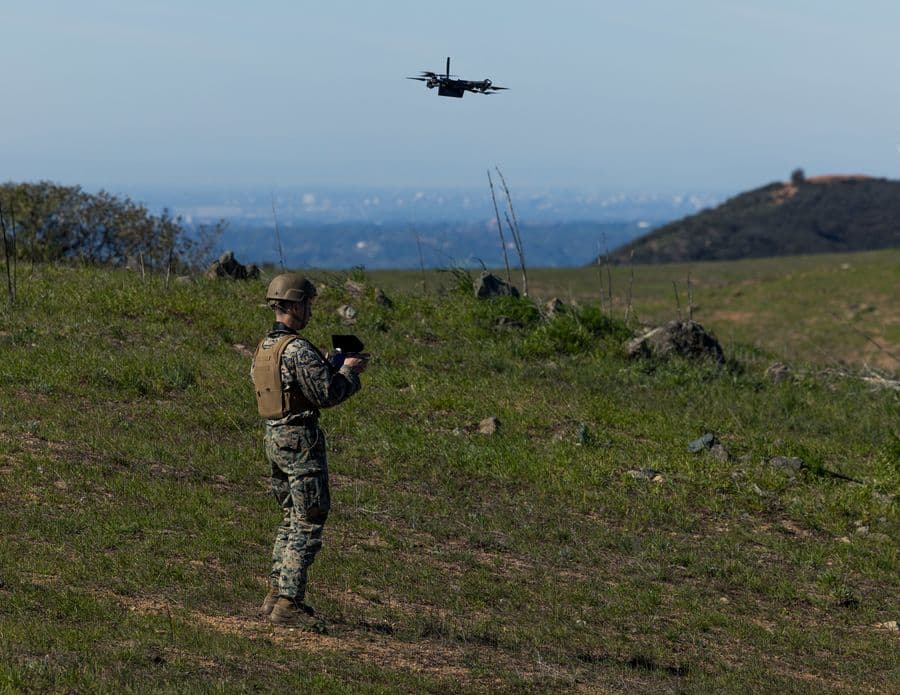
U.S. Marine Lance Cpl. Marcus Morgan, an intel specialist with Bravo Company, 1st Light Armored Reconnaissance Battalion, 1st Marine Division, lauches a Skydio X2D Unmanned Aerial System during the annual 1st MARDIV squad competition on Marine Corps Base Camp Pendleton, California, Feb. 7, 2023. The week-long squad competition incorporates a variety of combat-related tasks designed to evaluate each squad’s proficiency. Morgan is a native of Moore, Oklahoma. (U.S. Marine Corps photo by LCpl Earik Barton)
Skydio is a Silicon Valley-based company that designs and manufactures quad-copter drones in the United States. At the time of publication, Skydio is valued at over $2 Billion. Skydio represents one of the clearest examples of a company that produces dual-use technologies that sells to both commercial and government sectors - although they began their business with the commercial sector first. This business model is known as: dual use, commercial first.
Founded in 2014, Skydio’s aim was to create a product that was American-made and provided a higher quality consumer and prosumer drone by utilizing advanced artificial intelligence software in their hardware product. Prior to pursuing military or government contracts, Skydio focused their efforts on research and development and the consumer hobbyist drone market.
Skydio’s entry into the military market began with a Defense Innovation Unit Other Transaction Authority (OTA). Competing for a prototype OTA can be costly for a company. A company must weigh the investment of R&D dollars against the direct insights from the end users and the potential for a direct pathway into a DoD production contract. Skydio had the benefit of venture backing and therefore had the runway to pursue this endeavor.
When Skydio opened their DoD vertical in 2019, the company had five years of experience. This point is essential - Skydio had a proven product on the consumer market and the runway to begin the process of selling to the DoD which is notorious for its longer sales cycles. The stability that Skydio had due to its success on the consumer side, allowed Skydio to survive through the long process of working towards a DoD contract and its very restrictive milestone requirements.
As Skydio worked with the DIU and the U.S. Army to compete for the sUAS contract, their champion product was the X2, a drone designed for enterprise, public safety uses, and defense. While developing the X2, the process clearly benefited from improvements from the original version of Skydio’s drone. The DoD had similar requirements to future potential enterprise customers, so Skydio was able to develop the X2E (enterprise) during development of the X2D (defense). Moreover, as Skydio’s X2D was down-selected, their credibility as a Tier 1 venture-backed company and success selling to the consumer market, which signaled a strong ability to scale manufacturing capacity, made their selection to receive a $100 million contract more viable.
The U.S. Marine Corps paid close attention to the DIU solicitation. Following the DIU solicitation and an additional evaluation with the U.S. Marine Corp at 29 Palms, Skydio received their first order for X2D drones. In order to rapidly sell to their first military customer, Skydio leveraged a less-known method by utilizing a government reseller, all while the production OTA with the U.S. Army was being finalized.
The reseller concept has its pros and cons. As a benefit, the military can rapidly acquire Skydio’s technology for training and operations by U.S. service members without having to have a direct contract with that entity. But Skydio does pay a price for this rapid work around. Resellers are known to take up to 10% fees for this service. Additionally, the contract that the reseller utilizes is not reoccurring. Paying 10% to a reseller might be strategically worth it not only for increased speed in achieving traction with a military customer but also this allows a company to leverage the reseller's established track record and infrastructure, reducing the overhead burden of additional government sales personnel.
Designing for the consumer market spurs undeniable innovative solutions for the military. In the consumer market, customers are fickle, and the best products are rewarded with increased sales. In the defense market, this is not the case. Sales cycles are long and access to end-users can be challenging, creating a lag between feature development and end-user feedback. Even more challenging is the fact that military-end users rarely, if ever get a say in product selection, much less feature changes and additions. The consumer market consistently provides a direct feedback loop to a commercial company.
Skydio’s bet on opening a DoD contract through the use of a reseller seems to have clearly paid off. With their commercial and enterprise drones on the market and the X2D with the Marines, Skydio raised their Series D led by a tier 1 venture capital firm, Andreesen Horowitz. This round notably put them at a $1.07 billion valuation and unicorn status. Recently, Skydio raised a large series E round of over $220 million putting their new valuation at over $2.2 billion.
Skydio’s momentum continued with a U.S. Army $100 million production OTA contract and they began working with the Army's Program Executive Office (PEO) for Aviation’s Unmanned Aircraft Systems Project Management Office. This contract is for a firm-fixed price as a part of the Short Range Reconnaissance program of record. Ostensibly, Skydio was able to beat out 30 other competitors for the production OTA. While this is a high dollar value contract that Skydio can count as recurring revenue for the next five years ($20.2 million per year), this does not guarantee a long-term relationship with the U.S. Army or DoD. That said, Skydio continues to build momentum and credibility with this large contract that will entice future investment, possibly an IPO and at the very least, help to iterate on future product designs making an already impressive product that much better.
Skydio is an excellent case study for companies selling to the DoD while not being a defense prime. Bry, Skydio’s CEO, and his company achieved proof of concept of their technology and the ability to succeed in the consumer market before opening a DoD vertical. They continued to iterate and innovate in the enterprise space which will make future DoD products vastly superior.
Lieutenant Colonel Andy Yakulis (U.S. Army) is the Director of Corporate Ventures for the Army Applications Lab - the innovation arm for Army Futures Command. Andy's role is to serve as the lead for all industry engagement - sourcing technology companies that potentially could provide solutions to current Army problems. Andy has over 16 years of active service as an Army Aviation Officer with 8 years as an operational leader in Special Operations. He recently graduated from the Stanford Graduate School of Business Sloan MSx Program where he focused on Entrepreneurship, Venture Capital, and Defense Innovation.
The views expressed in this article are the author’s own and not that of the U.S. Army, Department of Defense or Stanford University.

Washington Cannot Ignore Afghanistan’s Weapons Legacy
By Saima Afzal • RealClearDefense
Moral Injury at One O'Clock
By Jeff Hood • RealClearDefense
The Mirror-Life Trap: When Deterrence Must Prevent Invention
By Lawrence J. Kaiser • RealClearDefense
The Pentagon’s AI Agents Could Complete the Mission and Still Leak Secrets
By Burak Oktenli • RealClearDefense
A Passage to the Middle East: India as a Mediator and Security Partner
By Irina Tsukerman • RealClearDefense

U.S. Intel Confirms This Is China’s Secret Spaceplane
By Joseph Trevithick, The WarZone
Navy Sees 10-year High For Class A Aviation, Afloat Mishaps
By H. Mongilio, USNI News
U.S. Navy To Install AI Vessel Detection System on Five Destroyers
By The Defense Post
U.S. Navy’s CHAOS Program
By Dylan Malyasov, Defence Blog
Two U.S. Navy Carriers Ready to Operate New MQ-25A Tankers
By Global Defense News