
It is Time to Withdraw from New START
Last updated 01:00 AM EST • Read time: 7m
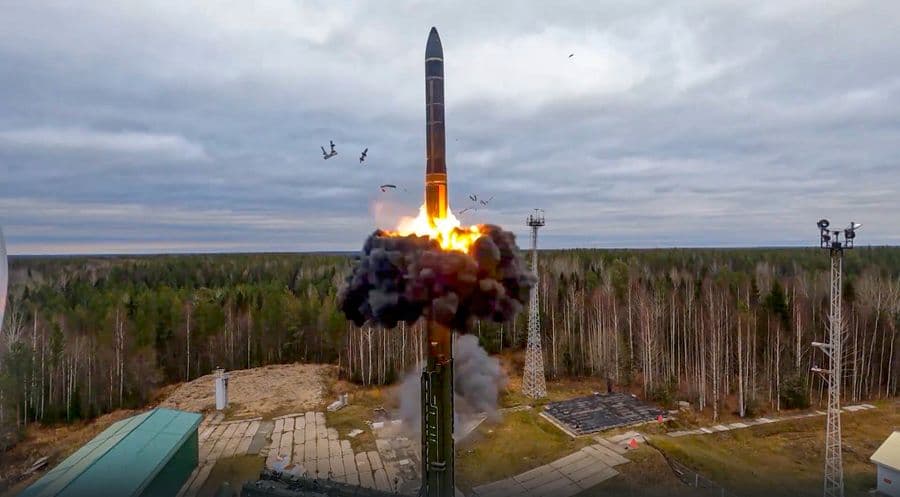
On Tuesday, Russian President Vladimir Putin announced that the Russian Federation is suspending participation in the New START Treaty—the sole remaining arms control treaty between the United States and Russia. He was careful to clarify that Russia is not withdrawing from the treaty but merely suspending participation.
This is no simple act but one of great, if not grave, concern for the United States and the free world. How President Biden reacts will undoubtedly have an important effect on the future of global stability and the Russo-American relationship. Before discussing the implications of Putin’s decision, it is important to first offer a little history.
History
New START was signed in 2010 after then-Presidents Barack Obama and Dmitri Medvedev negotiated a strategic arms control agreement to superseded the Strategic Offensive Reductions Treaty (SORT), which was signed in 2002 by Presidents George W. Bush and Vladimir Putin. With a limit of 2,100 operationally deployed strategic nuclear weapons, SORT’s numbers were ninety percent below Cold War highs. New START further reduced the number of operationally deployed strategic nuclear weapons by about five hundred additional warheads.
Soon after taking office, President Biden extended New START, which was set to lapse in 2021, for another five years. This was despite the fact that Russia was violating treaty requirements at the time for failing to allow onsite inspections since the beginning of the coronavirus outbreak. After two additional years of failing to comply with its treaty obligations, the Biden administration formally announced that Russia was in material breach of the New START Treaty last month.
Fast forward to Tuesday when Secretary of State Anthony Blinken called Putin’s announcement “deeply unfortunate and irresponsible.” He then added that the United States is willing to begin talks regarding a new nuclear arms control treaty at any time “irrespective of anything else going on in the world.” Blinken’s statement made it clear that the administration’s overriding concern was the negotiation of an arms control treaty…any arms control treaty.
Meaning
Putin’s decision is particularly troubling at a time when Russia is performing poorly in Ukraine and has already threatened to use nuclear weapons against NATO. Over the past year, this conflict has produced over 200,000 casualties and displaced over 8 million refugees, the most in Europe since WWII. Russian forces willfully attack civilians, bombing hospitals and residential apartment buildings, killing or injuring an estimated 19,000 Ukrainian civilians to date. In one instance, President Biden referred to Vladimir Putin as a war criminal in an effort to single out the lack of concern shown for civilians by Russia during its “Special Military Operation.”
Yet, somehow, despite Putin’s human rights atrocities, after already violating the Intermediate-Range Nuclear Force Treaty and the Treaty on Open Skies, the United States continues to believe that Vladimir Putin is a man to be trusted. Such a belief has no firm footing. In reality, neither the American people nor President Biden can trust Putin to keep his word at a time when doing so may hinder his ability to use coercive nuclear threats against NATO to limit its support for Ukraine.
Given Putin’s track record, the United States must assume the Russian Federation is violating key elements of the New START Treaty and is buying time before announcing withdrawal from the treaty. Possible violations may include uploading additional warheads beyond the 1,550 warhead limit found in New START and the mobilization of additional nuclear-capable bombers and intercontinental ballistic missiles—beyond the 700 delivery vehicles allowed by treaty.
Additionally, we should assume that Russia is not abiding by the Moscow Declaration (1994) which saw the United States and Russia de-target each nation’s intercontinental ballistic nuclear missiles—aiming them at the open-ocean. In all likelihood, Moscow has hundreds of critical American targets square in Russian crosshairs.
An expanding Russian strategic nuclear arsenal presents great risk to the United States. No amount of goodwill or “we come in peace” efforts can change the fact that the United States is facing two adversaries that seek to topple the post-WWII international order created and enforced by the United States. Allowing that to happen is not only unacceptable, but also intolerable.
The United States must take immediate steps to balance the American nuclear arsenal against Russia’s entire nuclear arsenal and China’s rapidly expanding arsenal. Five actions will go a long way to achieving this objective.
First, the United States should withdraw from the New START Treaty. Russia violated the INF Treaty for years before President Trump finally withdrew from it. When the United States continued to abide by the treaty in hopes that Russia would return to compliance, America’s hopes were dashed. Now, the United States is at a disadvantage in non-strategic nuclear weapons in Europe, which creates the view in Moscow that Putin has a distinct advantage, perhaps even escalation dominance.
Second, the United States should begin taking the necessary steps to return stored warheads to the deployed arsenal as the Minuteman III ICBM is re-MIRVed with three warheads per missile. Such a move will take some time but, this action will demonstrate American resolve in the face of Russian and Chinese nuclear expansion.
Third, it is time to return the strategic bomber force to alert status. This means regularly operating with nuclear weapons onboard and dispersing bombers and tankers to necessarily complicate adversary targeting and increase the second-strike survivability that is critical to successful deterrence.
Fourth, it is time to increase the operational tempo of airborne nuclear command and control assets. Demonstrating readiness is a critical element of effective deterrence. Our adversaries must not be able to disrupt the vital detect-decide-direct communication chain needed to order nuclear retaliation. Nor should they have any confidence in a decapitating first strike against our most senior national leaders.
Fifth, rapidly fielding a submarine launched nuclear cruise missile (such as TLAM-N or SLCM-N) is an absolute necessity in order to address the dramatic non-strategic nuclear weapon advantage both Russia and China possess. Currently, the United States deploys fewer than 200 B-61 nuclear gravity bombs in Europe (Russia has more than 2,000 nonstrategic nuclear weapons on more than a dozen platforms) and zero non-strategic nuclear weapons in Asia. The United States is at a distinct disadvantage when attempting to deter adversaries at the lower yield spectrum.
The era of American efforts to demonstrate that we mean no harm must come to an end. Vladimir Putin and the Russian military must understand that the United States takes its security seriously. They must also understand that American extended deterrence remains certain.
America must clearly communicate to President Putin—and by proxy Xi Jinping—that his decision to suspend Russia’s participation in the New START Treaty has an unexpected consequence. If it is ever the goal of the United States to bring Russia (and eventually China) back to the negotiating table, it will only happen when Russia believes that it is in its best interest to do so. By seeing the United States rapidly change its nuclear posture, Putin may come to understand that Americans are still willing to fight and risk everything to ensure freedom, peace, and stability.
Russian culture respects strength and, unlike Americans, judges leaders on their actions not their intentions. Russian leaders have a long-held paranoia that says the West is always on the brink of invasion. When you combine these two elements of the Russian psyche with President Putin’s actions this week, the only option for restoring deterrence is strong action. The United States must not appease Putin or this could be President Biden’s “Munich moment.”
Dr. Adam Lowther is Vice President for Research at the National Institute for Deterrence Studies and the host of ANWA DC’s Nuclecast. Col. Curtis McGiffin (U.S. Air Force, Ret.) is Vice President for Education at the National Institute for Deterrence Studies and visiting professor at Missouri State University’s Department of Defense and Strategic Studies. Together, they have more than five decades of experience in uniform and DoD civil service.
The views expressed in this article are the author's own.

The First Test of Peace Lies in Ukraine's Borderlands
By Dennis T. Cosgrove • RealClearDefense
The VFW’s Gambling Addiction Victimizes Veterans
By Jack Yoest • RealClearDefense
Superintelligence Exposes a Gap in the Law of Delegated Authority
By Sue Ghosh Stricklett • RealClearDefense
When the Network Goes Dark, Who Controls the Battlefield?
By Jonathan K. Corrado • RealClearDefense
We Cannot Build Tomorrow's Weapons With Yesterday's Alloys
By Joseph F. Krause • RealClearDefense
When the Network Goes Dark, Who Controls the Battlefield?
By Jonathan K. Corrado • RealClearDefense
Air Force Should Buy 250 Blended-Wing Tankers, as 2027 Demo Looms
By A&SF Mag.
Long Deployments to Be Navy Standard For Next Couple Years
By Mongilio, USNI NewsWhen the Network Goes Dark, Who Controls the Battlefield?
By Jonathan Corrado, RCD
Marines Deploy Neros Archer Drone in Live Fire Exercise for First Time
By USNI News