
Trump's Actions Could Ignite a New Nuclear Age
Last updated 07:56 AM EDT • Read time: 5m
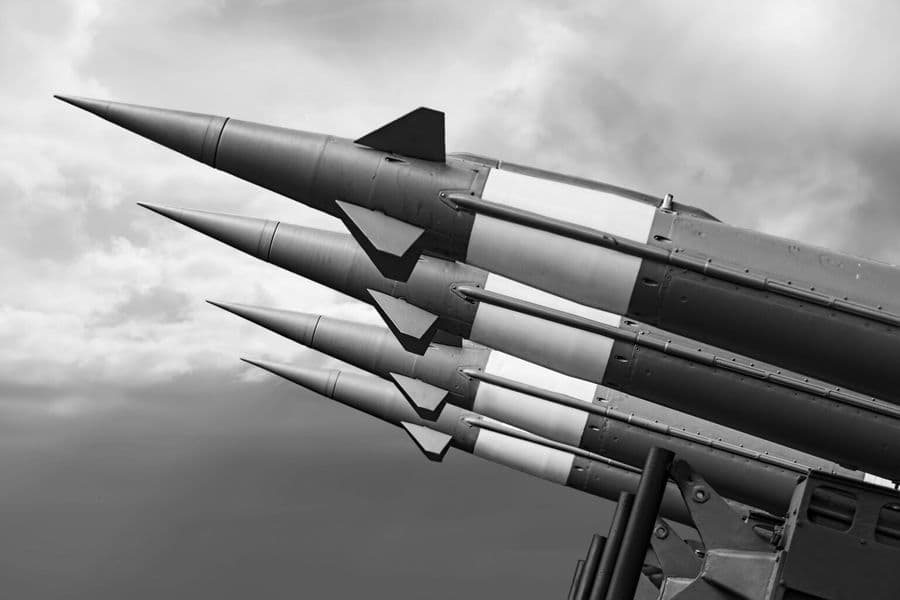
Last week, the world caught a brief glimpse of a nightmarish future in which many of America’s closest allies openly questioned the U.S. security blanket that has long stemmed the tide of nuclear weapons proliferation. This seed of doubt, should it sprout and grow, would spell disaster for American foreign policy.
On Wednesday, following President Trump’s embrace of Russia and his suspension of military assistance to Ukraine, French President Emmanuel Macron urged Europe to join him in discussing a nuclear deterrent independent from Washington. “I want to believe that the United States will remain on our side,” Macron said, “but we need to be ready if that were no longer the case.” He explained that his inspiration for an all-European deterrent stemmed from Germany’s recent proposal for the British and French nuclear arsenals to protect nonnuclear Europe as insurance.
Indeed, the image of a United States unwilling to defend nonnuclear allies appears to be widely shared in Europe and Asia following Trump’s reversal on Ukraine. If the White House wants to stave off a future where weapons of mass destruction spread to nonnuclear friends and foes alike, it should take steps to shore up its reputation as the leader of the Free World. It should lift the pressure it has placed on Ukraine and shift it to Russia – where it always belonged. And it should squash all talk of deep nuclear arms reductions with Russia and China – which have no chance of success in the near term and will only rattle allied confidence in Washington.
A survey of allied perceptions makes plain that the world is on the precipice of a breakdown in the nuclear nonproliferation regime that U.S. security guarantees long underpinned. Polish Prime Minister Donald Tusk declared last Friday that a “profound change of American geopolitics” has placed Poland in an “objectively more difficult situation.” He told the Polish parliament that an updated European nuclear deterrent was likely necessary to disabuse Russia of the notion that “we are completely powerless and helpless.” Citing Ukraine’s surrendering of the Soviet nuclear weapons it possessed in exchange for U.S. security assurances in 1994, Tusk stressed that Poland must have access to such weaponry in case Trump withdraws support from NATO.
Poland’s anxiety is shared by America’s closest allies and partners in Asia. On the heels of the U.S. presidential election in November, some South Korean security elites depicted Trump’s victory as an opportunity for Seoul to develop nuclear weapons. And just week’s into Trump’s second administration, South Korea’s top diplomat stated that taking such drastic measures is not “off the table.”
These same South Korean security elites have since watched Ukrainian President Volodymyr Zelensky trek to Washington only to receive a tongue-lashing from the White House. They undoubtedly took notes as Trump then stripped Kyiv of the intelligence support needed to defend itself against Russian missile attack. And they undoubtedly took more notes as Russia followed up with harrowing missile barrages on Ukraine’s civilian infrastructure – only for Trump to remark afterward that Moscow was “doing what anybody else would do.” It is thus not farfetched to assume that Trump 2.0’s behavior reminds Seoul of Trump 1.0’s threat to withdraw U.S. troops from the Korean peninsula.
Nor is it farfetched to assume that Japan and Taiwan are also taking their own set notes. Both countries – Japan a U.S. treaty ally, and Taiwan a U.S. partner – believe their security is inextricably tied to Ukraine’s fate. They envision a future where Russia absorbing Ukraine emboldens China to launch brutal wars of aggression in the western Pacific. They fear that Russia exhausting U.S. support for Ukraine means China can likewise exhaust U.S. support for them.
Such a grave future is not of academic concern for Japan and Taiwan. Trump, after all, openly questioned the U.S. security guarantee to Japan just days after suspending aid to Ukraine. And he has a long track record of questioning military assistance to Taiwan.
Given Japan’s rising security concerns, a South Korea that goes nuclear to counter North Korea will likely motivate Tokyo, Seoul’s historic rival, to spring for nuclear weapons as well. Proliferation in Northeast Asia, moreover, would likely have cascading effects in the Middle East – where Saudi Arabia watches anxiously as its regional rival, Iran, sits on the nuclear threshold.
If Riyadh senses that Washington is actively encouraging its treaty allies to go nuclear, it too could arm itself to hedge against a post-American Middle East. Perversely, a Saudi arsenal would undoubtedly be the final straw for Iran, which is likely debating crossing the nuclear finish line after having its conventional deterrent exposed as woefully inadequate in last year’s attacks on Israel.
Such a world is not in the U.S. national interest. In a world brimming with new nuclear weapons states – whether they be friend or foe – Washington’s freedom of action would be severely constrained. Friends could eventually decide to go it alone, becoming less amenable to U.S. political, economic, and security interests. Historic rivalries long pacified by the U.S. security blanket could burst into the open in Asia and Europe as allies fend for themselves.
Foes, meanwhile, would likely be emboldened to press their interests at the expense of the United States. A Persian Gulf rimmed with a nuclear-armed Iran on one side and a nuclear-armed Saudi Arabia on the other does not bode well for the future of global energy markets.
If the idea is to put America first, then Washington should take its role as leader of the Free World seriously. A good place to start doing so would be restoring military aid and full intelligence sharing with Ukraine to reassure anxious allies. The U.S. nuclear umbrella has helped underpin a nonproliferation regime that has long benefited Americans. Those advocating for allies to nuke up would surely miss the benefits of U.S. global leadership were it gone.
Kyle Balzer is a Jeane Kirkpatrick Fellow at the American Enterprise Institute.

The First Test of Peace Lies in Ukraine's Borderlands
By Dennis T. Cosgrove • RealClearDefense
The VFW’s Gambling Addiction Victimizes Veterans
By Jack Yoest • RealClearDefense
Superintelligence Exposes a Gap in the Law of Delegated Authority
By Sue Ghosh Stricklett • RealClearDefense
When the Network Goes Dark, Who Controls the Battlefield?
By Jonathan K. Corrado • RealClearDefense
We Cannot Build Tomorrow's Weapons With Yesterday's Alloys
By Joseph F. Krause • RealClearDefense
When the Network Goes Dark, Who Controls the Battlefield?
By Jonathan K. Corrado • RealClearDefense
Air Force Should Buy 250 Blended-Wing Tankers, as 2027 Demo Looms
By A&SF Mag.
Long Deployments to Be Navy Standard For Next Couple Years
By Mongilio, USNI NewsWhen the Network Goes Dark, Who Controls the Battlefield?
By Jonathan Corrado, RCD
Marines Deploy Neros Archer Drone in Live Fire Exercise for First Time
By USNI News