
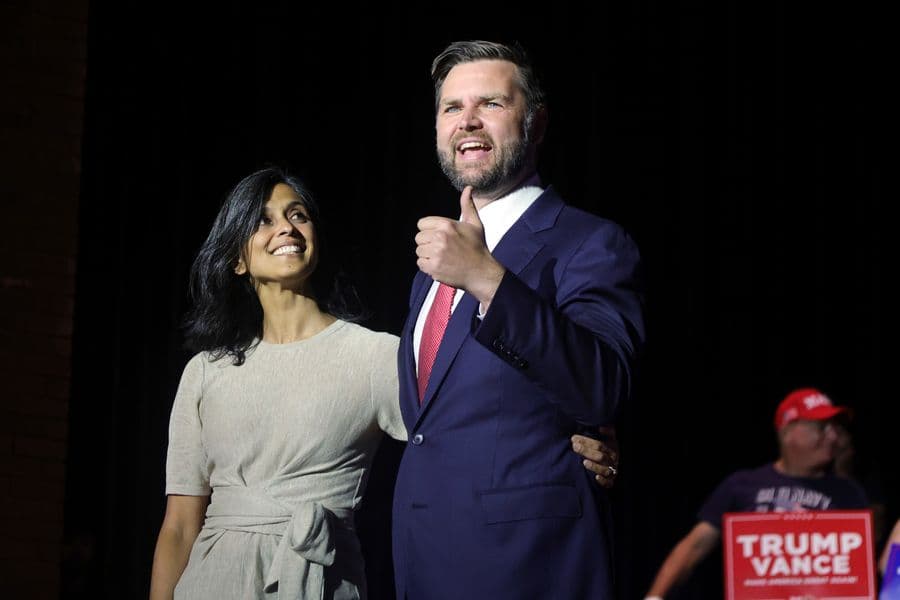
Who is J.D. Vance?
Last updated 11:19 PM EDT • Read time: 5m
So much has already been said of the 39-year-old vice presidential nominee. Politico has paraphrased Steve Brannon to compare Vance with St. Paul and Trump with Jesus Christ.
Vance has all the right credentials to be a leader.
So do lots of politicians who fail to deliver.
Vance could be just another “Scranton Joe,” ascending the slippery pole, one who only “struts and frets his hour upon the stage and then is heard no more.” Perhaps his incredible life story will amount only to “a tale told by an idiot, full of sound and fury, signifying nothing.”
J.D. Vance could be a real leader.
Or, he could be a performer, all shine and no substance.
We have learned only recently that Joe Biden, as President, has been acting for us; well-directed with good production values, well-groomed, nice smile, a few words supposedly spoken from the heart, and put out on the public stage from time to time.
Though he tries his best to follow instructions and read from scripts, Joe is no leader.
Having what Harvard Professor David Riesman called “inner-direction” makes leaders. Having what he called “other-direction” makes followers.
Other-directed people float through life like flotsam and jetsam, bobbing up and down and here and there on the currents of events with no goal in mind other than staying afloat. They take their views, their values, their “truths” from other people. They lack inner-direction, an “inner gyroscope” that maintains its direction no matter the spin of circumstances. They are followers, dependent on influencers, pollsters, toadies and lackies at heart. Nowadays, to rise up in the ranks of the Party, you must conform and play the other-directed game with false sincerity.
Other-directed personalities cannot lead. They love perks, privileges, and power but don’t stand for anything serious, anything that requires personal sacrifice.
So, is J.D. Vance inner-directed or other-directed?
We can only read his “tells,” as we do when we try to divine what cards an experienced poker player is holding close to the chest.
One “tell” is his decision in 2014 to take his maternal grandfather’s family name: Vance. That may signal a young man still trying to find his real self, moving on from the uncertain identity he inherited at birth. Not a “tell” resonating with resolute inner-direction; more the “tell” of a seeker looking for a safe-space in the public eye and in which he can find rest.
A second “tell” is what he did as a Marine. He was neither an officer nor in combat arms, but worked as a corporal in public affairs. One veteran called his service both “honorable and pedestrian.” Public affairs these days is a snake-pit of other-directed personalities; all is show, appearances, getting the politically correct story right for the audience. In this role, Vance was a bystander, never asked to make life-or-death decisions.
According to Stars and Stripes, “Vance wrote about Marines and took photographs of their work, escorting civilian news reporters and speaking about happenings on base. In Iraq, [then-named-Corporal James D. Hamel] embedded with different units to get a sense of their daily routines and wrote a story about a crew keeping KC-130J tankers in the air. He also waded into unprotected Iraqi territory with a civil affairs unit to meet with locals.
“I was lucky to escape any real fighting,” Vance wrote of his deployment.
“Lucky” to escape combat … an odd thing for a Marine to say of war; an appropriate thing to say for a civilian looking to move on with his life.
In his last nine months in service, Vance said he unexpectedly became a media relations officer at Cherry Point, a position typically reserved for the most senior Marines. The job involved liaising with news media, considered the “holy grail” of Marine Corps public affairs with the “biggest audience and the highest stakes.”
A third “tell” is that Vance is a Millennial, born to a generation like the Baby Boomers that had it easy. The psychological profile of Millennials is a far cry from real leadership. Millennials allegedly need constant feedback: “How am I doing?” “Am I fitting in with the team?” “Am I on track for promotion?”
Very other-directed.
Millennials easily go from context to context. They prioritize active listening, collaboration and seeing all points of view. Their fluidity may be associated with their comfort in using technology and social media, easily moving from point-to-point and quickly putting the past behind them. They can morph from one point of view to another. Again, very other-directed.
A fourth “tell” is that he did well in Yale Law School, mastering the educational culture which gave us “Slick Willie” Clinton.
As the New York Times reported, “A close look at Mr. Vance’s record at Yale, though, shows that he adapted rapidly, taking advantage of the school’s heady social and academic opportunities. He cooked for charity fund-raisers, organized reading groups, doted on his German shepherd, Casper, and led The Yale Law Journal’s flag football team. He spent a summer working on Capitol Hill.”
A fifth “tell” is that he easily joined and has prospered in our country’s elite New Class of highly educated professionals who manage our large institutions of business, government, education, media and wealthy foundations. Vance did exceptionally well for himself in that cultural ecosystem, moving easily from the ivory tower of Yale, to making money in high tech, writing a book about himself and gaining Hollywood’s approval.
A sixth “tell” is his adult conversion to Catholicism and his finding a home in national conservatism and Christian nationalism. One who needs community for self-respect has most likely been uneasy as not having inner direction.
J. D. Vance may well become a leader, even a great one.
But let’s wait and see.
The odds are against it.
Stephen B. Young is the Global Executive Director of the Caux Round Table for Moral Capitalism (CRT). Young was educated at Harvard College and Harvard Law School. He served as an Assistant Dean at the Harvard Law School and as the third Dean of the Hamline University School of Law. His new book is Kissinger's Betrayal: How America Lost the Vietnam War.

Reflecting on an Epic Horse Campaign in the Mountains of Afghanistan
By Brian Glyn Williams • RealClearDefense
The Godfather of American Foreign Policy Realism Speaks to Today’s World
By Francis P. Sempa • RealClearDefense
In Pursuit of Nuclear Abolition
By Peter Huessy • RealClearDefense
Innovation Alone Won’t Prepare the U.S. for the Future Battlefield
By Joshua Segal • RealClearDefense
The sUAS Tactical Trifecta
By Bryan T. Woody • RealClearDefense

Navy Civilianizes Six Former Flag Billets, Reduces Six to Captains
By Mongilio, USNI N.
Raytheon's $8B Contract for Strategic Comms Terminal Modernization
By M+A El
America’s Maritime Moment Will Not Wait
By CDR Salamander
Armor Up?
By Marine Corps Compass Points
Who Shoots Down the Drone Over the Shipyard?
By John Ferrari & Dillon Prochnicki • RealClearDefense