
Momentum Toward Operational Expertise in the USAF
Last updated 05:38 AM EST • Read time: 7m
The Nascent Middle: Momentum Toward Operational Expertise in the U.S. Air Force
Strategic goals precipitate down, and tactical actions percolate up into the operational level of war. Colliding in this complex, multidomain, dynamic middle, operational planners must simultaneously employ systems thinking and detail-orientation. It is no wonder it is called operational art to harmonize politicians’ broad, abstract objectives with discrete, concrete military movements. Yet operations are predominantly where wars are fought and won.
This is precisely why a recent article called for professional military education to revamp focus on operational thinking and to invest in and reward operational planning training in the U.S. Air Force. Especially against near-peer adversaries, where gray zone and conventional conflict can afford no slippage, the operational level is vital. Especially amid rapid pulses of technological change, when data volumes surge as the tempo of warfare hastens and decision timelines compress, the operational level is critical.
The dearth of operational training and expertise might be damning. Fortunately, it is not entirely accurate and may be short-lived. In November 2024 at a faculty townhall at the U.S. Air Force Academy, I proposed an Air Force-wide multidomain operational wargaming and training facility to then-Secretary of the Air Force Frank Kendall. It did not come out of nowhere, and with the right advocacy it could lead somewhere extraordinary.
The Multi-Domain Lab
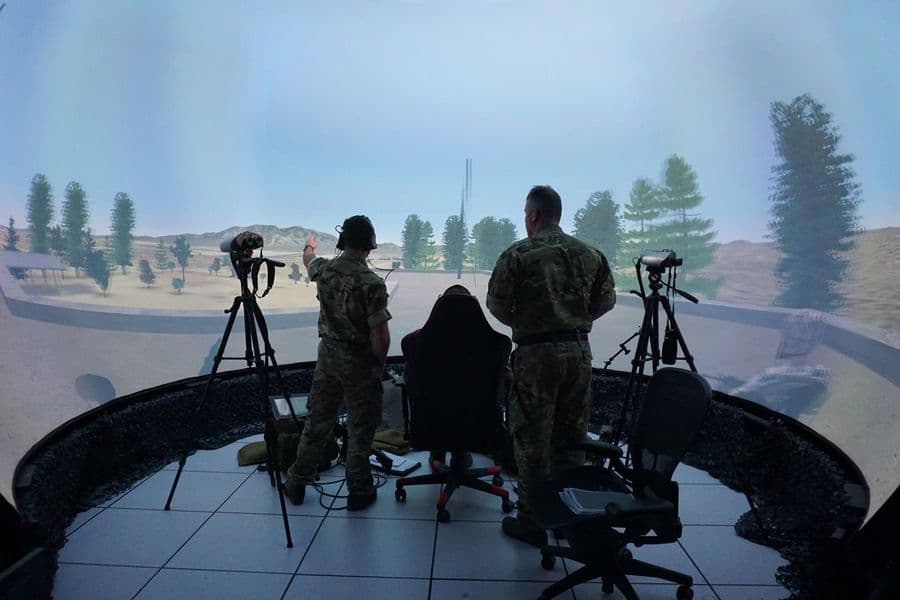
Three years ago, the Department of Military and Strategic Studies at the Air Force Academy created the Multi-Domain Lab, a vivid, immersive, scalable venue where future warfighters can cultivate critical thinking and operational skills. Now part of the core curriculum, all Air Force Academy cadets learn fundamentals of planning and executing joint operations, narrowing focus from national security strategy to air, space, and cyber power in context to operational application. It teaches, and more importantly simulates practice for, the top-down capacity to define and connect strategic ends to tactical efforts.
In fact, it does more. Designed for commissioning cadets, it also emphasizes the bottom-up skills to interpret tactical actions at the operational level so that future lieutenants are empowered with mission command in dispersed environments of future warfare. Coordinating clusters of intelligence and command in an operations center with air assets in flight simulators, cadets execute mock operations pointedly designed around probable exchanges with the United States’ pacing threats.
Approximately 1,000 cadets each year have frequent, deliberate touchpoints with the Lab for this core experience. Beyond that, multiple courses can and do incorporate it into their curricula including in capstone experiences. Synthesizing operational knowledge, practice, and at times even research, the Multi-Domain Lab distinctly enhances officer education and preparation.
Secretary Kendall articulated the urgent need for Air Force officers to be ready to lead on “day one” of commissioning. In the past, lieutenants could be tactical leaders. The battlespace has changed. The earthiest tactical leader can no longer make decisions without multidomain awareness, without understanding the operational picture with a minimum degree of resolution. Consequently, we must educate and iterate the foundational knowledge, skills, and capabilities to do this. To the Military and Strategic Studies Department, that means we must layer simulation upon lecture, experience on concepts, and practice over rote. In short, we must cultivate operational art.
Only Part of the Solution
The Multi-Domain Lab serves all graduates of the Air Force Academy, but this is only one of three accession pathways. Its isolated, air-gapped position in Colorado Springs inhibits opportunities for those commissioning through Officer Training School or across college campuses in Reserve Officers’ Training Corps.
That is why I proposed an Air Force-wide fusion of two robust precedents. The Distributed Missions Operations Center offers a model of a networked infrastructure across the globe. From myriad locations, warfighters can virtually interface to practice operations featuring realistic threat scenarios, both collaboratively and competitively. This operations center, however, dwells within high levels of classification and is exorbitantly expensive, limiting its accessibility and sustainability to enfold all accession and promotion pathways.
The standalone Multi-Domain Lab offers an educational analog that is open (unclassified) and affordable to serve all officers-in-training and even middle-grade officers. Blend these models, and you have an Air Force-wide operations training center.
Profits and Potential
This type of capability would enable users to gain experience stitching the operational seams from both directions. From the bottom-up, younger leaders can learn to construe the operational picture to harmonize tactical actions. From the top-down, senior officers would iterate cohesively, contextualizing strategic directives across diverse operational elements. Both would benefit simply from practice—converting information learned in lecture or seminar to actionable knowledge and accumulating synthetic experience and intuition. With the luxury to safely fail, which humans internalize far more intensely than theory, users can do all this without adverse effects on real operations.
The benefits extend beyond honing operational tradecraft. With options to array users competitively, teams can contend in real time against thinking, responsive red teams, making for richer and more externally valid scenarios that might grant insights on key adversaries. Vertically, this training venue would enable practitioners to workshop operational potentials, perhaps yielding innovations kicked up to the formal capability development system. Internally, Air Force officers-in-training would commission with a common, focusing experience contoured to acute threats. Across services, warfighters could collaborate to develop joint perspective and rapport prior to being thrown together under pressure or fire.
Speaking of collaboration across services, the U.S. Military Academy and the U.S. Naval Academy are also actively pursuing this capability, but lag without an existing onsite lab. As they build out similar capacities, ideally with integration in mind, the Air Force can deploy kits for joint exercises and invite sister services to plug in for multidomain operations that will doubtlessly comprise future operations.
How to Blend Them
The Multi-Domain Lab has a partnership with Air University / Maxwell Air Force base. For some time, it has been providing deployable “Multi-Domain Lab in a Box” kits to support a degraded simulation experience. These kits are unnetworked and limited to execute at scale, but they have nurtured a vision to stand up an interoperable lab at Maxwell and emplace capabilities in key Reserve Officers’ Training Corps nodes around the country that would bear profound dividends across all commissioning sources. Happily, this is where both Air Force Officer Training School and Reserve Officers’ Training Corps are headquartered. Moreover, this is where the Air Command and Staff College, which educates middle- and senior-grade officers most likely to be in the thick of operational planning, is located. Once the architecture is in place, programming new scenarios of varying complexity, jointness, and challenge would be limited only by imagination. This implies that the capability would spread well, scaling from cadets to battle-borne senior officers of high specialization (the Air Force could find its Enders and its Mazers), and age well, flexing to rising threats, shifting rosters of allies and adversaries, and new technologies.
Keeping Momentum Amid Transition
Following my proposal, Secretary Kendall tasked stakeholders at Air Education and Training Command and Air University to “see to it that it gets seriously considered.” Mere weeks later, he has rolled into retirement and the transition of leadership in the Oval Office and Department of Defense is complete.
The imminent need for operational training and expertise remains, and a solution that is already scoped, tested, and half built exists. Momentum could turn to inertia, however, if the leadership turnover inadvertently truncates it. That would bring the U.S. military full circle, where a deficiency of operational training and expertise undermines its prowess in the future fight.
A sizable cohort of innovative, eager, operationally minded individuals have been building and refining this capability to edify warfighters. It is ready to mature. General Brown (guns up!); General Allvin; Secretaries Hegseth, Ashworth (acting) and Meink (nominated), standing by with a solution.
Kerry Chávez, PhD, is an assistant professor in the Military & Strategic Studies Department at the United States Air Force Academy and an advisor for Project Air and Space Power at the Irregular Warfare Initiative. Previously, she was a nonresident research fellow with the Institute for Global Affairs and a two-time nonresident research fellow with the Modern War Institute at West Point. Her research focusing on the politics, strategies, and emerging technologies of modern conflict and security has been published in several venues and impacted multiple policymaking efforts.
The views expressed are those of the author and do not reflect the official position of the United States Air Force Academy, Department of the Air Force, or Department of Defense.
Is It Déjà vu All Over Again: The 2012 Report on Global Zero
By Peter Huessy • RealClearDefense
As Private Investment Pours Into Defense, the Clock Is Ticking
By Elaine McCusker • RealClearDefense
The First Test of Peace Lies in Ukraine's Borderlands
By Dennis T. Cosgrove • RealClearDefense
The VFW’s Gambling Addiction Victimizes Veterans
By Jack Yoest • RealClearDefense
Superintelligence Exposes a Gap in the Law of Delegated Authority
By Sue Ghosh Stricklett • RealClearDefense

When Your Navy is too Small, the Bill Comes Due Bigly
By CDR Salamander
Quo Vadis MCU?
By Marine Corps Compass Points
When the Network Goes Dark, Who Controls the Battlefield?
By Jonathan K. Corrado • RealClearDefense
Air Force Should Buy 250 Blended-Wing Tankers, as 2027 Demo Looms
By A&SF Mag.
Long Deployments to Be Navy Standard For Next Couple Years
By Mongilio, USNI News