
An Army Modernization Problem: Local Transformation Without Direction
Last updated 06:37 AM EDT • Read time: 8m
The Army’s Transformation in Contact initiative drives transformation from the tactical to the strategic level. Soldiers and battalion-level formations are developing prototypes, brigades are testing new formations and capabilities, and divisions are validating combat systems. Portfolio acquisition executives are shortening acquisition timelines and moving capabilities toward fielding. Innovation initiatives connect tactical experimentation with Army-wide modernization. Army leaders have committed the organization to continuous transformation.
Strategic direction has not kept pace with Army modernization. Units and organizations face several valid strategic demands without a clear framework for deciding which demands should shape force design, doctrine, training, and investment. Local adaptation produces useful results but if the Army does not institutionalize those, then they can result in the Army moving down divergent paths. Consequently, Army modernization faces a problem of direction rather than effort.
Strategic clarity must connect modernization activity to a defined future force. Clear priorities should determine which capabilities receive investment, which formations change, which experiments scale, and which risks the Army accepts. Without those choices, successful local innovation does not ensure Army-wide coherence.
Transformation Across the Force
Army modernization depends on experimentation across multiple levels. Transformation in Contact programs allow formations to test emerging capabilities under operational conditions. Project Convergence-Capstone 6 validated Next Generation Command and Control at division scale. Cross-functional teams and portfolio acquisition executives seek to connect requirements, acquisition, and fielding more quickly. Together, these efforts show an Army changing how formations fight and how capabilities reach soldiers, backed by clear direction to move quickly.
Tactical formations also generate modernization from below. Battalion commanders prototype organizational approaches and small-unit tactics in response to operational problems. Soldiers develop local solutions, commanders test new methods, and units feed lessons back into Army learning systems. Local experimentation gives the Army a broad base for adaptation and, more importantly, gains buy-in from the end users who feel a sense of ownership in the process including the resulting end products.
However, local success does not automatically produce Army-wide change. Experiments must move from individual formations into force structure, doctrine, training, acquisition, and funding. Scaling therefore requires institutional decisions about which innovations support the Army's strategic direction. Without those decisions, modernization can remain a collection of successful local efforts rather than a coherent force-wide program.
Why Local Innovations Remain Local
Past Army programs show how difficult successful scaling can become. Land Warrior demonstrated value during limited fielding. Unfortunately, technical, interoperability, human-factor, and program-management problems prevented uniform Army-wide adoption. Operational promise alone did not create an enduring capability.
Institutional ownership often determines whether local innovation survives. TIGR, the Tactical Ground Reporting System, began as a tool for patrol leaders to record and share local knowledge. Wider adoption eventually brought the system under Army program management in 2011. Human Terrain System followed a different path, facing persistent problems with personnel, governance, assessment, and institutional ownership before ending. Both cases demonstrate that local demand must connect with Army systems for management and sustainment.
Scaling requires more than a successful pilot. Army-wide adoption depends on decisions about force structure, doctrine, training, technical ownership, and funding. Deliberate transformation provides a way to connect experimentation with those institutional systems. Commanders need the latitude to approve local solutions and clear guidance on how those solutions go on a path towards enterprise-level adoption.
Strategic Guidance and Modernization
Current strategy gives the Army several competing demands. The 2022 National Defense Strategy identified China as the pacing challenge. The 2026 National Defense Strategy places homeland defense first, deterrence of China in the Indo-Pacific second, and greater allied responsibility for European conventional defense among its major priorities. Army modernization must translate those priorities into choices about formations, capabilities, posture, and investment.
Army operations continue across several regions at the same time. Forces in Europe maintain forward presence, Pacific formations continue to transform, and homeland defense receives greater emphasis. Army forces also remain responsible for requirements outside Europe and the Pacific, including the ongoing conflict with Iran. Multiple missions place competing demands on the same force.
Budget choices reflect the same breadth of requirements. Army fiscal year 2027 budget supports worldwide operations, homeland defense, Pacific deterrence, modernization, munitions production, cyber capabilities, and drone and counter-drone systems. Funding several priorities at once does not by itself define how each priority should shape Army force design. Senior leaders still must decide which capabilities serve all theaters, which require regional specialization, and where the Army accepts risk.
Strategic ambiguity pushes those choices downward. Commanders adapt available guidance to local missions, terrain, threats, and resources. Each decision can make sense within one formation while producing different approaches across the force. Repeated across multiple echelons, local adaptation can weaken coherence even while increasing innovation. Adequate strategic guidance will bridge that gap.
What Clear Direction Would Enable
Clear strategic direction would connect experimentation at each echelon to a common Army purpose. Efforts like the XVIII Airborne Corps’ Dragon’s Lair encourage small units and individual soldiers to bring their innovation ideas to the command. These programs are being replicated elsewhere but need to be fully implemented across the Army as a bridge from tactical innovators to the enterprise level. Three effects would follow from that implementation: battalion experimentation gains purpose, brigade modernization gains alignment, and division-level specialization gains strategic focus.
First, clear strategic direction would give battalion experimentation a defined purpose. Commanders would continue solving local problems, but Army priorities would provide criteria for judging which solutions deserve broader adoption. Successful prototypes that support those priorities would move into doctrine, training, force structure, and acquisition. Innovation would remain decentralized while scaling decisions become more disciplined.
Second, clear direction would also align brigade modernization. Brigades receiving new equipment and formations would understand which operational problems those changes are designed to solve. Similar formations could develop common methods when preparing for similar missions. Shared direction would reduce unnecessary divergence while preserving room for adaptation.
Third, clear direction would help divisions specialize where strategy requires specialization. Pacific formations may need capabilities suited to dispersed operations and contested logistics. European formations may place greater weight on reinforcement, interoperability, and large-scale ground combat. Homeland missions may require another mix of capabilities. Strategic choices should determine where common Army standards end and mission-specific design begins.
Strategic Clarity and Institutional Efficiency
Strategic clarity can reduce duplication across modernization programs. Consolidating fragmented command-and-control systems around common architectures and data standards reduces integration burdens. Common systems also make Army-wide training and sustainment easier. Modernization becomes more efficient when organizations solve shared problems through common approaches.
Strategic clarity can also increase modernization speed. Traditional requirements and budgeting cycles move slowly, while recent prototypes have advanced on shorter timelines. Army efforts moved Next Generation Command and Control from early prototyping toward broader scaling within a compressed period. Faster experimentation gains greater value when senior leaders can quickly decide which capabilities support strategic priorities and deserve wider fielding.
Common standards could also improve continuity across formations. Soldiers who move between units might benefit when systems, procedures, and data standards remain familiar. Commanders might spend less time rebuilding basic proficiency after personnel turnover. Thus, Army-wide coherence would support modernization and readiness.
Required Strategic Direction
Army senior leaders should define what modernization is intended to produce. Strategic priorities should translate into decisions about force structure, doctrine, capability development, posture, and investment. A strategy centered on China should identify which capabilities and formations receive Pacific priority. Greater allied responsibility in Europe should shape Army posture and reinforcement requirements. Homeland defense priorities should identify required capabilities and where those capabilities reside in the force.
Clear direction should also provide a common test for innovation. Senior leaders should ask whether a prototype supports a defined strategic requirement, whether a capability deserves Army-wide scaling, whether a force structure change advances the future force, and whether doctrine and training reinforce the same purpose. Common criteria would connect local experimentation to Army-wide outcomes.
The Path Forward
Army modernization shows broad commitment to rapid and efficient transformation. Soldiers, commanders, divisions, acquisition leaders, and Army organizations are producing new capabilities and testing new approaches across the force. These efforts provide a strong foundation for continued modernization. A clearly defined future force, grounded in strategic priorities, would better align these efforts.
Strategic clarity should connect innovation to force design. Army senior leaders should define modernization priorities, identify required tradeoffs, evaluate local innovations against those priorities, and scale the approaches that support the chosen direction. Decentralized experimentation would then feed a coherent institutional process.
Army transformation depends on innovation guided by clear direction. Institutionally, the Army expects rapid transformation. Formations across the Army are quickly generating the ideas, capabilities, and operational lessons required for change. Senior leaders can turn that activity into sustained institutional progress by defining the force the Army intends to build.
Matt Russell is a retired Army infantry officer and strategist. Currently, he is the co-founder and managing partner of Attain Leadership Solutions, LLC, a consulting firm focused on strategy, leadership, and team performance.
Michael Carvelli is an Army officer who writes on strategy, operational planning, protection, and engineering. He has written on large-scale combat operations for Real Clear Defense, War on the Rocks, Parameters, Modern War Institute, and Small Wars Journal.
The views expressed are his own and do not represent those of the U.S. Army, the Department of Defense, or any part of the U.S. government.
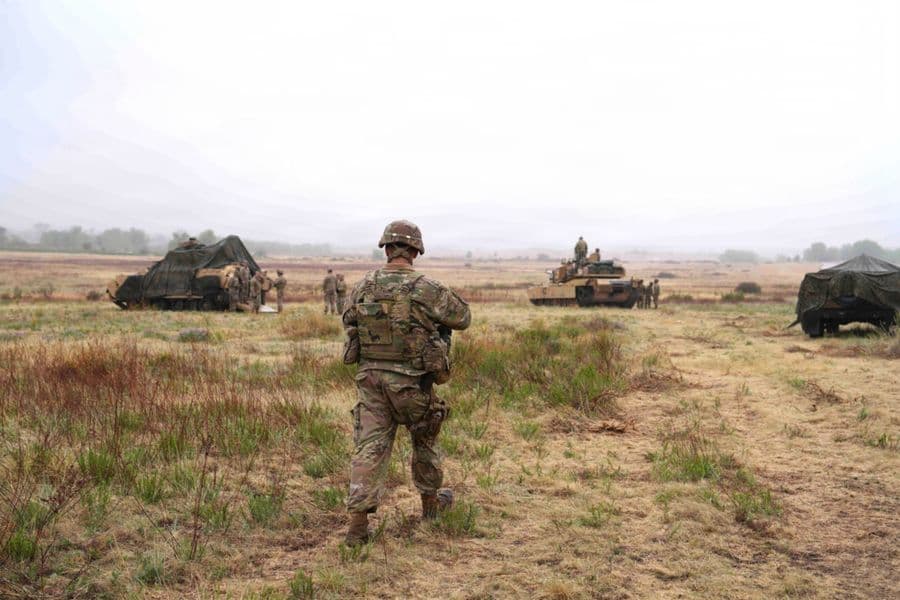
image: Soldiers with the 4th Infantry Division demonstrated Next Generation Command and Control (NGC2) on-the-move command post capabilities on May 5, 2026, at Fort Carson, Colorado. These modern prototype capabilities, integrated as systems of systems into multiple vehicle variants including Joint Light Tactical Vehicles, Abrams Tanks, and Strykers, are connecting tactical communications, data systems, and applications into a cohesive ecosystem to ensure the Army can outpace threats and remain operationally flexible in contested environments.

In Pursuit of Nuclear Abolition
By Peter Huessy • RealClearDefense
Innovation Alone Won’t Prepare the U.S. for the Future Battlefield
By Joshua Segal • RealClearDefense
The sUAS Tactical Trifecta
By Bryan T. Woody • RealClearDefense
The Revolutionary War: When Strategic Options Share the Same Weakness
By Henry Yep • RealClearDefense
The Houthis Are Testing the Limits of Collective Defense
By Saima Afzal • RealClearDefense

Who Shoots Down the Drone Over the Shipyard?
By John Ferrari & Dillon Prochnicki • RealClearDefense
Northrop Grumman Breaks Out the Big Guns at AUSA
By Daniel Terrill, Defense News
Army Pursuing Diverse Array of New Anti-Air Interceptors
By Trevithick, The WarZoneWho Shoots Down the Drone Over the Shipyard?
By John Ferrari & Dillon Prochnicki, RCD
F-35C Lands for the First Time on a Ford-Class Aircraft Carrier
By The Aviationist