
The Army's Drone Bet Is Rational. The Timing Isn't.
Last updated 07:51 AM EDT • Read time: 7m
My oldest son was commissioned out of West Point and is now a Second Lieutenant working on the UH-60 Black Hawk platform. This isn't an abstraction for me. It's the flight line he's living. The Army has decided that airpower close to the ground doesn't need a pilot's name on it as often as it used to, and it plans to cut close to 6,500 active-duty aviation positions in fiscal years 2026 and 2027, pulling pilots, aircrew, and maintenance out of the force and shifting the money toward drones and other unmanned systems. That's roughly one-fifth of the roughly 30,000 soldiers in the aviation branch, and the cuts start with the same year group my son is entering: the junior officers who fly Apaches and Black Hawks. The Army confirmed the numbers to Military Times last September, and talent panels began sorting junior warrant officers, lieutenants, and captains the following month.
I'm not going to argue that the Army is wrong to make this bet. Ukraine has spent three years teaching the world that a $50,000 drone can find and kill a $30 million helicopter, and any officer who ignored that lesson would be committing malpractice. The problem isn't the direction. It's the sequencing. The Army is dismantling manned aviation capacity on a fixed schedule while the systems meant to replace it remain, in large part, still on the drawing board. Momentum is not readiness, and Congress is starting to notice the gap.
What's Actually Changing
The reduction runs through fiscal 2027 and targets pilot, aircrew, and maintenance billets across the force. Army spokesman Maj. Montrell Russell has said the service won't reach a point with zero crewed aircraft, and that soldiers cut from aviation billets are being cross rated into other Army branches rather than shown the door outright. That's a fair distinction, and it matters for morale. It doesn't change the operational math. Fewer aviators mean fewer flight hours logged across the force, and flight hours are the one input you cannot manufacture on short notice when a crisis breaks.
The Money Problem Arrived Early
Personnel cuts are one part of this story; the systems meant to backfill them are still maturing on their own timelines, which I'll get to below. The budget half showed up at a House Appropriations hearing in May, when Rep. Betty McCollum of Minnesota told Defense Secretary Pete Hegseth that the Pentagon's standard fuel price assumption had jumped from $154 to $195 a barrel, eating directly into training dollars. ABC News reported the Army is now working against a shortfall of $4 billion to $6 billion, driven partly by costs tied to the Iran operation and an expanded homeland security mission, and that internal documents show aviation units in III Armored Corps could deploy next year at a lower state of readiness than commanders would prefer.
That's the part that should worry every member of the Armed Services Committee. You can debate the wisdom of trimming pilot billets on a multi-year timeline. You cannot debate the danger of doing that at the exact moment flight hours and maintenance-crew proficiency are getting squeezed by a fuel bill nobody budgeted for. Currency in the cockpit isn't a box you check once a year. Warrant officers and junior pilots build the judgment to fly Apaches and Black Hawks in contested airspace through repetition, and repetition is the first casualty of a training budget under strain.
Procurement Followed the Same Pattern
Lawmakers found a second problem next to the first. The fiscal 2027 budget request effectively guts new-buy funding for the legacy fleet: Apache procurement falls from roughly $362 million to about $1.5 million, Black Hawk from about $913 million to roughly $39 million, and Chinook from about $629 million to about $210 million, according to figures reported by Fox News. Sen. Mark Kelly of Arizona, a former Navy pilot, put it plainly during a May 12 Senate Armed Services hearing: the request funds "zero H-64 Apaches, zero Chinook Block IIs and one UH-60 Black Hawk." Hegseth told lawmakers that the Pentagon was taking another look. Maj. Gen. Clair Gill, who runs Army manned-aircraft acquisition, insists the service isn't divesting the fleet and plans to keep existing airframes flying for decades. Both things can be true at once: the intent may be sustainment, but the budget line reads like divestment, and the House and Senate armed services committees have already moved to restore the funding the Pentagon left out.
The Replacement Isn't One Drone. It's Three Programs.
It's worth being precise here: the Army isn't swapping a retired Black Hawk for a single unmanned aircraft. It's running three efforts in parallel, and none are complete. The first is "launched effects" — small drones a crewed Black Hawk carries and releases mid-flight for reconnaissance, jamming, or strike. Sikorsky landed a $43 million contract last August to build the digital backbone that lets UH-60Ms do this, fielding targeted for 2026. That's the helicopter keeping its pilots and picking up a new tool, not a replacement for it.
The second effort removes the crew entirely. Sikorsky's S-70UAS U-Hawk, unveiled at AUSA last October, is a UH-60L with the cockpit stripped out and replaced by clamshell cargo doors, roughly 25% more hauling capacity, flying itself on Sikorsky's MATRIX autonomy software. It's a genuine prototype, built in ten months, aimed at pilotless resupply into places too dangerous for a crew. By Sikorsky's own framing, it's built for cargo and logistics, not air assault or medevac.
The third piece isn't a drone at all. The Army's manned successor to the Black Hawk is the MV-75 Cheyenne II, a Bell V-280 Valor-derived tiltrotor flying roughly twice the speed and range of the aircraft it replaces. The Army named it in April and is pushing to pull fielding forward from the early 2030s. It will still need a human in the cockpit for troop insertion, medevac, and command-and-control close to the fight. Put together, that's a manned-unmanned mix, not a substitution, and it's why personnel cuts moving on a fixed FY2026-27 calendar deserve scrutiny: the Army is drawing down the manned force on a schedule that doesn't obviously match when Cheyenne II reaches the field or the U-Hawk graduates from prototype to program of record.
The Risk Congress Should Be Pricing In
Strip away the press releases and this comes down to five points of exposure: helicopter reductions outrunning drone fielding, training cuts hitting crews the Army intends to keep, a fuel-driven shortfall suppressing flight hours, an industrial base harder to restart the longer it sits idle, and experienced pilots and maintainers walking out before their replacements are operational. Any one of them is manageable alone. Stacked together, on the same two-year timeline, they describe a force thinner in the cockpit right when the drones aren't ready to carry the load.
None of this means the Army should reverse course. Ray Dalio has a line I've used with clients for years about disciplined risk-taking, and it applies here too: the risk isn't in taking the bet, it's in taking it without hedging the downside. Congress controls the hedge. It can insist personnel cuts track actual fielding milestones rather than a calendar, restore enough legacy helicopter funding to keep the industrial base alive, and require the Army to report flight-hour data by unit so nobody discovers a readiness hole after it's already occurred. Peace through strength has never meant betting the whole hand on a system that hasn't left the test range. It means keeping enough of the old capability in reserve while the new one proves itself. That's not nostalgia for the Huey. It's how you avoid finding out, the hard way, that the transition moved faster than the technology did.
Jay Rogers is a financial professional with more than 30 years of experience in private equity, private credit, hedge funds, and wealth management. He has a BS from Northeastern University and has completed postgraduate studies at UCLA, UPENN, and Harvard. He writes about issues in finance, constitutional law, national security, human nature, and public policy.
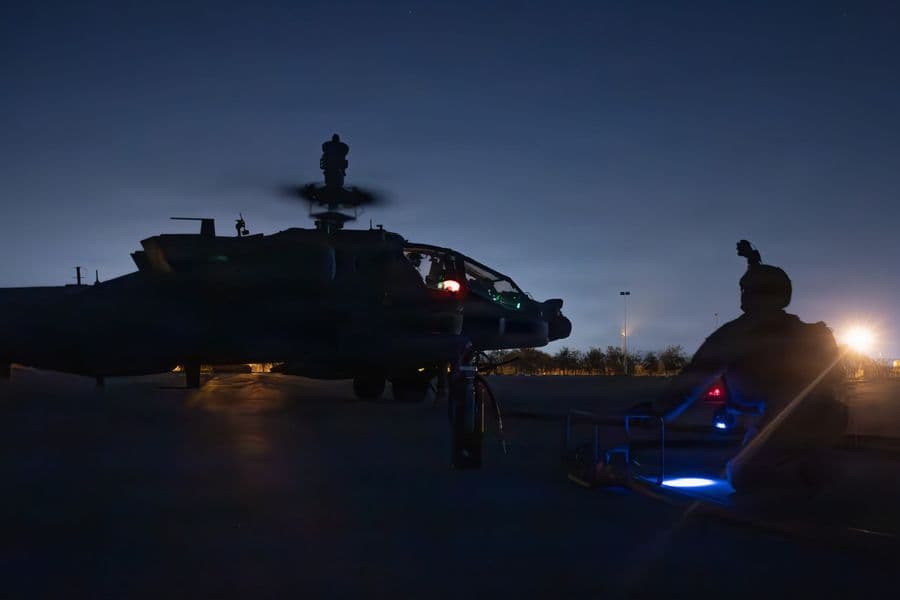
image: A U.S. Marine with Marine Medium Tiltrotor Squadron (VMM) 265 (Rein.), 31st Marine Expeditionary Unit, begins to refuel an AH-64E Apache assigned to the 82nd Airborne Division, at a forward arming and refueling point in the U.S. Central Command area of responsibility, May 8, 2026. (U.S. Marine Corps photo)

In Pursuit of Nuclear Abolition
By Peter Huessy • RealClearDefense
Innovation Alone Won’t Prepare the U.S. for the Future Battlefield
By Joshua Segal • RealClearDefense
The sUAS Tactical Trifecta
By Bryan T. Woody • RealClearDefense
The Revolutionary War: When Strategic Options Share the Same Weakness
By Henry Yep • RealClearDefense
The Houthis Are Testing the Limits of Collective Defense
By Saima Afzal • RealClearDefense

Who Shoots Down the Drone Over the Shipyard?
By John Ferrari & Dillon Prochnicki • RealClearDefense
Northrop Grumman Breaks Out the Big Guns at AUSA
By Daniel Terrill, Defense News
Army Pursuing Diverse Array of New Anti-Air Interceptors
By Trevithick, The WarZoneWho Shoots Down the Drone Over the Shipyard?
By John Ferrari & Dillon Prochnicki, RCD
F-35C Lands for the First Time on a Ford-Class Aircraft Carrier
By The Aviationist