
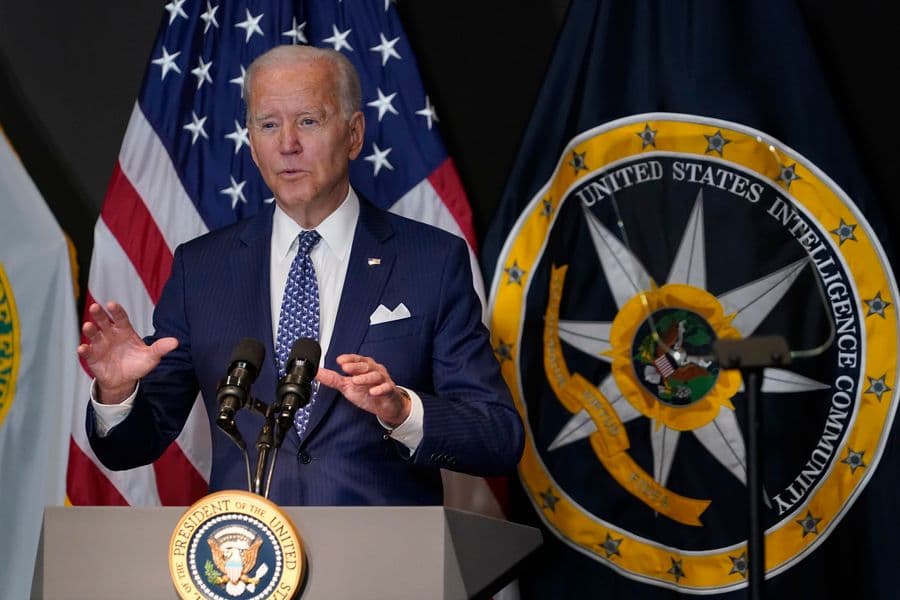
Decoding intelligence on Afghanistan
Last updated 05:18 PM EDT • Read time: 4m
An official inquiry should answer much wider questions
about the U.S. mission than only those of the final few weeks.
Did the U.S. intelligence community fail by not accurately predicting the speed and scale of the Taliban’s victory?
A familiar blame game is now underway in Washington with administration officials and intelligence sources each backgrounding the media with their respective sides of the story. An official inquiry, such as that conducted after 9/11 terrorist attacks, would be a better way to answer the question about what was or should have been foretold – as well as much larger questions about U.S. failure in Afghanistan.
What can the United States expect of its intelligence services?
Quite a lot. The U.S. intelligence community budget for 2020 was $85 billion. Intelligence agencies bidding for these resources haven’t hesitated to hype their capabilities.
Yet there are limits to what even the best intelligence services in the world can do. They can’t predict the future.
There are limits to what even the best intelligence services in the world can do (Olivier Doulier/Getty Images)
The main job of intelligence is to keep decision makers informed. “Creating decision advantage” is a common buzz phrase. Intelligence services are best at obtaining secrets and making sense of them – joining the dots and putting them in context. It is much easier to reveal secret capabilities than to uncover intentions, especially if they are not spoken out loud. And the traditional tools of intelligence gathering and assessment are rarely useful for understanding large-scale social movements or dynamics, especially when these are accelerated by conflict.
The speed of the Taliban’s success seems due less to its military prowess and more to the perceptions and decisions of various parts of the Afghan National Security Forces. Those who had been willing to fight were no longer. Their choices were shaped by the decisions – or the anticipated decisions – of those around them. And when a conflict reaches a tipping point like this, other things change. Previously dependable sources of information become far less reliable.
Awareness of those dynamics would have complicated any attempt at an orderly withdrawal from Afghanistan. Every step to smooth the way for the U.S. to leave risked sending a signal that could embolden the Taliban and weaken the morale of the Afghan National Security Forces. Those opposed to the withdrawal had little incentive to help ensure that it was orderly.
Any inquiry should look closely at the role intelligence played in Afghanistan decisions over the last two decades. It will likely shed more light on widely reported differences of opinion within the intelligence community. Dissent and disagreement is a good thing – these are signs of a healthy community. But claims that military assessments were skewed by their closeness to the mission will need to be closely scrutinised. Years of listening to overly optimistic military projections appears to have been a major factor in the hardening President Joe Biden’s determination to get out of Afghanistan whatever the cost, and it may have made him less open to more nuanced assessments.
Ben has over twenty years’ experience in diplomacy, intelligence and international development. He joined the Lowy Institute from the Office of National Intelligence, where he was a Senior Middle East Analyst before representing ONI at the Australian Embassy in Washington DC from 2016-2020.
In Israel and the Palestinian territories, Ben was the Rule of Law Adviser to Quartet Representative Tony Blair, Australian Representative to the Palestinian Authority and Third Secretary at the Australian Embassy in Tel Aviv.
Ben was a Diplomatic Fellow at the Lowy Institute in 2005 and wrote the LIP, Re-imagining PNG: Culture, Democracy and Australia’s Role. He served as a Bougainville peace monitor for six months in 1998.
This article appeared originally at Lowy Institute's the interpreter.

The Services Do Not Need a Four-Star Autonomous Warfare Command
By Steven Wills • RealClearDefense
Honor Them While There Is Still Time
By Jeffrey Rosales • RealClearDefense
From Siberia to Fairford: How Operation Spider’s Web Has Changed the Rules of Airpower
By Frank A. Rose • RealClearDefense
Faster Simulations, Better Defense Decisions
By Rut Lineswala • RealClearDefense
Will HASC Have an Oversight Subcommittee in the Next Congress?
By Christopher J. Bright • RealClearDefense

Hegseth Barred Trans Troops. Military Boards Are Rejecting Those Orders.
By NYT
Closing the Sea: Lessons from Ancient Mediterranean Blockades
By DeCasien, CIMSECFrom Siberia to Fairford: How Operation Spider’s Web Has Changed the Rules of Airpower
By Frank A. Rose • RealClearDefenseFaster Simulations, Better Defense Decisions
By Rut Lineswala • RealClearDefense
Bombers Could Have a Major Air-to-Air Combat Role
By Joseph Trevithick, The WarZone