
Quibbling Over the Number of U.S. Forces in Syria Misses the Point
Last updated 05:01 PM EDT • Read time: 4m
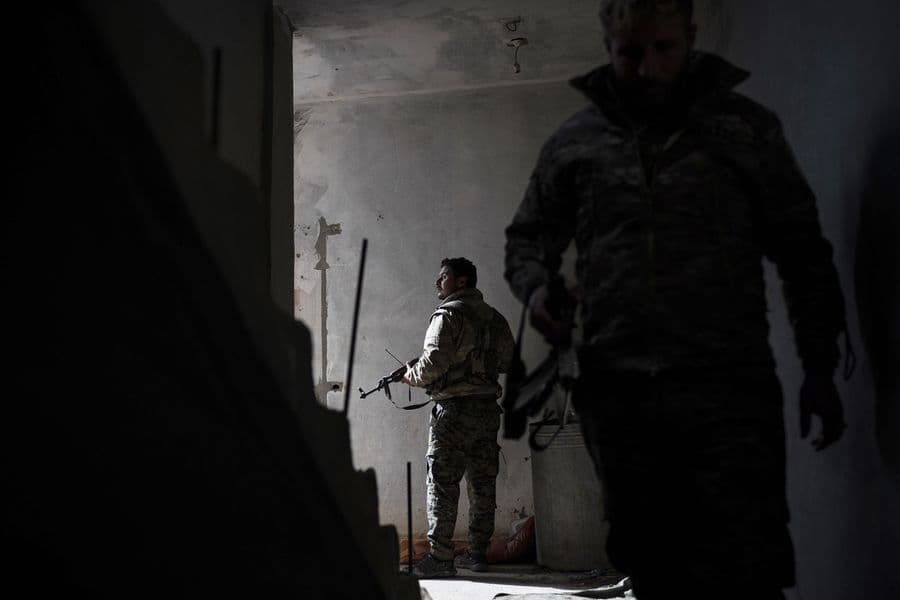
The magic 8-ball that is the Trump Administration’s foreign policy sent Washington and world leaders on another whipsaw last week, this time announcing the U.S. would leave 200 troops in Syria. Not even two months ago, President Trump announced the military mission to liberate ISIS-held territory was (nearly) complete and that it was time to bring American forces home.
Some national leaders applauded the decision and others disagreed; while most Americans likely shrugged their shoulders knowing that whatever they thought, there was little that could be done about it. That’s because quibbling over 200; 2,000; or 20,000 troops in Syria misses the more important point: Congress has never authorized a U.S. military presence in Syria, and an overall justification that reflects American national security priorities has never been established more than half a decade since we became involved in the civil war.
The inconsistency of our reasoning for involving U.S. military and intelligence assets in Syria’s civil war does not inspire confidence in the political or national security leadership at the helm. Even as the Islamic State caliphate has largely been defeated, it seems like we are looking for more problems to solve, grasping at the latest straws to stay present in the country.
When the civil war in Syria started in 2011, our national security leaders became particularly interested in the potential ousting of President Bashir Assad, a ruthless but secular dictator and perennial gadfly to the United States and Israel. Foreign policy intellectuals on both sides of the aisle believed the Arab Spring was the long-anticipated realization of Washington’s democratization projects in the region and eagerly ordained the Syrian rebels, with proper western guidance, to usher in the era of good governance in the Levant.
While there were doubtlessly opposition members in Syria prone to that type of thinking, the overall situation on the ground—as in Iraq, Afghanistan, and Libya—was significantly more complicated.
Sunni extremists in Syria, who had opposed the secular Assad government for decades, were part of the opposition from the outset and quickly became the more powerful factions of the rebellion. This turned western attention away from Assad towards the potential of ungoverned areas, especially in eastern Syria, becoming safe havens for Al-Qaeda-like terrorist groups.
Then in 2013, our focus shifted back to the Assad regime, when it allegedly used chemical weapons against rebel-controlled areas, killing hundreds if not thousands of civilians. The threat of chemical weapons proliferating throughout global conflicts after nearly a century became more of a national security concern than the extremists who were gaining strength in opposition to the regime.
But not even a year later, those extremists gained enough support from disenfranchised Sunnis in the region to launch a shocking campaign across northern Iraq to capture Mosul and deal a nearly fatal blow to the Iraqi government the U.S. spent a decade and hundreds of billions of U.S. taxpayer dollars building.
Since that time, other justifications for involving our military in Syria have passed in and out of American talking points, each as complicated and sometimes contradictory as the others—protecting the Kurds and other minorities; supporting our Turkish NATO allies, who violently oppose our Kurdish allies; supporting our Gulf state allies, who often play both sides when it comes to Sunni extremists; pushing back against Russian and Iranian influence; shielding Israel from either an Assad-led or a Sunni extremist-led Syria; performing a humanitarian mission; or maintaining the credibility of the United States, however that is measured.
The list continues to grow in 2019 with “peacekeeping” now added, a function that had historically been reserved for the United Nations.
This confusion and lack of strategic direction stem from gross neglect of our constitutional processes. The governing body charged with declaring war (or not) and providing a foundation of consistency and continuity amid presidential changes—the United States Congress—has willfully chosen to surrender its responsibility and influence when it comes to Syria and virtually all other current foreign wars.
The Pentagon, State Department, and CIA are not deliberative bodies—by design—and therefore are not equipped to set the long-term strategic goals and policies for a Republic. Only the elected representatives of the American people—by design—are equipped to determine such issues.
So as the Trump Administration continues to be frustratingly unpredictable and inconsistent on issues like Syria and Afghanistan, Congress is failing to perform its most solemn duty by standing idle. Stability and a more disciplined, national-interest focused foreign policy could be restored by the new Congress if they reassume their Article I responsibilities as our founders intended.
Robert Moore is a public policy advisor for Defense Priorities. He has nearly a decade of experience working on national security issues in Congress, most recently working for Senator Mike Lee on the Senate Armed Services Committee.

The Services Do Not Need a Four-Star Autonomous Warfare Command
By Steven Wills • RealClearDefense
Honor Them While There Is Still Time
By Jeffrey Rosales • RealClearDefense
From Siberia to Fairford: How Operation Spider’s Web Has Changed the Rules of Airpower
By Frank A. Rose • RealClearDefense
Faster Simulations, Better Defense Decisions
By Rut Lineswala • RealClearDefense
Will HASC Have an Oversight Subcommittee in the Next Congress?
By Christopher J. Bright • RealClearDefense
Hegseth Barred Trans Troops. Military Boards Are Rejecting Those Orders.
By NYT
Closing the Sea: Lessons from Ancient Mediterranean Blockades
By DeCasien, CIMSECFrom Siberia to Fairford: How Operation Spider’s Web Has Changed the Rules of Airpower
By Frank A. Rose • RealClearDefenseFaster Simulations, Better Defense Decisions
By Rut Lineswala • RealClearDefense
Bombers Could Have a Major Air-to-Air Combat Role
By Joseph Trevithick, The WarZone