
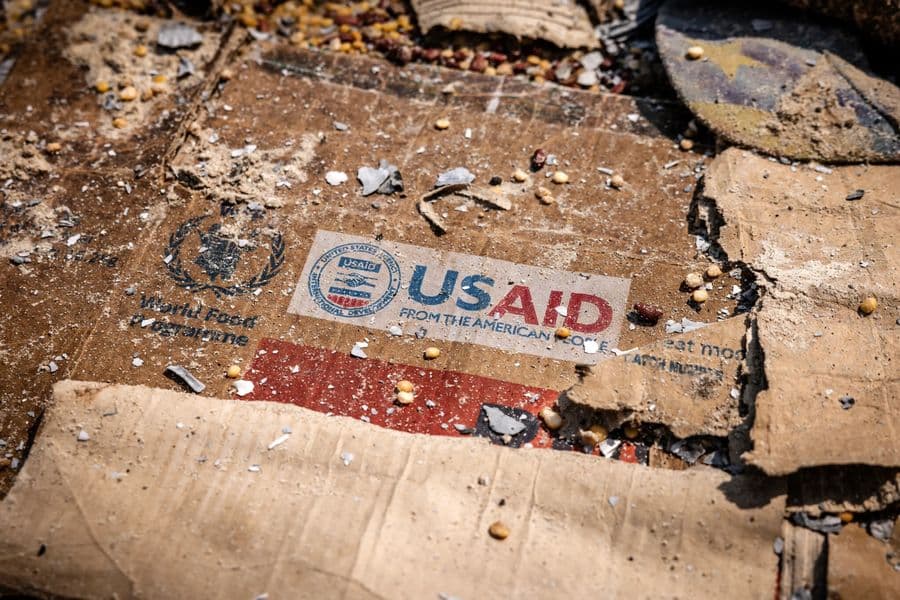
USAID Can and Should Advance U.S. National Interests
Last updated 06:33 AM EDT • Read time: 6m
Misperceptions about the costs and benefits of U.S. foreign aid have led to current budget and policy missteps. According to KFF, an independent health policy research and polling organization, most U.S. adults overestimate the proportion of the federal budget allocated to foreign aid. Approximately 86% of U.S. adults believe that the U.S. spends about a quarter of its budget on foreign aid.
Due to this misconception, polling consistently indicates that approximately 60% of U.S. adults think the U.S. government allocates "too much" toward foreign aid. This figure is nearly 90% among Republicans and 55% among Democrats.
In reality, foreign aid has been about one percent of the federal budget for the past 25 years. This is dramatically less than the high of about six percent during the adoption and execution of the Marshall Plan following World War II.
Virtually all U.S. foreign aid is appropriated annually through the Foreign Assistance Act. Each year, Congress has the opportunity and constitutional responsibility to review, debate, and adjust foreign aid programs to ensure they meet U.S. objectives in a fiscally responsible manner.
Using FY2023 data, the U.S. provided $68.2 billion in foreign aid in the most recent year with completed reporting. The State Department disbursed $21.3 billion, almost 30% of the total. Smaller amounts were disbursed by the Treasury and Health and Human Services departments, the Millennium Challenge Corporation, and 16 other agencies. USAID distributed the most significant portion, nearly $43.8 billion in aid.
Overview of USAID
Until 1960, U.S. foreign aid was developed and executed haphazardly. There was no coherent structure or planning to ensure that federal dollars were focused on U.S. interests and objectives. In 1961, as part of the new Foreign Assistance Act, Congress established the U.S. Agency for International Development (USAID) as an independent entity, separate from the Department of State, to ensure the rapid and targeted deployment of U.S. foreign assistance, particularly in times of crisis, to meet our national security goals.
USAID is a relatively small agency with approximately 13,000 employees. This includes a few thousand federal workers, several hundred foreign local staff working from various U.S. embassies worldwide, and primarily U.S. contractors or NGOs executing ongoing projects. As mentioned earlier, they manage a tiny fraction of the federal budget, about 0.04% (two-fifths of one percent). A significant portion of that budget is spent in the U.S. on goods and services, particularly agricultural products, delivered to recipient countries. Yet the agency consistently performs beyond expectations, delivering substantial benefits to the U.S. in terms of goodwill and support. Always in coordination with broader U.S. military and political objectives, USAID programs help align the interests of recipient partner nations with those of the U.S. The return on investment is extraordinary.
Not Always Perfect
There have been a few major program failures by USAID. A good example occurred in Afghanistan. For fifteen years, from 2002 to 1017, USAID spent about $1.46 billion to develop alternative programs encourage Afghan farmers to shift away from poppies (opium) toward more traditional cash crops. The program was unsuccessful. Agricultural production continues to be heavily focused on poppy cultivation. Additionally, a report issued by the U.S. Special Inspector General for Afghanistan Reconstruction (noted cases where U.S. aid, in the form of farm equipment, fertilizer, and education went to improve poppy cultivation. Clearly an example of unintended consequences.
Of course, there have been mistakes along the way. Some programs were ill-conceived and some missed the mark. Even a small program can we wasteful and sometimes inadvertently do more harm than good to U.S. interests. The current focus has been on programs related to the USAID budget categories “Democracy, Human Rights, and Governance;” “Education and Social Services;” and “Peace and Security.” Again, using 2023 numbers, these three categories represented a combined total of $3.3 billion (about 7.5% of the total). While it is tempting to throw the baby out with the bathwater, a more focused way to improve how U.S. foreign policy is conducted might be to either apply greater scrutiny to programs in those budget categories or simply eliminate those specific categories altogether.
My Experience with USAID
I have worked with USAID on many military assignments, including at the U.S. Embassy in Turkey, and Albania. Across multiple countries, projects, and programs, I found them to be dedicated and focused on mission success. The individual programs were integrated and focused on advancing important U.S. foreign policy objectives.
An excellent example is my assignment as Chief of the Office of Defense Cooperation in Albania. At the time, the U.S. and coalition forces were heavily engaged in both Iraq and Afghanistan. Albania had been sending troops to Afghanistan since 2003, primarily serving as base security. When Albania joined NATO in 2009, enthusiasm grew for Albania to quickly complete the requirements for NATO ascension and gain the ability to participate in operations “outside the wire,” relieving some of the pressure on U.S. Special Operations Forces.
General Bantz Craddock, Commander of U.S. European Command, and U.S. Ambassador to Albania John Withers II collaborated with the Albanian government and other NATO partners to create an integrated plan to achieve that goal. The plan addressed all statutory, structural, and capability requirements for NATO membership. A key component focused on enhancing Albania’s military capability, preparing the nation politically, and securing the full support of the Albanian people to deploy Albanian Special Operations Forces for active operations in Afghanistan.
USAID played a crucial role in preparing the Albanian population for this demanding task, working across the country while focusing on the hinterlands during 2009 and 2010. By collaborating with the U.S. Army Corps of Engineers, USAID renovated five schools and established six telemedicine clinics in remote areas. The total budget of $4 million for 11 projects averages about $363,000 each, compared to the median price of a single new home in the U.S. in 2010, which was $222,000.
This cost-effective and straightforward USAID program demonstrated the U.S. commitment to improving conditions in Albania. It generated goodwill and reciprocal support for the U.S. and NATO among the Albanian population. This led to a willingness to deploy young Albanian soldiers into direct combat roles that supported U.S. interests, roles that would have otherwise been filled by U.S. soldiers.
Martin A. Perryman, a retired U.S. Army Colonel, is a defense and foreign policy expert.

The Services Do Not Need a Four-Star Autonomous Warfare Command
By Steven Wills • RealClearDefense
Honor Them While There Is Still Time
By Jeffrey Rosales • RealClearDefense
From Siberia to Fairford: How Operation Spider’s Web Has Changed the Rules of Airpower
By Frank A. Rose • RealClearDefense
Faster Simulations, Better Defense Decisions
By Rut Lineswala • RealClearDefense
Will HASC Have an Oversight Subcommittee in the Next Congress?
By Christopher J. Bright • RealClearDefense
Hegseth Barred Trans Troops. Military Boards Are Rejecting Those Orders.
By NYT
Closing the Sea: Lessons from Ancient Mediterranean Blockades
By DeCasien, CIMSECFrom Siberia to Fairford: How Operation Spider’s Web Has Changed the Rules of Airpower
By Frank A. Rose • RealClearDefenseFaster Simulations, Better Defense Decisions
By Rut Lineswala • RealClearDefense
Bombers Could Have a Major Air-to-Air Combat Role
By Joseph Trevithick, The WarZone