
Real Innovation for the Marine Corps
Last updated 07:27 AM EST • Read time: 6m
In 1989, a group of Marine Corps officers and civilian military theorists wrote several professional military journal articles describing a new wave of conflict that they dubbed Fourth Generation Warfare (4GW), defined by non-state actors, terrorists, armed militias, cyber actors, and even corporate entities engaged in conflict with established governments.
The first three generations of warfare were evolutions of conventional warfare marked largely by advancements in military technology. 4GW is still a contested concept of warfare, defined as: “Unlike traditional warfare, which focuses on defeating a military's capabilities, 4GW aims to undermine an adversary's societal cohesion and political will through asymmetric tactics, often targeting civilian populations and infrastructure.”
Success in 4GW can be achieved when the adversary convinces the civilian populace that casualties sustained by friendly forces are not worth the political objectives being pursued or that the cost in civilian casualties is both counterproductive and immoral. That is exactly what we are seeing happening in cities such as Minneapolis today. Fatalities on both sides are low, but their impact is worldwide and immediate.
The marine authors on the topic of 4GW had seen this happen in many places in the world in the 70s and 80s of the last century but were particularly impacted by the deaths of more than 241 of their comrades in the1983 Beirut bombing. The result was a loss of support for the UN Peacekeeping mission in Lebanon and the subsequent withdrawal of US forces.
Ten years later, 4GW tactics by non-state militias in Somalia led to the withdrawal of US forces. In both cases, the loss to American servicemen were much smaller than in conventional wars, but the sight of US body bags coming home for no discernable American vital interest had wide-ranging political impact.
In Somalia, the images of Somali women and children willingly using themselves as human shields in confrontations with US forces in the Battle of the Black Sea Market, known as Black Hawk Down, was deeply shocking to the American public.
4GW is less about the physical impact of conflict than it is on the civilian psyche. The tactics used by leftist activists in places like Minneapolis are not new, they date back to the 1968 Democratic Convention in Chicago. The dissident marines saw Minneapolis coming long before its time.
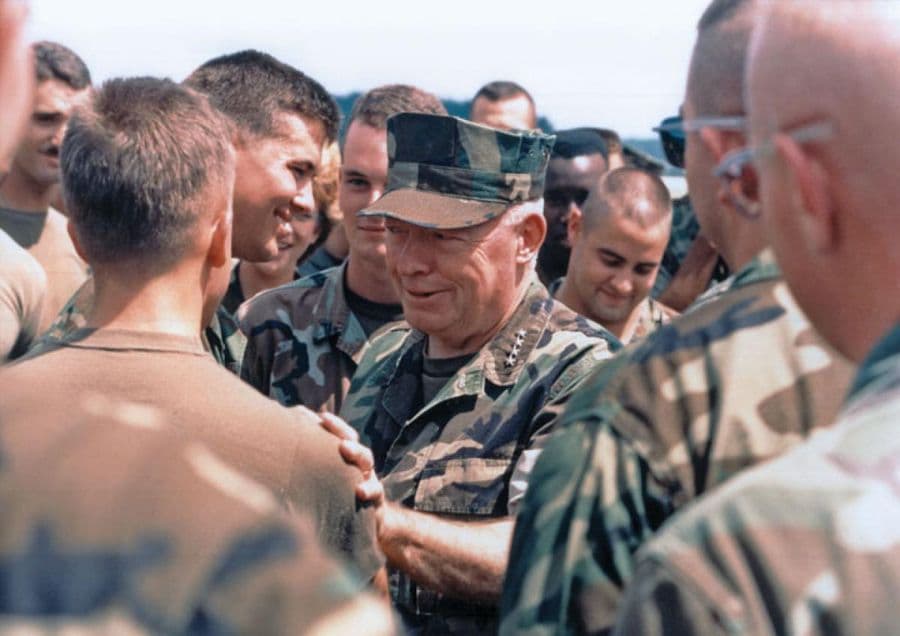
In1995, the Marine Corps began developing a concept called the "Three Block War" where marines were taught to be "Strategic Corporals" training them that any action they took might appear on the news world-wide almost immediately due to the twenty-four-hour news cycle. ICE would do well to study and emulate this concept.
Despite the misconception among many in the other services and some civilians that marines are dumb, the Three Block War and 4GW are examples of perceptive marines seeing trends in the world that others might have missed.
There is a myriad of other examples such as the combat use of the helicopter and the jump jet as well as the development of maneuver warfare as opposed to the more traditional American attritional approach.
Until 2019, the ingenuity of the Marine Corps has been to integrate these new ideas seamlessly into the Corps in an additive way that did not disrupt the basic fabric of the organization or its aggressive outlook.
However, when the Corps occasionally gets something wrong, it's a doozy. The adoption of the Gama Goat is a good example. Conceived in the late 60s early seventies of the last century as a futuristic replacement for the venerable Jeep, the Goat proved to be a rolling abortion. Unreliable and hard to maintain, it was quickly and quietly phased out (I think we foisted them off on the Army). I don't even think there is a representation of it in the Marine Corps Museum
Also, in the seventies the Marine Corps tried an early computer-based "just in time " logistics system. It failed miserably as computers were not yet ready for the challenge. It was buried quietly in an unmarked shallow grave. The Corps did such a good job of erasing it from history that I can't even find a reference to it doing a Google search.
As a result of those and other debacles, the Corps came up with a disciplined Combat Development Process (CDP), designed to weed out truly bad ideas. Sometimes the CDP frustrated some of us who had what we thought of as useful innovations; but, until 2019, it prevented any more Gama Goats.
Unfortunately, the CDP was bypassed in the latest and most radical change in Marine Corps warfighting approach. This concept called Force Design, required a radical revision of the force structure and warfighting philosophy of the Corps to send small missile shooting teams situated on remote islands in the South China Sea and China’s first island chain rather than forward deployed strike forces – a global force-in-readiness.
The war games that justified it were held in secret by a hand-selected group of officers and contractors. Informed debate was forbidden. After nearly seven years, the system is outdated, logistically unsupportable, and is being ignored by INDOPACOM, its primary intended customer. Meanwhile the worldwide posture of the Marine Corps as a force-in-readiness has suffered to the detriment of the country’s ability to respond to global crises.
Force Design has created a dangerous defensive mind set among senior marine leaders, infecting marines down the chain of command.
There is some good news, however. Much like the original proponents of 4GW and Maneuver Warfare, there is a growing group of active and retired marines who are diligently working as a counter reform movement with the avowed desire to see Force Design replaced with a force structure that returns the Marine Corps into a modernized global force-in-readiness, while in keeping with the traditional values and ethos of the Corps.
It may take years to kill or neuter Force Design, but there is hope. One of the original authors of the 4GW articles eventually became Commandant of the Marine Corps and instituted the Three Block War concept, but he did it in a manner that was in keeping with the ethos of the organization.
In the 1980s, a commandant who has been part of the dissident Maneuver Warfare group instituted it as Marine Corps warfighting doctrine. Again, he did so without basically changing the fabric of the Corps. Meanwhile, an internal civil war rages beneath the surface. Civil wars killed the old Roman Republic, but our American Civil War eventually made the American Republic stronger. Hopefully, we can emulate the latter in making the Marine Corps stronger by serving the nation whenever and wherever needed.
Gary Anderson retired as the Chief of Staff of the Marine Corps Warfighting Lab where he worked heavily on developing urban 4GW operational and tactical doctrine.

We Cannot Build Tomorrow's Weapons With Yesterday's Alloys
By Joseph F. Krause • RealClearDefense
Americans Will Sacrifice for Their Country, Not for Politicians
By Jane Li • RealClearDefense
No Need for a New World Order
By Will Thibeau • RealClearDefense
Congress: Don’t Let the NDAA Hand China Our Defense Blueprints
By Richard Newton • RealClearDefense
Washington Cannot Ignore Afghanistan’s Weapons Legacy
By Saima Afzal • RealClearDefense

Marines Deploy Neros Archer Drone in Live Fire Exercise for First Time
By USNI News
Confessions Of An SR-71 Blackbird Pilot
By Howard Altman, The WarZone
Air Force Exploring Creative Ways to Produce More Pilots
By Laura Heckmann, NatDef
"Super F-22' Propels Rator to Fly With F-47 Into 2060s
By Kris Osborn, Warrior Maven
GA-ASI and Saab Test AEW Payload on MQ-9B
By Stefano D'Urso, The Aviationist