
America Should Build the Future of Unmanned Aviation
Last updated 09:14 AM EDT • Read time: 4m
When most people think of drones, they typically picture one of two things: a weapon of war or a bothersome toy hovering uninvited over backyards and public spaces.
Lately, their use as weapons has dominated the headlines. From Ukraine to Iran, inexpensive drones have transformed the economics of warfare, allowing relatively cheap aircraft to threaten militaries and infrastructure worth billions. What was once a niche technology has become one of the defining weapons of modern war. But the battlefield is only the beginning.
The same technology transforming modern warfare is about to become part of everyday American life. In the coming decades, drones will become as common a tool for first responders and critical infrastructure as helicopters and radios are today, because they can solve problems that have always put human lives at risk. An unmanned aircraft can search through smoke before firefighters enter, inspect a damaged bridge without putting a worker hundreds of feet in the air, or scan miles of woods for the heat signature of a missing child. It can fly over gridlocked traffic carrying a defibrillator to someone whose heart has stopped, map a chemical spill before a responder steps into it, or give soldiers a view beyond the next ridge without sending someone forward to discover what is waiting there. That is the drone story we have barely begun to tell.
But for unmanned aviation to deliver on that promise, the aircraft must be present when the critical moment arrives. It must launch reliably, maintain its connection and remain airborne long enough to accomplish the mission.
That future is exciting. It is also exactly why Americans are right to ask hard questions about who builds these machines and where their data goes. If drones are going to become a ubiquitous part of American life, trust cannot be an afterthought. Until recently, most of America’s drones were built by a single Chinese company: DJI.
At its peak DJI held more than 70 percent of the North American drone market, and an even larger share of the public-safety market. DJI helped create the modern market by building reliable, easy-to-use aircraft that first responders could depend on. But as drones become part of the infrastructure protecting our communities, the United States should not have to rely on a foreign manufacturer for systems this important.
In 2025, the FCC moved to restrict new drones and drone components from foreign-adversary countries, including China, unless national-security agencies approve them. That created an opening for a domestic drone industry. But opening the market is not the same as winning it. Law enforcement and American soldiers should not be asked to accept inferior equipment simply because it carries an American label. Domestic manufacturers have to build something better.
That means designing aircraft specifically for public safety and national defense missions, rather than repurposing consumer products for higher-stakes work. A public-safety drone should remain overhead long enough to follow an emergency as it develops. It should be reliable in the field, simple to repair, and ready to return to service when lives depend on it. American manufacturers should not win solely because foreign competitors were restricted. They should win because they built the better aircraft.
Every additional minute a drone stays in the air is another minute to find a missing person, track a changing threat, or keep a responder or soldier from moving into danger blind.
There is plenty of anxiety that autonomous systems will replace people. But in this case, unmanned aviation will not remove people from the mission. It is about making dangerous jobs safer and giving the people doing them better information before they have to act.
America now has the opportunity to help build that future. We should not settle for merely replacing what came before. We should build aircraft worthy of the people who will depend on them—and capable of being present when the moment matters most.
Will Hasting is co-founder and CEO of Angel Aerial Systems, an American drone manufacturer based in Cincinnati. He spent 26 years across U.S. Navy nuclear operations and aerospace engineering at GE Aviation, and holds 23 patents.
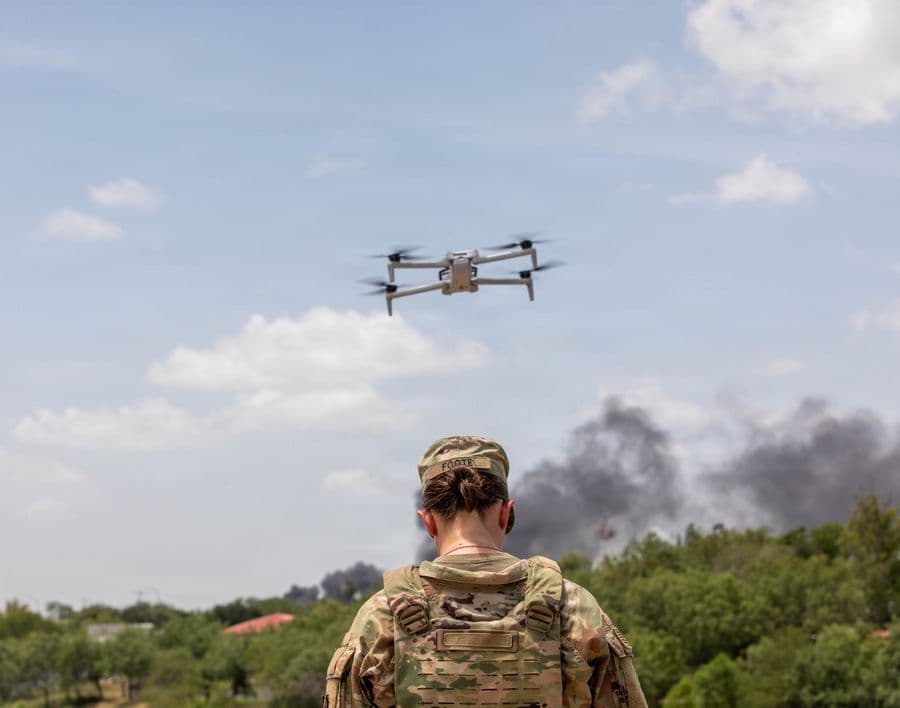
image: U.S. Army Spc. Drew Foote, with the 211th Military Police Battalion, 130th Maneuver Enhancement Brigade, assigned to Joint Task Force-Southern Border in support of Operation Ardent Vanguard, operates a Skydio X10D small unmanned aircraft system in Rio Grande Valley, Texas, July 16, 2026. U.S. Northern Command is working side-by-side with the Department of Homeland Security and the U.S. Customs and Border Protection within narrowly defined authorities to provide unique military capabilities to protect the territorial integrity of the U.S. southern border. (Dept. of War photo by Sgt. Raekwon Wilson)

A Passage to the Middle East: India as a Mediator and Security Partner
By Irina Tsukerman • RealClearDefense
South China Sea is Key to Invigorate Positive U.S.–Malaysia Relations
By Brent D. Sadler • RealClearDefense
The Necropolitics of the Wasteland
By Yunus Emre Tumen • RealClearDefense
AI, Robotics, and Marines
By Gary Anderson • RealClearDefense
The Emerging SQUAD
By Muhammad Shoaib • RealClearDefense
AI, Robotics, and Marines
By Gary Anderson • RealClearDefense
AUKUS Partners Test Autonomous Maritime Systems
By Jangoulun Singsit, Naval Tech
AUKUS: USS Colorado Announced as First Submarine for SRF – West
By USNI News
Navy, Marine Corps Simulate Ship Strikes From Air and Land
By Alex Wilson, S&S
Air National Guard To Stand Up a New Special Tactics Squadron
By Patty Nieberg, T&P