
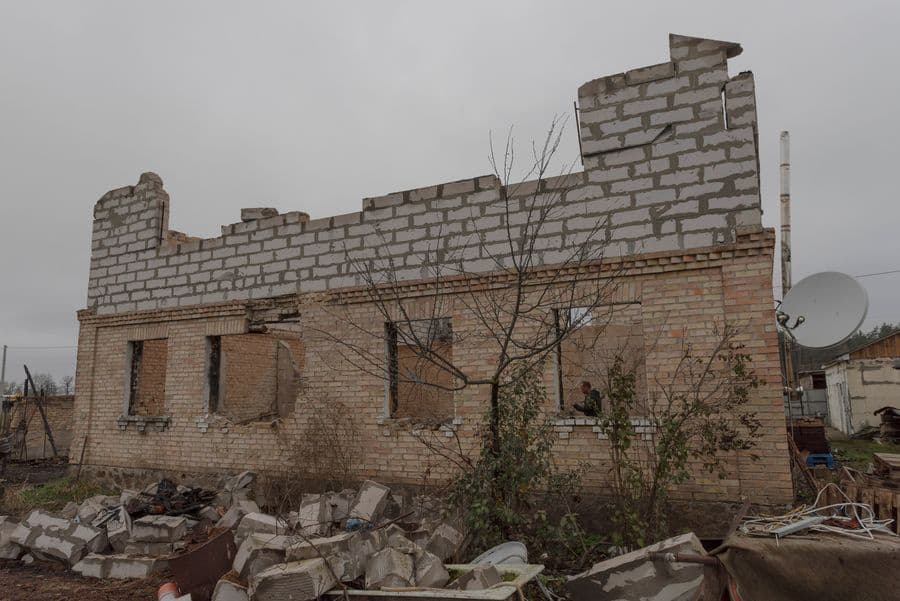
Do Not Underestimate Ukraine's Resilience to Bombing
Last updated 06:59 AM EST • Read time: 9m
Beginning on October 18, 2022, the eruption of Russian drone and missile bombardment of Ukraine’s electricity and water purification infrastructure, has led Kyiv to a desperate search for air defense systems capable of intercepting these attacks. This is followed by a sense of urgency that a failure to provide for the heating demands of the coming winter, will demoralize Ukrainians and sap their resistance.
However, despite the privations that the bombing of key infrastructure will produce panic in the general Ukrainian population, the overwhelming historical evidence is that bombing builds resilience, rather than a weakening of resolve, when people are faced with the threat of foreign occupation. The heaviest deliberately targeted bombing campaign against a civilian population was the U.S. destruction of Japan cities in the last 18 months of the Second World War. Although it killed 900,000 Japanese out of a population of 70 million, its only social disintegrative effect was a rise of worker absenteeism to 8 percent. Rather, it was the Soviet defeat of Japan’s army garrison in Manchuria, and the fear of a Soviet invasion of Japan proper, that brought Tokyo to negotiate.
Historically, inflicting punishment on an adversary’s civilians by bombing, has never worked as an independent method of compelling political capitulation, for two essential reasons: first, societies are much more resistant to suffering than is commonly understood, and second, modern states have the ability to re-organize their societies to reduce their exposure to the effects of bombing.
The sociological model that underpins the assumed coercive effects of bombing has its origins in the nineteenth century understanding of society as hierarchical, morally fickle, and brittle. Bombing was thought to bring victory not by killing, but by destroying expectations of order, unleashing the internal contradictions of a society against itself. For example, Germany’s battlefield defeat of France at Sedan in the 1871 Franco-Prussian War, was not enough to end the conflict. Rather, France capitulated once Paris was put under siege. The German bombardment of the city released social antagonisms between the urban workers and the upper classes of Paris, leading the French government to submit quickly to German peace conditions, including the transfer of the provinces of Alsace-Lorraine. This freed the French army to focus on the brutal suppression of the French worker’s Commune, which was viewed as the greater threat to the nation. In effect, France was more fearful of its own reformist population than the Prussian Army.
It was widely believed that the non-lethal moral effect of bombing was twenty times the physical effect of inflicting casualties. The social dislocation would be so severe that either the central government would collapse, or the surviving population would demand that the government surrender. H.G. Wells, in his popular 1908 book War in the Air, depicts the panicked reaction of fickle populations to the bombing of their cities by floating dirigibles (giant war balloons). A five-year ban was placed on arming balloons in 1899 by the major European powers a The Hague, and major attempts were made in 1922 and 1934-35 by the League of Nations to either ban bombers, or for the League to take possession of them to enforce world peace.
However, this panic behavior is typical only of isolated individuals. So long as family units persist, they form self-help groups that mitigates much of the moral effect. There is also a selection effect, in which those civilians that struggle to survive, contribute to order. In effect, the dead don’t panic, and survivors adapt. Studies on Ukrainian social cohesion before the war generally categorized it as problematic. Now during war we see an abundance of examples of volunteering to help the war effort, whether its collecting donations to help the internally displaced or volunteers preparing and delivering food to the front, horizontal cohesion has been able to rally around the cause of Ukraine’s survival. Furthermore, Ukrainians are using telegram and other platforms, creating local channels to coordinate and concentrate their efforts locally. Surveys indicate that 80 percent of the civilian population are involved in volunteering of some form. This further carries into enabling a social reorganisation to combat the effects of bombing. Civilians have both opened up their homes to displaced people as well as built additional bunkers and shelters in their homes to accommodate for more people. The above indicators show that the situation in Ukraine is far from a social breakdown.
Total social breakdowns have been observed in epic natural disasters like the 1902 volcanic destruction of St.Pierre in Martinique, but only the limited contours of a collapse were present in the German bombing of Coventry on November 14, 1945, the British firebombing of Hamburg in July of 1943, and the U.S. nuclear attack on Hiroshima on August 6, 1945. The egalitarianism that comes with democratization, mass mobilization and strengthened state bureaucracies, has rendered people far more resistant to the social disintegrative effects of bombing. For example, during the First World War, Germany dropped 9,000 bombs on England killing 1,413 people and wounding 3,408. Because of civil defense procedures, deaths per ton of bombing in England, was 13 times less effective during the Second World War. Similarly, civil defense in Ukraine has been effective, and not succumbed to Russian pressure. Firefighters and paramedics have been able to keep up and minimize damage where possible.
University of Chicago professor Robert Pape, in his seminal Bombing to Win (1996), demonstrated that air power has never succeeded in bringing an enemy to defeat, when used separately from a ground invasion. This is so for three principal reasons. First, no nation will ever surrender to bombing when it is facing territorial conquest, since any loss of land is usually permanent. Democratic countries like Ukraine are even more likely to resist territorial concessions.
Second, bombing rarely directly hurts more than a small portion of the total population. The Russian suicide drone attacks on Kyiv’s energy, water purification and hospital facilities, especially given the light losses, does not represent more than an inconvenience, at worst. By comparison, an army occupation of Kyiv by Russian troops would expose the Ukrainian population to several orders of magnitude greater losses resulting from atrocities and deportations. Ukraine’s total civilian losses to non-artillery bombardment may number less than a thousand, although exact figures are not available.
Third, states are very efficient are social reorganization and substitution to minimize the punishment effects of bombing. German bombing of Rotterdam (1940), London (1940), Belgrade (1941), and Stalingrad (1942), did not produce anything approaching the political effects of social collapse. In effect, the logic of inflicting civilian punishment by bombing leading to political collapse has never been demonstrated in history.
There are instances where bombing of the civilian population and infrastructure is effective, but none of these conditions are present in the current circumstances of Ukraine. First, countries that are especially vulnerable to bombing concede to negotiations before the outbreak of war. During the Second World War, Hungary secured a secret arrangement with the U.S. Air Force not to use its air defenses during U.S, overflights in exchange for not being bombed. One of the reasons an Italian coup deposed Italian fascist leader Benito Mussolini on July 25, 1943, was the fear in Rome of Italy becoming a target of devastating Anglo-American bombing. Ukraine, by contrast, has already resolved to accept the costs of resistance.
Second, states are more likely to be politically affected by bombing if they have a divided leadership. The Iraqi bombing of Iran’s capital of Tehran with SCUD missiles, during the Iran-Iraq War in the 1980s, ultimately led to the strengthening of the peace faction over the hard-line faction in Iran because of the tremendous social dislocation: over one million people had fled Tehran. Harvard University professor Ernest May termed this the incumbent hypothesis: bombing does not so much change the mind of the leader in power, as much as weaken them with respect to competing political agents who will use the disorder to unseat the incumbent. The government of Ukrainian president Volodymyr Zelensky seems far more united than that of Russian President Vladimir Putin.
Third, nations are usually less willing to make concessions after they have suffered some minimum threshold of sunk costs in a war, principally because families that have lost a loved one are seeking some modicum of revenge. Those political factions willing to negotiate are typically marginalized out of power. This phenomenon explains the costly stalemate of the First World War, despite numerous opportunities to come to an early cease-fire.
Russian President Vladimir Putin is indeed correct that the Russo-Ukrainian War is a competitive test of wills, but he has misidentified the respective centers of gravity. It is not a trial of resolve between the Ukrainian and Russian people, the latter of whom are largely insulated from the horrors of war, if not most of the economic sanctions. Rather it is a test between the Ukrainian nation, which is committed to independence, versus the far more limited motivation of the conscripted Russian army, which, when its will is eventually broken, will lead it to overthrow Putin in a coup. The Russian bombing of Ukraine is an act of political desperation. Surveys show that approval for the war within Russia has been declining rapidly, and internal tensions have not eased even with the annexation of the new territories. This is further evidenced by the lack of any broad public mobilization in Russia, even on the contrary leaning toward public sabotage of mobilization efforts. On the other hand, 86 percent of Ukrainians support the continuation of the counteroffensive to retake lost territory, with Zelensky holding a 91 percent approval rating. Russia’s principal advantage was its ability to conquer Ukraine militarily, something Moscow squandered early in the war.
Attila Arslaner is a Master's student studying Security and Defense at the Norman Paterson School of International Affairs, Carleton University. He has been invited to conferences at NORAD, and completed research contracts for the Department of National Defense. His research focus is on nuclear weapons and arms control.
Dr. Julian Spencer-Churchill is an associate professor of international relations at Concordia University (Montreal), former army engineer officer, and has written extensively on Pakistan, where he conducted field research for over ten years.
Eight Months of Epic Fury and Still No Internal Alternative
By Stephen D. Cook • RealClearDefense
The Readiness Cliff: Pacific Lessons Drawn from the Middle East
By Brian McSorley • RealClearDefense
The Pentagon’s Real Modernization Problem Is Time, Not Technology
By Bruce Allen Lubbering • RealClearDefense
The World His Mother Opened
By Carlo J.V. Caro • RealClearDefense
Wake Island Lessons for Expeditionary Advanced Base Operations
By Brian J. Dunn • RealClearDefense
Wake Island Lessons for Expeditionary Advanced Base Operations
By Brian J. Dunn • RealClearDefense
U.S. Navy Expands Unmanned Mine Hunting
By Global Defense News
MRF-SEA Will Maintain Continuous Presence in the Philippines
By Mahadzir, USNI News
Space Force Weighs Proliferated Cislunar Satellite Constellation
By C. Albon, A&SF
America-Class Amphibs Enable New Ship-to-Shore Attack Strategies
By Warrior M.