
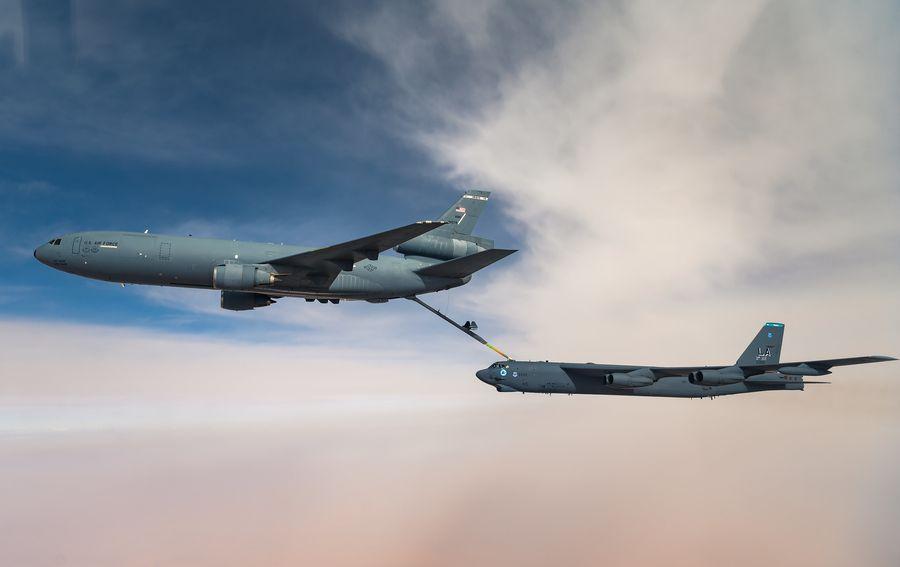
Running on Empty: U.S. Aircraft Need Bigger Tankers to Deter China
Published Feb. 4, 2022 • Read time: 5m
Distance and sophisticated threats make for a “mission beyond fuel.”
Armed with a single 500-pound bomb, the SBD Dauntless dive bomber my grandfather flew in 1944 had a practical range of 325 miles. A workhorse of the US Pacific fleet in World War II, this was considered extensive for carrier-based aircraft, pilots often had to ditch due to fuel limitations – as during the Battle of the Philippine Sea.
Seven decades later, I traversed the same theatre aboard various U.S. military aircraft while serving as a speechwriter for U.S. Secretary of Defense Jim Mattis. Though the vast distances had not diminished since my grandfather’s day, a fleet of aerial tankers ensured we never set down to refuel. Fuel limitations were never a concern.
Whether top brass traveling to security conferences or fighter groups on a mission, this aerial refueling ability is the sine qua non of America’s deterrent and warfighting power. It has sustained the rules-based order won by the Greatest Generation, from Guadalcanal to Midway to Okinawa. In 2021, this ability is now at risk, and with it, the security architecture that rests on it.
The FY22 NDAA
In the FY2022 National Defense Authorization Act (NDAA), Congress allows the Defense Department to retire more than 40 aging aerial refueling tankers while tasking Vice Chairman of the Joint Chiefs Admiral Christopher Grady to deliver a report on “requirements for a Bridge Tanker aircraft.”
As America begins retiring its largest tanker – the KC-10 – Grady must put at the top of his list a solution that gives the greatest amount of fuel for the air assets that will carry any future fight in America’s priority theatre.
Why and When Bombing Still Wins
Blackbirds: Take These Broken Wings and Learn To Fly, Says NASA
The Race to Build Ukraine's Western Air Force
For the United States, the Autonomous Battlefield Must Have a Tether
Just as in 1944, today, America’s ability to fight over the Pacific depends on its ability to fuel aircraft. This has become even more imperative in light of China’s highly sophisticated A2AD threats, including new maneuverable warheads and hypersonic missiles and extensive aircraft modernization.
The tyranny of distance and China’s reach make tanker capacity the top requirement.
The Pacific Ocean is roughly 64 million square miles, comprising nearly a third of the earth's surface and more than the earth's landmass combined. Compared to the U.S. West Coast, China sits next door to allies Japan, South Korea, the Philippines, and the likeliest areas of conflict – the Taiwan Strait and the South China Sea.
The kinetic fight is in the air and at sea. But while the U.S. has airbases throughout the region, an exhaustive yet underreported study from the Hudson Institute concludes, “Given the relatively short range of U.S. fighter aircraft, even moving from airfields in central Japan to the Southwest Island Chain or Taiwan would require significant tanker support.”
In addition to operational distances, China's long-range air-to-air and surface-to-air missiles hold at-risk U.S. bases and fuel depots within allied territory. Additional mainland-based missiles – like China’s DF-26, also known as "the Guam killer” – threaten American facilities like Andersen Air Force Base on Guam and would force America’s carriers back a distance where the effectiveness of their aircraft is severely reduced.
One vignette explored by Hudson saw the Navy deploy unmanned MQ-25 tankers to offset this challenge. However, the authors noted, “the very small MQ-25A being fielded by the U.S. Navy can only provide approximately 15,000 lb. of fuel offload at 500 nm, enough to refuel two fighters” (emphasis added) when the carrier remains at 4,000 kilometers.
This further underscores gas-give as the overarching priority for a bridge tanker. The Hudson report identifies the LMXT– the largest frame under consideration – as providing 38% more fuel than the next-largest candidate. Pentagon leaders should note that the Air Force retires 14 KC-10 Extenders this year and another dozen in 2023.
China recognizes the supreme importance of tankers – and has since at least 2014.
In 2014, the US-China Economic and Security Review Commission authored a report detailing how the U.S. Air Force's airpower superiority over China was “rapidly diminishing” because of China’s swift modernization of air assets. In that report, one area of optimism was that China lacked the aerial refueling capability of the U.S., having only just begun testing the Y-20 aircraft, a strategic airlifter with three times the cargo-carrying capacity of the U.S. Air Force’s C-130, and which could be repurposed into a tanker.
Today, that optimism has evaporated. Last November, a Y-20 tanker – now capable of refueling China’s J-20 stealth fighter and H-6 bombers – joined nearly 30 Chinese aircraft to fly into Taiwan’s air-defense identification zone. The message – and strategic direction – is clear.
Beijing’s military planners clearly recognize the need to give their air assets more fuel. The U.S. should too. The demands are dramatically increased in a theatre of such vast ranges; the requirement for gas-give to keep aircraft in the air is the overarching requirement. In his report to Congress, Admiral Grady should place it at the top of his list.
Returning to the battle of the Philippine Sea: 80% of downed aircraft were lost to fuel exhaustion and desperate nighttime landings, not enemy action. That fateful action was termed the “mission beyond darkness.” Without a clear requirement for greater give, the 21st century analogy may well be the “mission beyond fuel.”
Bill Rivers was speechwriter to U.S. Secretary of Defense Jim Mattis from 2017-19. He is the author of Last Summer Boys, a novel of the Vietnam War era. Follow him on Twitter at @riverswrites.

Iron Raven: Remembering Colonel Joseph B. Conmy, Jr.
By Louis Marano • RealClearDefense
Stand Proud of the Force
By Jay Rogers • RealClearDefense
How a Dying Agency Turned Fentanyl Into a Weapon of Mass Destruction
By Barry Angeline • RealClearDefense
The Pressure Is the Message: What Xi and Putin Faced in Shenzhen
By Emzari Gelashvili • RealClearDefense
China’s Revised Mobilization Law and the Expanding Reach of National Defense
By Muhammad Shoaib • RealClearDefense

Marine Corps Hero Under Federal Investigation
By Laporta, Burnham & Watson, CBS
A Postmortem of Maneuver Warfare in the U.S. Marine Corps
By Donald Vandergriff
U.S. Putting Weapons in Space: A Strategic Blunder?
By Ajey Lele • RealClearDefense
U.S. Senate Seeks to Exchange Shipbuilding Funds for More Munitions
By Naval News
F-35C Completes First Launch and Recovery Trials on a Ford-Class Carrier
By Navy T.