
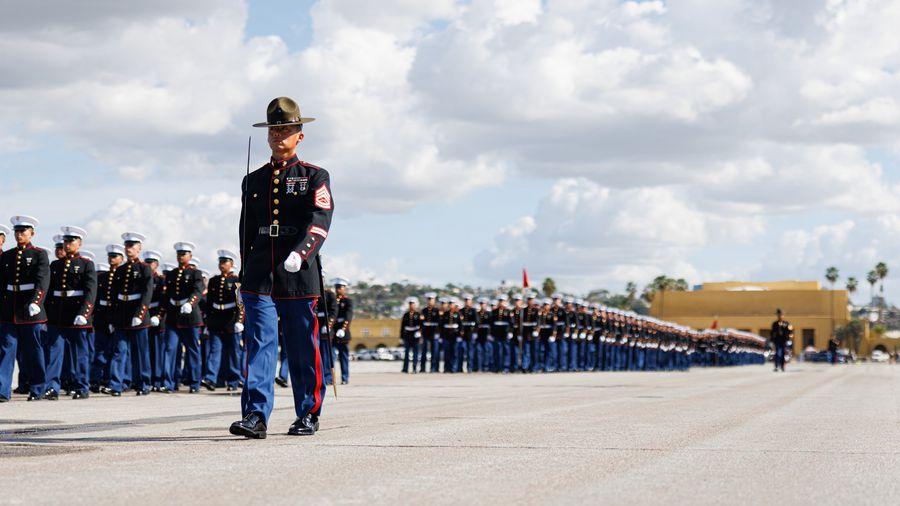
U.S. Marines with Delta Company, 1st Recruit Training Battalion march in formation during a company graduation ceremony at Marine Corps Recruit Depot San Diego, California, Nov. 20, 2026. This ceremony marked the end of a 13-week transformation that included training in drill, marksmanship, basic combat skills, and Marine Corps customs and traditions.
Stand Proud of the Force
Published Nov. 21, 2026 • Read time: 8m

I graduated from Marine Corps Officer Candidate School in 1988, and the lesson that stuck is that standards are a form of respect. They tell the person next to you that you take the mission seriously, and that you take them seriously too. After a few rough years, I'm watching that idea come back into fashion, and I'd like to say so out loud.
My son is a West Point graduate on active duty. He tells me morale in his world is good and the troops around him back Pete Hegseth. One family's report is an anecdote, but it rhymes with what the recruiting and retention numbers show, and those numbers deserve a victory lap.
The best public gauge of troop opinion I can find is a 2025 survey of 440 active-duty personnel, which found 47% approved of Hegseth and 41% disapproved. That's net-positive support, though short of a majority. Polls from the same advocacy group have run cooler since, and I'd rather the Pentagon publish its own morale surveys than leave us arguing over outside samples. Until then, I'll go with the numbers I can verify. They're strong.
The Recruiting Comeback
In fiscal 2022 the Army enlisted about 45,000 soldiers against a 60,000 goal, the worst year on record since the all-volunteer force began. Today the picture looks different. The Army hit its fiscal 2024 goal with at least 55,300 accessions, although a lower target helped. In 2025 it signed contracts with more than 61,000 future soldiers four months before the fiscal year ended. The Navy brought in 44,096 sailors, its best total since 2002. For the first time in four years, every branch met its recruiting goal.
After the Silence
One Year Later: The U.S. Military Continues Quartering Charlie Kirk Assassination Celebrants
The Uniform Doesn't Come With a First Amendment Waiver
Army Secretary Dan Driscoll Is Stepping Down After 18 Months on the Job
The pipeline looks healthy going forward too. Fiscal 2026 began with about 25,000 soldiers already in the Delayed Entry Program, which means a large share of the next class has signed and is waiting to ship. From my years in finance, I've learned to appreciate a full backlog. It lets a manager plan and invest with confidence, and recruiters get to spend the year finding the best people instead of scrambling to hit a number.
Credit belongs to many hands. The Army turned the corner in September 2024, and recruiters, drill sergeants and the families who encouraged a son or daughter to sign deserve a salute. Hegseth and his team inherited momentum and kept it going, which is harder than it looks. Anyone who has taken over a fund in the middle of a good run knows how easily momentum slips.
Retention tells the same story. The Army reached 108% of its fiscal 2025 retention goal. In April it had kept 15,600 soldiers against a 14,800 target. Young people who sign up are one thing. Veterans of the force choosing to stay is a vote of confidence from the people who know the job best.
I've coached youth football, rugby, and high school track, and I've seen the same thing in every locker room. Teenagers rise to the level of the expectation placed in front of them. Give them a clear standard and a coach who sweats alongside them, and they'll show up. Give them vague goals and a lecture, and they'll find the exit. The military has the most demanding standards in American life, and young people who want to be tested are exactly the ones this country needs it to attract.
A Mission-First Military
I'll give my opinion plainly since that's what an op-ed is for. A military exists to deter wars and win them. The early 2020s asked the services to carry a great deal more, and mandatory diversity programming competed for time with range days and flight hours. Analysts point to a tight job market and a shrinking pool of qualified recruits, and I accept that. Over 70% of young Americans already fail to qualify for service. Still, a service that sounds confident about its mission has an easier pitch to a nineteen-year-old than one that sounds unsure of it. I believe the course correction helped, even if the data can't yet prove how much.
The correction came with standards. At Quantico on Sept. 30, 2025, Hegseth ordered two fitness tests a year and a sex-neutral, male-standard test with a 70% average for combat arms. He then worked out alongside 600 troops at the Pentagon. General Colin Powell said soldiers watch what their leaders do, and a secretary sweating beside them says more than a memo. His case for the standard is that the job is life or death. As a former track coach, I'll add that the stopwatch has no opinion about anyone, which is exactly why athletes trust it.
Fairness deserves a straight answer too. Hegseth has acknowledged the male-standard rule would likely exclude some women from combat roles. Women have served with courage and skill throughout our history, and many will pass any test the Army sets. A single standard for a job where a teammate's life depends on your strength gives every soldier the same finish line and every squad the same confidence in the person beside them. That's a policy worth defending on its merits.
He is also trimming the top. Hegseth has ordered a 20% cut in general and admiral positions by Jan. 1, 2027. Fewer layers between a captain's idea and a commander's decision is something every taxpayer and every private in the formation can cheer. His own résumé fits the theme. He's an infantry officer who graduated from Princeton and served in Guantanamo, Iraq, and Afghanistan, earning two Bronze Stars. Critics call him an outsider. His supporters call him a soldier who knows what a rifle company needs. Both can be true.
Proof on the Battlefield
Training standards are worth something only if they show up when the shooting starts. On Jan. 3, U.S. forces captured Nicolás Maduro. No Americans were killed, and seven were injured, five of whom returned to duty. The Delta Force soldiers who carried it out, working from CIA intelligence on his location, pulled off a raid that Hollywood would have rejected as too tidy. Think Argo, with better odds and fewer bad haircuts.
My youngest brother is a retired Green Beret weapons sergeant, so I grew up around people who judge a unit by what it can do. Operations like Caracas don't happen by luck. They come from years of rehearsal, from commanders who trust their sergeants, and from a force that spends its time on the craft of fighting. Every hour a unit spends sharpening that craft is an hour that pays off when the call comes. As Richard "Demo Dick" Marcinko would say, "The more you sweat in training, the less you bleed in battle." A department focused on lethality and readiness gives those units the time and the resources to keep sharpening.
Iran is a longer story, and I won't pretend a war is cheap or finished. What I can say is that the troops fighting it have performed superbly. Hegseth says the U.S. has destroyed Iran's navy, air force and defense systems, and the Pentagon's tally shows 23 American deaths and 865 wounded. Those are our neighbors' kids, and they earned a country that stands when they walk in. A force that can project that kind of power across the globe, and then sustain it, is the most capable military on earth. That statement is a fact, and we're allowed to be proud of it.
Strength also keeps the peace. Reagan built the modern American military on the idea that adversaries think twice when they face a force they can't match. In his March 23, 1983, address on defense and national security, he said, "We maintain the peace through our strength; weakness only invites aggression." The Maduro raid, the Iran campaign and the recruiting surge send the same message to Beijing, Moscow, and Tehran. A country that recruits well, trains hard and wins operations is a country that doesn't get tested often.
How We Keep It
Pride is useful only when it carries a to-do list. Three items would keep the momentum. The Pentagon should publish its Status of Forces and climate survey results by service and rank, using the same questions every year, so the next debate about morale starts with data. The services should report how the fitness standards affect qualification, injury, and attrition rates. Congress should look at whether the general-officer cut removes jobs or only changes their titles.
The idea isn't to doubt anyone. It's to give a winning team the film it deserves. In coaching, game film is how a good season becomes a great one, and nobody who's winning should fear it.
I'll keep listening to my son, and I'll keep counting enlistments. Between the two I see a force with its confidence back, its standards raised and its mission clear. The next time someone suggests that America's best days at arms are behind us, point them to the recruiting office, the retention rates and the soldiers who flew into Caracas and flew home. We have the finest military in the world. Be proud of it and thank the people who make it so.
Jay Rogers is a financial professional with more than 30 years of experience in private equity, private credit, hedge funds, and wealth management. He writes about issues in finance, constitutional law, national security, human nature, and public policy.

Iron Raven: Remembering Colonel Joseph B. Conmy, Jr.
By Louis Marano • RealClearDefense
Stand Proud of the Force
By Jay Rogers • RealClearDefense
How a Dying Agency Turned Fentanyl Into a Weapon of Mass Destruction
By Barry Angeline • RealClearDefense
The Pressure Is the Message: What Xi and Putin Faced in Shenzhen
By Emzari Gelashvili • RealClearDefense
China’s Revised Mobilization Law and the Expanding Reach of National Defense
By Muhammad Shoaib • RealClearDefense

Marine Corps Hero Under Federal Investigation
By Laporta, Burnham & Watson, CBS
A Postmortem of Maneuver Warfare in the U.S. Marine Corps
By Donald Vandergriff
U.S. Putting Weapons in Space: A Strategic Blunder?
By Ajey Lele • RealClearDefense
U.S. Senate Seeks to Exchange Shipbuilding Funds for More Munitions
By Naval News
F-35C Completes First Launch and Recovery Trials on a Ford-Class Carrier
By Navy T.