
Riyadh's Shia Two-Step
Last updated 05:48 PM EDT • Read time: 3m
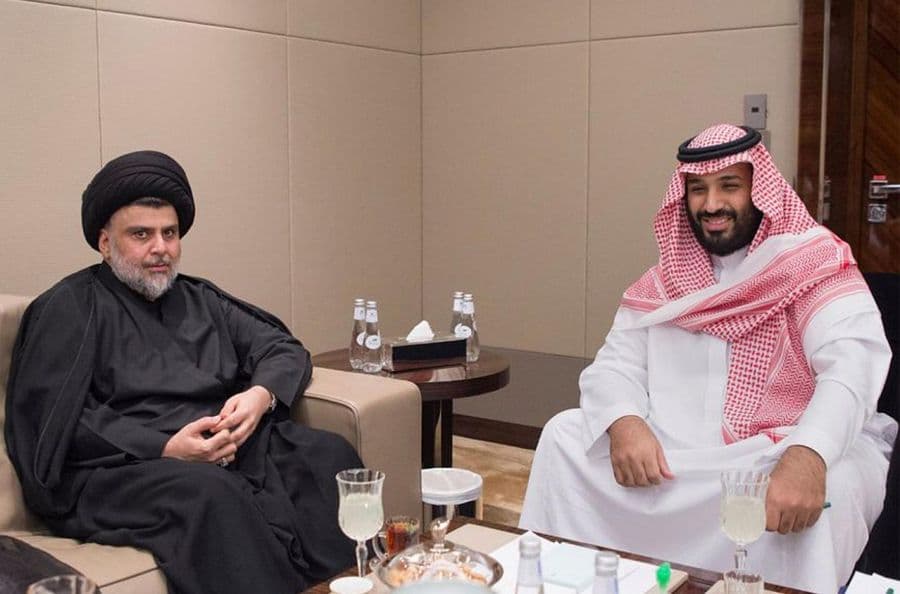
Iraqi Shia Cleric Muqtada al-Sadr's reconciliation tour of Sunni-run Gulf states continued this week, following up his visit to Riyadh to see Saudi Crown Prince Mohammed bin Salman with a visit to the UAE. There he was met by the Crown Prince of Abu Dhabi, Mohammed bin Zayad.
There is little doubt that Gulf states have decided to try a carrot-based approach towards Iraq Shia leaders in attempting to blunt Iranian influence in Iraq, rather than flail around by either ignoring or working against the system. These actions haven't gone unnoticed in Tehran, with the media largely reacting negatively to Saudi Arabia's transparent moves.
It is a common mistake to treat Shia communities anywhere, let alone Iraq, as a homogeneous bloc. When they operate within a sectarian political system, their ideological differences are exacerbated by the normal competition for allies, resources and influence that federal politicking involves. Iranian and Iraqi Shia are both connected and separated by history and geography, and their religious-political leaders have a keen understanding of the way in which regional and local politics works.
Hence Sadr's willingness to be seen to be courted by Gulf Sunni ruling families. Sadr has shown himself in the past to be a particularly flexible politician, and with Iraqi parliamentary elections due next year, he would have understood that it was good politics to be seen in the presence of wealthy Gulf political leaders at the same time as Riyadh is making noises about greater economic links with Iraq.
But we should also not confuse Saudi Arabia's 'carrot' approach towards Iraq's Shia as a major change in response to what it sees as Iranian-inspired adventurism around the region. Rather, it is a small change in tactics. There is still plenty of stick. One need look no further than the Kingdom's Eastern Province, where a rather different Sunni-Shia dynamic is playing out in the sometimes restive province. This time, fighting in the town of Awamiyya (the home town of Sheikh Nimr al-Nimr, the Shia cleric executed in Saudi Arabia last year) has resulted in numerous casualties.
The Arab-Persian-Sunni-Shia-Riyadh-Tehran relationship is a complex one, and the events of recent weeks simply go to show that the complexity continues.
Dr. Rodger Shanahan is a Research Fellow at the Lowy Institute. A former army officer, he had extensive service within the Parachute Battalion Group (PBG) and has had operational service with the UN in South Lebanon and Syria, with the PBG in East Timor, in Beirut during the 2006 war, and in Afghanistan. He was the former director of the Army's Land Warfare Studies Centre, and has also been posted to the Australian Embassies in Riyadh and Abu Dhabi. Dr Shanahan has MAs in International Relations and Middle East Studies from the ANU, and a PhD in Arab and Islamic Studies from the University of Sydney.
This article appeared originally at Lowy Institute's the interpreter.

We Cannot Build Tomorrow's Weapons With Yesterday's Alloys
By Joseph F. Krause • RealClearDefense
Americans Will Sacrifice for Their Country, Not for Politicians
By Jane Li • RealClearDefense
No Need for a New World Order
By Will Thibeau • RealClearDefense
Congress: Don’t Let the NDAA Hand China Our Defense Blueprints
By Richard Newton • RealClearDefense
Washington Cannot Ignore Afghanistan’s Weapons Legacy
By Saima Afzal • RealClearDefense
Marines Deploy Neros Archer Drone in Live Fire Exercise for First Time
By USNI News
Confessions Of An SR-71 Blackbird Pilot
By Howard Altman, The WarZone
Air Force Exploring Creative Ways to Produce More Pilots
By Laura Heckmann, NatDef
"Super F-22' Propels Rator to Fly With F-47 Into 2060s
By Kris Osborn, Warrior Maven
GA-ASI and Saab Test AEW Payload on MQ-9B
By Stefano D'Urso, The Aviationist