
What Trumps the Nuclear Blackmail Card? Missile Defense
Published June 27, 2018 • Read time: 4m
Nuclear blackmail, a card often played by rogue regimes in diplomatic negotiations, is rendered ineffective by the U.S. ballistic missile defense system.
While applying the pressure of sanctions, the Trump Administration has engaged in direct talks with Kim Jong-un with the objective of complete and irreversible denuclearization of the Korean Peninsula within two and a half years. This is already the third iteration of a U.S.-North Korean rapprochement with a third-generation dictator, and success has eluded us in the past two. However, missing in the current dialogue is the urgency to reach détente based on mutually assured destruction. America’s security can no longer be held hostage by nuclear blackmail.
President Trump, on August 8, 2017, delivered a chilling message: “North Korea best not make any more threats to the United States. They will be met with fire and fury like the world has never seen.” The President’s deliberate imagery of American arsenals capable of annihilating North Korea was the condition precedent to dialogue on denuclearization.
While the media gasped in horror of unchecked American power, a Gallup Poll conducted in September 2017 showed overwhelming American public support for the President’s threat of military action against North Korea if economic sanctions and diplomatic dialogue failed. The fact remains that unilateral annihilation without a reciprocal retaliation is a threat that only the President of the United States can credibly deliver.
America fights an ideological cold war and minor hot wars with multiple enemies: communists, neo-czarists, and jihadists. Given the emerging missile capabilities of Iran, the declared missile capabilities of North Korea and Pakistan, and the technologically-evolving militaries of China and Russia closing their gap with the United States, why do we no longer hear the warning sounds of nuclear-attack sirens?
The silent, unsung heroes of America’s ballistic missile defense operation allow us to enjoy our freedoms and our carefree lives. With a global array of networked ground, sea, and space-based sensors for target detection and tracking, an extensive number of warhead interceptors, and battle management capabilities to link the sensors with the interceptors, America’s ballistic missile defense system (BMD) renders our enemies powerless and defangs their nuclear first-strike capability.
For many years, America and its allies have relied on THAAD (Terminal High Altitude Defense). THAAD is a highly mobile, rapidly deployable system designed to shoot down short- and medium-range missiles during their final or terminal phase of flight. Additionally, the Aegis system, deployed on U.S. Navy destroyers, can shoot down incoming short- and medium-range ballistic missiles. Our regional BMD system has strengthened alliances with treaty allies such as NATO, Australia, Japan, and South Korea. It has also successfully defended Israel in a rather rough neighborhood. Moreover, the possibility of BMD participation has expanded the scope of bilateral cooperation with India.
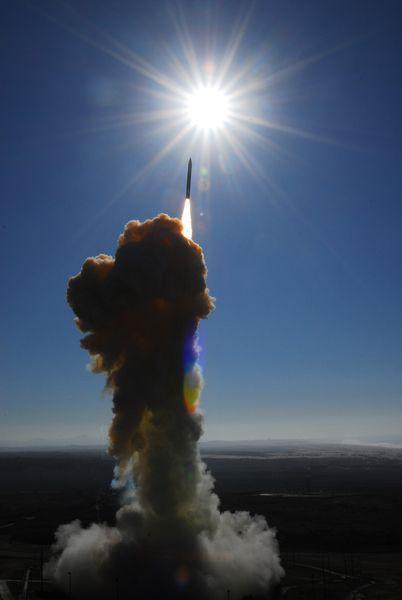
In a May 2017 test, the GMD (Ground-based Mid-Course Defense) successfully destroyed an ICBM (Inter-Continental Ballistic Missile) in space at the apogee of its flight path. It would seem that Ronald Reagan’s promise to America long ago is a reality today. The development delays and the billions of dollars expended can be explained by the complex architecture of sensors and communication systems, which must all work in unison-timing and with far greater precision than that of a Swiss watch.
An ICBM launched from the Kamchatka Peninsula in far eastern Russia, close to the Chinese-North Korean border, can hit Alaska in under six minutes and California in under twelve minutes. The GMD, a system of ground-based interceptors (GBI), located at Fort Greely (Alaska) and Vandenberg Air Force Base (California), can shoot an Exo-atmospheric Kill Vehicle (EKV) beyond the troposphere to directly collide with the ICBM. The EKV is not armed with an explosive; rather, the impact of the collision is sufficient to destroy the warhead. ICBMs launched anywhere from earth can now be diverted and destroyed in outer space without the damage from scattering nuclear debris. Thus, obviated are the hazards of destroying a mid-course ICBM with explosives dropped from an F-16 airplane.
In short, President Trump is better-positioned than any of his predecessors in office to avert a nuclear doomsday scenario. American negotiators know that the nation’s ballistic missile defense system will deter incoming nuclear missiles with limited collateral damage.
Every year, on Memorial Day, we are reminded to never take liberty for granted. Freedom is not for free, we are told. However, we are comforted by the knowledge that our nation cannot be blackmailed by missile-toting rogue regimes. Indeed, the GMD system in operation is a great day for America and a regrettable one for Kim Jong-Un.
Sue Ghosh Stricklett is an attorney (Member of the D.C. Bar) specializing in national security law.

Iran’s Nuclear and Chemical Weapons Threat
By Ben Ollerenshaw • RealClearDefense
Europe’s Rearmament Paradox
By Daniel Darling • RealClearDefense
Pentagon’s Pursuit of Faster Acquisition
By Ben Harris • RealClearDefense
The Army’s AI Cyber Defenders Need a Proven Stand-Down Order
By Gleb Tsipursky • RealClearDefense
After the Silence
By Chase Skylar DeMayo • RealClearDefense
The First Surface Drone-v-Drone Fight
By CDR Salamander, CDR Salamander
Air Force Strengthens F-22 Raptor Combat Readiness in the Pacific
By Global DefenseAfter the Silence
By Chase Skylar DeMayo • RealClearDefense
Underwater Arms Race Puts U.S. Naval Supremacy at Risk
By Tom O'Connor, Newsweek
New Facilities To Pump Out Upgraded F/A-18E/F Super Hornets
By Trevithick, WarZone