
Military Aid for Ukraine: Deterring Russia Promptly
Last updated 04:00 AM EST • Read time: 6m
The ongoing debate over the provision of military aid to Ukraine has been frequently contaminated by naïve misunderstandings of Ukrainian military and technological capabilities. Partly this is a result of Western media uncritically regurgitating Russian and pro-Russian propaganda. But frequently, it also reflects a failure by media and so called analysts to read what is already widely available on the public record.
The absurdity of some commentaries, where Ukraine is compared to Iraq or Afghanistan, ignores the reality that Ukraine long ago proved able to design, engineer and manufacture space launch vehicles, terminally guided ballistic missiles, airborne, naval and land-based radars, including solid state AESA radars, guidance systems for and complete air-air and air-surface missiles, guided artillery rockets, anti-ship and land-attack cruise missiles, anti-tank guided missiles, tanks, armored vehicles, and a wide range of other military and aerospace systems.
While Ukraine retains these capabilities, its industry has struggled with problems ranging from a Russian embargo on spare parts and components, Germany’s de facto embargo on substitute components from NATO nations, dysfunctional bureaucracies, and chronic undercapitalization. The latter has seen many defense industry plants using their capacity to generate export revenue rather than equip the Ukrainian military, as the export revenue is used to pay personnel salaries on government projects.
In the almost eight years the Ukrainians have been at war with Russia, the Ukrainians have managed to refurbish and upgrade significant portions of their considerable inventory of Soviet era equipment, and despite active sabotage by some Western nations like Germany, replace a wide range of Russian components in equipment with Western replacements. But as noted in an earlier comment, this still leaves Russia with a number of asymmetric capability advantages that would be leveraged to best effect during any invasion or large-scale land grab operation by the Putin regime.
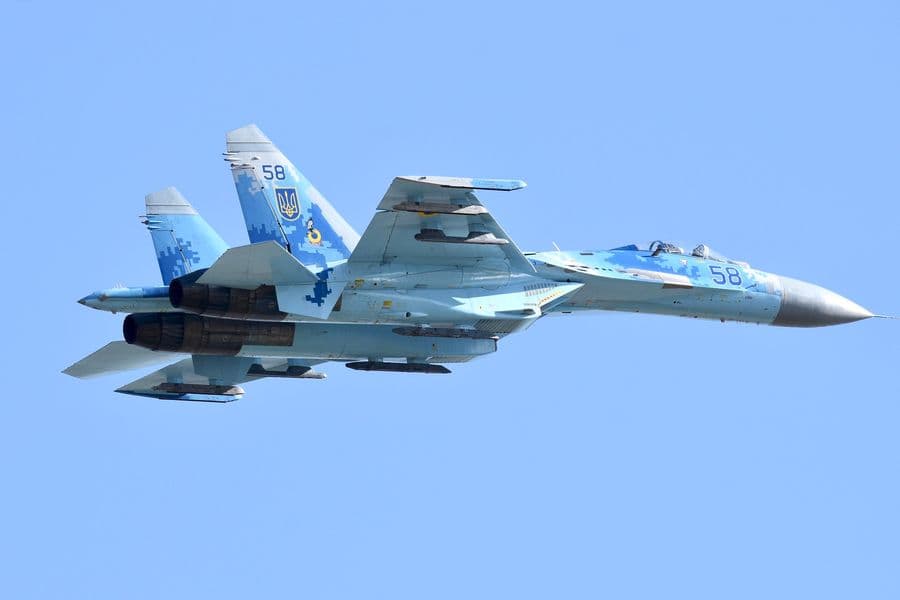
A key problem Ukraine confronts is that their dense and otherwise capable air defense system, equipped with dozens of batteries of the S-300PT/PS (SA-10 Grumble), S-300V1 (SA-12 Gladiator), and Buk M1 (SA-11 Gadfly), lacks effective capability against ballistic missiles, and is short of systems that can effectively deal with saturation attacks by low flying Russian cruise missiles. Ukraine’s air force has several brigades of late Cold War era Su-27 Flanker and MiG-29 Fulcrum fighters, equivalent to early model F-15 and F-16 fighters. Still, serviceability remains a challenge, avionic upgrades have been basic, and war stocks of missiles and PGMs have not been built up to levels required for a full-scale defensive air campaign.
While Ukraine’s air force is by European standards credible, it is not large enough and lacks the sustainability to withstand what could be weeks or months of Russian attacks using ballistic missiles, cruise missiles and low flying bombers. Ukraine lacks Airborne Early Warning and aerial refueling of substance, its fleet of Soviet era Il-78 Midas aerial tankers sold off by the previous pro-Russian administration. Another problem yet to be rectified is the loss of most of Ukraine’s navy and all of its coastal anti-ship missile batteries. While the latter is being replaced by the domestically developed Harpoon lookalike Neptun anti-ship cruise missile, a credible number of missile batteries is at least two years away, as is the planned air-launched variant of the missile.
In many respects, Ukraine's predicament resembles that of Britain in 1940 – an aging or obsolete force structure and an industrial base capable of building credible weapons, but not in the quantities needed quickly enough to deter or defeat a stronger opponent.
Ukraine’s leadership has actively sought U.S. equipment to plug the most critical capability gaps in ballistic and cruise missile defense, and recently a U.S. DoD team visited Ukraine to assess areas where U.S. supplied capabilities could be employed to meet the most critical needs.
Suggestions that a few hundred Stinger MANPADS or Javelin ATGWs would be adequate misunderstand Ukraine’s situation.
Naysayers have frequently argued that it would take the Ukrainians years to learn how to operate and maintain sophisticated weapons like U.S. made F-15s, F-16s and Patriot SAMs, an argument that fails to consider the sophistication of the equipment the Ukrainians already design, manufacture and operate. While it might take 100 hours of flying time to teach a novice fighter pilot to fly an F-15 or F-16, an experienced Su-27 or MiG-29 pilot can be converted in much less time. A much better analogy is to compare the Ukrainians to the Israelis some decades ago – smart, motivated, but under-resourced, fighting for survival, and let down by their European “allies.”
The U.S. saved Israel from probable defeat in 1973 by ferry flying and airlifting an unprecedented volume of military materiel during Operation Nickel Grass, and this could be a template for deterring Russia in Ukraine.
The NDAA is expected to see almost one hundred F-15C/D and F-16C/D fighters sent in coming months to the AMARG boneyard to be mothballed, yet these fighters are in capability and quantity exactly the kind of equipment the Ukrainians need. No differently, some of the 18 KC-135R and 14 KC-10A aerial tankers headed for storage would fit.
Other assets in storage or destined for storage suitable for Ukraine include A-10C Warthogs, Navy E-2C Hawkeyes being replaced by new E-2Ds, Harpoon capable F/A-18s, just retired by the USMC, former Navy SH-60 Seahawk, Army UH-60 Blackhawk and AH-64D Apache helicopters.
All assets with remaining life that would provide a short term stopgap capability to deter Russia and provide the Ukrainians with a transition path over the next few years to future new build U.S. platforms.
Short term provision of air and ground crews could be done using former U.S. service personnel under contract, precedents being volunteer pilots serving in Britain during the 1940s or in Israel in its early years, while experienced Ukrainian personnel are transitioned. Again, there are many precedents, and Ukraine itself has made extensive use of volunteer troops from former Soviet republics, and the West, since 2014.
Stephen J. Blank, Ph.D., is Senior Fellow at FPRI’s Eurasia Program. He has published over 1500 articles and monographs on Soviet/Russian, U.S., Asian, and European military and foreign policies, testified frequently before Congress on Russia, China, and Central Asia, consulted for the Central Intelligence Agency, major think tanks and foundations, chaired major international conferences in the U.S. and in Florence; Prague; and London, and has been a commentator on foreign affairs in the media in the U.S. and abroad. He has also advised major corporations on investing in Russia and is a consultant for the Gerson Lehrmann Group. He has published or edited 15 books, most recently Russo-Chinese Energy Relations: Politics in Command (London: Global Markets Briefing, 2006). He has also published Natural Allies? Regional Security in Asia and Prospects for Indo-American Strategic Cooperation (Carlisle, PA: Strategic Studies Institute, U.S. Army War College, 2005). He is currently completing a book entitled Light From the East: Russia’s Quest for Great Power Status in Asia to be published in 2014 by Ashgate. Dr. Blank is also the author of The Sorcerer as Apprentice: Stalin’s Commissariat of Nationalities (Greenwood, 1994); and the co-editor of The Soviet Military and the Future (Greenwood, 1992).

The Services Do Not Need a Four-Star Autonomous Warfare Command
By Steven Wills • RealClearDefense
Honor Them While There Is Still Time
By Jeffrey Rosales • RealClearDefense
From Siberia to Fairford: How Operation Spider’s Web Has Changed the Rules of Airpower
By Frank A. Rose • RealClearDefense
Faster Simulations, Better Defense Decisions
By Rut Lineswala • RealClearDefense
Will HASC Have an Oversight Subcommittee in the Next Congress?
By Christopher J. Bright • RealClearDefense

Hegseth Barred Trans Troops. Military Boards Are Rejecting Those Orders.
By NYT
Closing the Sea: Lessons from Ancient Mediterranean Blockades
By DeCasien, CIMSECFrom Siberia to Fairford: How Operation Spider’s Web Has Changed the Rules of Airpower
By Frank A. Rose • RealClearDefenseFaster Simulations, Better Defense Decisions
By Rut Lineswala • RealClearDefense
Bombers Could Have a Major Air-to-Air Combat Role
By Joseph Trevithick, The WarZone