
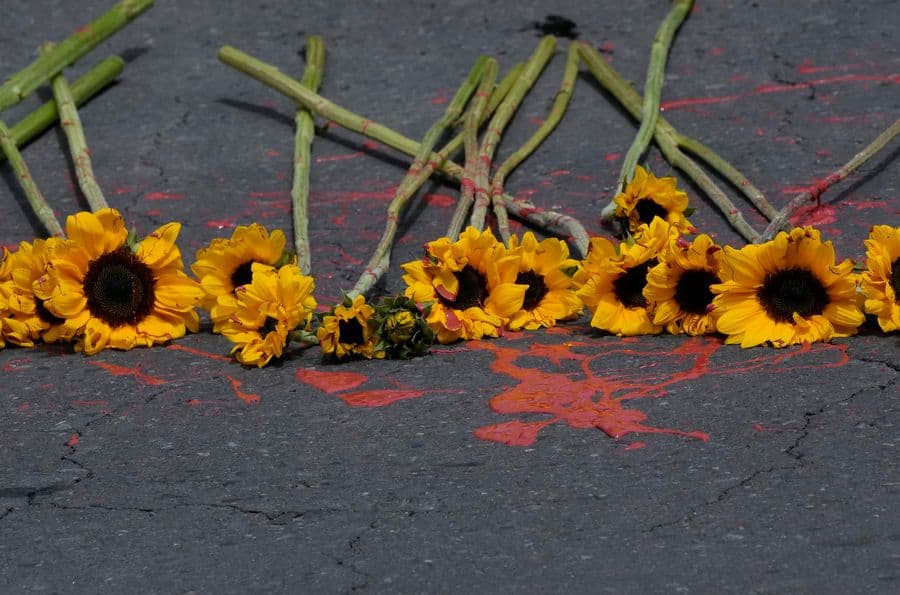
Ultraviolent Warfare: Where Conflicts Often Go
Last updated 07:38 AM EDT • Read time: 8m
Television viewers in Europe and the United States have been both mesmerized and appalled watching the increasing violence in the ongoing war in Ukraine. Many are surprised not only by the outbreak of war but also the course it is following. We have been conditioned by a decade of writers like Stephen Pinker. He is a Harvard University professor of psychology who argued in his influential book The Better Angels of Our Nature that there are a host of psychological, biological, cultural, and historical reasons for a decline of violence in the world. There has been a decline in wars between nations, though critics have countered that has been matched with an increase in intrastate conflicts. However, even if there are fewer “big wars” in this new era, we cannot assume they will somehow be less violent than their predecessors. Commentators on the current war in Ukraine consistently refer to recent Russian military operations in Grozny and Aleppo to project the future tragic course of the conflict. But those examples are not unique. The mass targeting of civilian concentrations is a tactic as old as warfare. And it is often very terrible and has only gotten worse.
Thucydides' classic book on the Peloponnesian War is full of examples of cities razed in punishment for resistance or revolt. The famous Melian dialogue depicts the classic dilemma of besieged towns – surrender or risk total destruction. The island of Melos chose not to give up to the Athenians but fell after a lengthy siege. All adult males were executed, and the women and children were sold into slavery. Such drastic repercussions always have two purposes, to punish those who resisted and deter other cities and towns from doing the same.
There have been plenty of other examples since then. When the Romans finally conquered Carthage in the Third Punic War in 146 BC, they killed or enslaved all the inhabitants, destroyed the city, and salted the earth. When Jerusalem fell to the soldiers of the First Crusade in 1099, while there is some argument about the actual number killed, there was great slaughter in a frenzy of greed, lust, and religious fervor. History is replete with the purposeful targeting of helpless civilian concentrations for military and political purposes. Combatants in the Hundred Years War in the 14th Century often conducted “chevauchees,” raids through enemy territory to spread death and destruction to coerce their rulers into concessions. The largest loss of life in the terrible Thirty Years War was the sacking of Magdeburg by the Catholic League in 1631, resulting in the death of 25,000 non-combatants. French troops depopulated most of the German Palatinate in a ruthless campaign in 1688-1689. Some consider American military campaigns against the Indians that included the purposeful razing of their villages genocide and escalation during our Civil War left harsh memories in the southern United States. William Tecumseh Sherman and Ulysses Grant both realized that to defeat a fully mobilized democracy, it would be necessary to make the costs of war felt throughout society.
However, the capability to inflict mass civilian casualties and destroy vulnerable modern cities expanded greatly with industrialization in the 19th and 20th Centuries. One of the first indicators of the new possibilities occurred with the Prussian artillery barrages that forced the surrender of Paris in 1871. World War I featured some bloody sieges, but the full impact of the expanded capability for carnage really became apparent in World War II.
Masses of artillery and fleets of bombers wreaked havoc in a conflict that killed at least 50 million civilians. This was especially evident on the Eastern Front, where quarter was rarely granted on either side. There are many graphic accounts of the atrocities during the German attack into Russia and the bloody urban battle for Stalingrad that really ended German hopes for victory in the theater. The Russian drive back was even more terrible than the original German advance. The siege of Warsaw in 1944 added more tribulation for a population already suffering from the effects of a brutal occupation. The culmination of ultraviolent trends came in Berlin in 1945. The mass rape and pillage exceeded excesses from previous centuries, as did the total destruction of the city wreaked by years of bombing and weeks of massed artillery. There were similar examples of carnage in the Asia-Pacific theater, as Richard Frank points out in the first volume of his trilogy of that part of the war, Tower of Skulls. The Japanese Rape of Nanking in 1937 resulted in the deaths of at least 200,000 civilians along with the sexual assault of between 20,000 and 80,000 women.
Strategic airpower magnified the trends in WWII ultraviolent warfare even further. Belligerents did not have the technology, nor really the inclination in most cases, for real bombing accuracy, but they had the industrial might to build lots of bombs and bombers with the ability to punish cities around the clock. At least 300,000 civilians died from air attacks in both Germany and Japan. The Hamburg firestorm started by the Royal Air Force in 1943 killed at least 45,000 people. Curtis LeMay's fire raid on Tokyo on the night of March 9, 1945, incinerated as many as 100,000 Japanese. And, of course, the war ended with atomic bombs on Hiroshima and Nagasaki.
Bombing again wreaked havoc on North Korea in 1952 and 1953. The main UN tool to coerce concessions at the peace table was American airpower. By the time an armistice was signed, 18 of 22 major cities had been more than half obliterated, and many North Koreans were living in caves. One of the main motivations for Kim Jong Un’s nuclear program is to avoid a repeat of that devastation. Even the advent of precision munitions did not prevent this inevitable escalation of violence. The 78 day air campaign against Serbia that was instrumental in coercing Milosevic to concede over Kosovo was effective at least in part because escalating attacks against dual-use targets inspired memories of Tokyo and Hiroshima. Modern trends toward urbanization have also created even more concentrations of civilians vulnerable to mass targeting.
A sad fact of warfare is that any standards of restraint tend to fray as wars drag on, even for a nation like the United States. Throughout history, conflicts between peers or near peers almost always turn into lengthy wars of attrition. While Ukraine’s military capacity does not equal the invaders, factors such as Western technological aid, fanatic popular resistance, and surprising Russian ineptitude have made the contest more equal than simple force ratios would imply. The Russian military experience has been more brutal than ours, and they have far fewer restraints to erode if any. Modern technology along with Russian military history and practices portend a grim future for Ukrainian cities.
This will create challenges for leaders in the United States and Europe. Public expectations have been shaped by visions of an interconnected world where no two countries with McDonald's will ever go to war, and even if war begins, precision munitions will limit damage in a conflict that resembles a video game. We in the West must be instead prepared for another grim tally of civilians killed in the grinder of ultraviolent warfare. What will be different this time is that we will be watching the death and destruction on our television screens. As the scenes of carnage engage "the better angels of our nature," Abraham Lincoln described in his First Inaugural, there will be increasing cries to stop the slaughter that will be difficult to ignore. Tens of thousands of Ukrainian deaths, or much worse, will deliver a massive shock to both public psyches and the international system. That should reinforce a lesson too often ignored by politicians and the public, war is a bloody business that continues to engage and devastate vulnerable civilian populations. And the level of potential violence involved has only increased, not declined, even without a resort to nuclear weapons.
Conrad Crane is a research historian at the US Army War College. He has written extensively on airpower and landpower issues. His latest books are American Airpower Strategy in World War II published by University Press of Kansas, and Cassandra in Oz: Counterinsurgency and Future War published by Naval Institute Press.
The views expressed in this article are those of the author and do not purport to reflect the positions of the U.S. Army War College, Department of the Army, or Departments of Defense. The author has no special access to intelligence or any operational matters that are not otherwise available to the general public.
The Services Do Not Need a Four-Star Autonomous Warfare Command
By Steven Wills • RealClearDefense
Honor Them While There Is Still Time
By Jeffrey Rosales • RealClearDefense
From Siberia to Fairford: How Operation Spider’s Web Has Changed the Rules of Airpower
By Frank A. Rose • RealClearDefense
Faster Simulations, Better Defense Decisions
By Rut Lineswala • RealClearDefense
Will HASC Have an Oversight Subcommittee in the Next Congress?
By Christopher J. Bright • RealClearDefense
Hegseth Barred Trans Troops. Military Boards Are Rejecting Those Orders.
By NYT
Closing the Sea: Lessons from Ancient Mediterranean Blockades
By DeCasien, CIMSECFrom Siberia to Fairford: How Operation Spider’s Web Has Changed the Rules of Airpower
By Frank A. Rose • RealClearDefenseFaster Simulations, Better Defense Decisions
By Rut Lineswala • RealClearDefense
Bombers Could Have a Major Air-to-Air Combat Role
By Joseph Trevithick, The WarZone