
Why Does Germany Keep Neglecting Its Defense?
Published Jan. 14, 2023 • Read time: 4m
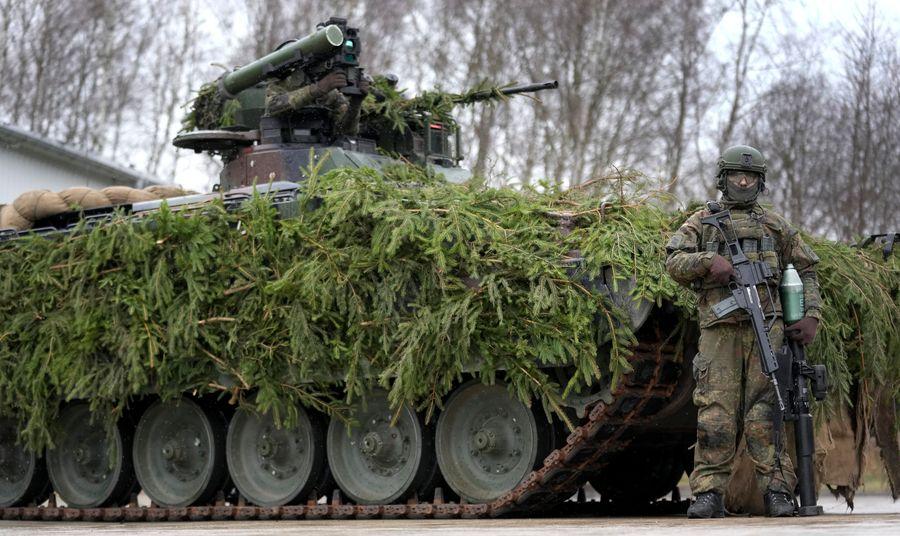
Following Russia’s invasion of Ukraine in February, German Chancellor Olaf Scholz declared the moment to be a Zeitenwende, a turning point for European security. From the Bundestag podium, Scholz announced the creation of a €100 billion fund for defense and a commitment to meet NATO’s two percent of GDP defense spending target moving forward. Nearly a year later, Germany is predicted to miss the spending benchmark once again, and the Bundeswehr continues to experience severe neglect, with German defense officials warning that the military only has enough ammunition to last for two days of intense combat.
Why, despite Russia’s war of aggression in Ukraine, does Germany, the continent’s strongest economic power and a close U.S. ally, continue to neglect its defense? Simply put, as long as the United States serves as Europe’s primary security guarantor and Russia’s armed forces prove themselves inadequate, Germany has no reason to seriously reform their defense policy or invest in costly defense expenditures.
From Berlin’s perspective, this strategy makes perfect sense. The United States remains committed to bearing the primary burden of Europe’s defense, with the Biden administration sending an additional 20,000 troops to the continent, bringing the total to 100,000 U.S. troops in Europe—almost 40,000 of which are stationed in Germany. In addition to enjoying permanent U.S. protection, threat perception also contributes to Germany disregarding defense. Russia’s military has proven itself to be inadequate, experiencing repeated failures on the battlefield. As Moscow struggles to maintain control over relatively small territories in an adjacent country, the Cold War fear of Russian tanks storming toward the Rhine is unimaginable. Germany therefore has little to fear from conventional Russian forces.
Germany being a poor military ally was not always the case. With the front line of the Cold War literally dividing Germany, the United States helped facilitate the creation of the new German armed forces—the Bundeswehr— and integrated West Germany into the NATO alliance in 1955. The Bundeswehr quickly developed into a highly capable military partner. By the 1980’s the Bundeswehr was the second largest western European armed force behind the United States, encompassing some 500,000 military personnel, 7,000 battle tanks, 1,000 combat aircraft, 18 surface-to-air missile battalions, a sizeable surface fleet and 24 submarines.
Following the collapse of the Soviet Union, Berlin allowed the Bundeswehr to atrophy to embarrassing levels. Germany maintains some 180,000 troops, with frequent reports of inadequate equipment, weapon systems, infrastructure, personnel and training. An infamous example highlighting the Bundeswehr’s shortcomings includes a 2015 NATO training exercise where German soldiers used broomsticks in lieu of machine guns. A recent 2021 Bundestag report assessing the readiness of the armed forces highlights its continued dysfunction with only 77 percent of the Bundeswehr’s main weapon systems being operational and over 20,000 vacant officer positions. The Bundeswehr’s competency during the Cold War highlights that the core issue here is not one of a lack of material wherewithal, but a lack of political will.
Actions speak louder than words. Berlin’s strong rhetoric about transforming its defense policy and finally pulling its weight as a NATO ally has failed to materialize. German leaders continue to placate Washington with commitments to increase defense spending and do more for Europe’s collective defense, but little should be expected without a fundamental restructuring of Europe’s collective security architecture. Washington may complain about Berlin continuing to come up short, but without a willingness to transfer the primary responsibility of Europe’s defense to the Europeans themselves, Germany, and other wealthy European allies, will continue to free ride on the United States. As the U.S. defense budget skyrockets to $858 billion, the American people rightfully are beginning to question why U.S. leaders continue to adhere to such an unbalanced relationship.
Sascha Glaeser is a Research Associate at Defense Priorities. He focuses on U.S. grand strategy, international security, and transatlantic relations. He holds a Master of International Public Affairs and a Bachelor’s in International Studies from the University of Wisconsin-Madison.

The Army’s AI Cyber Defenders Need a Proven Stand-Down Order
By Gleb Tsipursky • RealClearDefense
After the Silence
By Chase Skylar DeMayo • RealClearDefense
Defense Chip Procurement Needs a Recovery Test
By Percy Yixuanchen Yu • RealClearDefense
FORTRESS America Must Measure Missions, Not Megawatts
By Burak Oktenli • RealClearDefense
After the Midterms, the Right Strategy Against Iran
By Lance Gordon • RealClearDefense
After the Silence
By Chase Skylar DeMayo • RealClearDefense
Underwater Arms Race Puts U.S. Naval Supremacy at Risk
By Tom O'Connor, Newsweek
New Facilities To Pump Out Upgraded F/A-18E/F Super Hornets
By Trevithick, WarZone
U.S. Navy Expands Tomahawk Warhead Production
By Naval News Staff, Naval News
SSN(X) Attack Boat Will be a Swift, Lethal Mothership for Undersea Drones
By USNI N.