
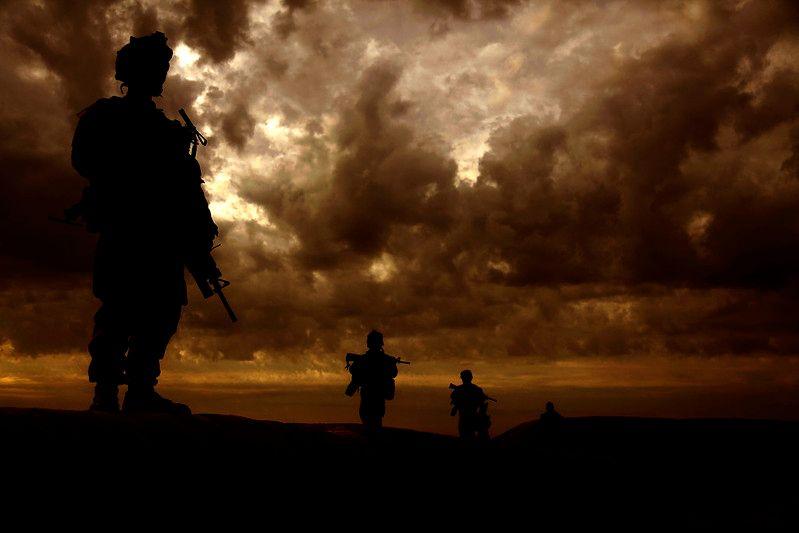
He Had Command On the Cutting Edge in Sangin
Published Feb. 11, 2023 • Read time: 19m
Naval Institute
Naval Institute
Seth W.B. Folsom is nearing the end of a long, successful Marine Corps career. Nearly 30 years of service. Long resume of combat commands in Iraq and Afghanistan. Plenty of medals and ribbons on his chest. Several steely-eyed command photos. And soon it will be over.
But his work will remain.
First came The Highway War. In that book, Folsom describes his 2003 tour leading Marines and sailors from Delta Company, First Light Armored Reconnaissance Battalion as they fought their way from Kuwait through Baghdad to Tikrit. Next came In the Gray Area, which continues the story of Folsom’s experience in Iraq by focusing on his 2008 deployment leading an advisor team embedded with an Iraqi Army infantry battalion. Most recently, Folsom turned his attention to Afghanistan and published Where Youth and Laughter Go. A memoir like the others, this book details Folsom’s preparation for combat and his day-to-day experiences leading Third Battalion, Seventh Marine Regiment through Sangin District, one of Afghanistan’s most hostile areas of operation.
Folsom’s openness sets this book apart from other war memoirs, particularly those written by officers. More than a decade into the war on terror, he describes how challenging it became to articulate conviction in the war’s mission. “I believe in the mission,” Folsom tells his Marines in the days before the battalion leaves California for Afghanistan. “It is a mission worth fighting for and, if necessary, worth dying for. [The Marines’] silence and empty stares gave me no confidence or indication that they agreed with me or believed me. How many of these officers, I wondered, actually believed in the mission themselves?”
Passages like this lend his narrative sweep and authenticity.
I spoke with the author about Afghanistan, the sometimes-ridiculous administration of the war, and why troops always fight for one another.
Afghanistan became a storytelling war. Veterans came home and shared stories about the things they saw in combat. Those tales filtered through the ranks. But we were more than a decade into the war by 2011 and media coverage was poor. “Sangin signaled the greatest kind of fear,” you wrote. “The unknown.” Talk to me about the trepidation of preparing your battalion to deploy to Sangin.
Going back to 2011, I had a very similar feeling in 2003 before we went into Iraq. You can spend your entire life reading about anything, whether it’s sports or politics or whatever else. You can spend your entire life studying and reading and getting details, but until you’ve done the thing you won’t know what it’s like.
In 2003, I was with a company of Marines, the overwhelming majority of whom did not have combat experience. We were new. Only a handful of guys had been in Somalia or Desert Storm. But by 2011, somewhere between 40 to 60 percent of my battalion had been on the previous deployment to Afghanistan. And so, when I was hearing these stories about what it was like over there and balancing that with a more measured story from the battalion commander I was replacing, when I balanced those two sets of stories, I had the feeling of “holy shit, what am I getting myself in to.” These amplified when I did my pre-deployment site survey with Tom Savage, the battalion commander for First Battalion, Fifth Marines. We had known each other since we were Majors and I trusted Tom. When he told me we were going to have a tough time in Sangin, it really crystallized for me. I knew it would be tough. It wasn’t just a nagging fear anymore but had become a certainty. All the information turned into a feeling about me and my guys suddenly. So, all these stories converged with the guy who was on the ground and created a sense of dread as we prepared to leave California. Those feelings will always be with me.
You left to little fanfare. “Volunteers no longer filled the hangar in the same numbers they had in past years. I wondered if it was one more sign of how unpopular the war had become or just an indication of how few people gave a shit anymore.” Describe the mood as your battalion left for Afghanistan.
There was a sense of confidence in what they were doing but also fatigue. The pace of deployments was very heavy for people and so there was a struggle between “this is our job” and “we’re also exhausted.” Marines were continuing to cycle through deployments and there was no measure of progress. There was cynicism among the Marines who had done this before, and even some cynicism among those young Marines who had done this only one time before. There was a sense of fatalism involved.
It’s been repeated so many times that we fought the same war one year at a time and never really moved the ball forward. The young Marines knew this. There was no end, it seemed, and the truth trickled down to them. Of course, we were proud of ourselves and the progress we made, but deep down everybody knew by then that the lasting effects [of our work in Afghanistan] were going to be minimal. I had this feeling that, for the whole war on terror, society cared about servicemembers but not what they served, not the mission. That’s hard to swallow for anyone going into harm’s way. Regardless of how the war has evolved or devolved, you want to feel like you’re there for the right reasons. You want the backing of people at home. I used to say that part of supporting the troops should be supporting the mission, and I know that’s a lot to ask of people in a democratic society. Nonetheless, it’s hard for young Marines to make sense of the disconnect.
You’re comparing a tour in Iraq in 2003 with your tour in Afghanistan in 2011. What stands out about your 2011 deployment as compared to your 2003 tour in Iraq?
We very rarely saw the enemy up close in 2003, but that was magnified to the nth degree in 2011. The idea of vengeance and getting payback was always at the forefront of my mind in 2011. That was one of the things that played into my mental calculus about going onto patrols with the Marines. I wanted to keep my finger on the pulse of my Marines. I remember sitting down with journalist Bob Woodruff in 2003, on the Diyala River right outside of Baghdad. He asked what was going through my mind. I said that because we’re not seeing the people we’re going after, because the Fedayeen guerrillas were all we were fighting, I told him it felt very much like a Vietnam thing. Going back now, I laugh at that idea. If anything felt like “Vietnam” it was Sangin. Endless daily patrols through a giant minefield. Enemy marksman and snipers zeroing on us. Multiple times a week Marines were stepping on mines and losing limbs. We rarely saw an armed fighter. We dealt with IEDs and the aftermath. There was frustration percolating inside the battalion.
Add on top of that what I knew from the battalion’s previous deployment, that there had been casualties and deaths and that Marines harbored anger and resentment about those losses. Their mindset was “let’s glass this place.” I had to focus on those Marines, teaching them that the campaign had evolved past the clear phase into the hold phase. Col. Smith told me my job was to deepen the hold in the district. Still, the Marines wanted to put the wood to the bad guys. That feeling was a problem for us with the constant amputations from IED strikes and attacks from an enemy we hardly ever saw.
Back to 2011. You write about not being allowed to drink a beer at the military bar in Manas, an airbase Marines stopped at on their way to Helmand. “My first real taste of the ridiculous direction the administration of the war had taken,” you wrote. Tell me more about this.
I’m not sure if this answers your question but there was a lot of discussion going on at the time about white socks. Do you remember the great white sock controversy?
I think so.
Well, guys wanted to wear white socks inside their combat boots. The junior Marines said who “gives a shit if my socks are white or black—it’s combat.” Others, mostly officers, said it’s a slippery slope to poor discipline, that you got to wear your regulation dark-colored socks no matter the circumstances. The Marines said: “Sir, we wore white socks on the last deployment, and we did just fine.” But the reason they wore the white socks was because the logistics supply line had completely broken down and their socks were rotting off their feet, and so they were using these white socks that the well-meaning people back home were sending through the mail in care packages. By 2011, it was like a point of pride to continue to wear a uniform that was crumbling and boots that were rotting out. I would show up at a patrol base and see a Marine with boots that had holes in them and say, “Why are you wearing those boots? We can get you new boots. I’ll call FOB Jackson and we can get you new boots today.” Same for the socks. I wasn’t sure why they were wearing these busted uniforms and white socks and disintegrating pants, but Marines took pride in wearing a seasoned uniform that had been through a lot of shit. It was a badge of honor to have been through something.
Let’s stick with the theme of being worn down by combat. When you arrived in Sangin, you were struck by how worn-down Tom Savage looked. “His eyes had sunk into their sockets, and his cheekbones cut sharp lines across his deeply tanned face.” What does a combat Marine look like?
There was a stark difference between the Marines who lived and worked at a FOB and the Marines who lived and patrolled out of the PBs. From the neck down, the ones who were out in the village looked like they had just worn their bodies down to dust. You often read about someone wearing themselves down to gristle. One of the elements of being in combat is to focus on the essentials. I just saw a bad miniseries on Amazon called The English. A Pawnee scout tells a woman that the difference between what you need and what you want is what you can fit on a horse. That resonated. What you need is what you’re willing to carry around Sangin for eight hours. Your body ends up blowing its ballast. It doesn’t need that extra layer of fat you brought on deployment. It doesn’t need that thick layer of muscle you got in the gym. It leaves you with bone and basic muscle to get you through the day. The Marines were carrying only what they needed. From the neck up, the body had consumed itself. All that was left was the skull with skin covering it. At least that’s how it looked to my eyes when we showed up.
You’re patrolling through what is arguably the most dangerous AO in Afghanistan at the time. And yet, there were not enough Navy corpsmen. There were not enough interpreters. There were not enough metal detectors. How can America spend so much money on military and defense technology and yet be shorthanded on mission essential equipment in combat?
Well, if I had the answer or solution to that, I would either be a millionaire or the most famous person in the defense industry. We felt the same in Iraq in 2003. There was a spare parts shortage despite the huge effort going into the country. We remember that Mattis prioritized fuel, ammunition, and water—everything else could catch up later. That was the stuff we needed to press the fight and the priorities worked. Flash forward to 2011, and there were problems in our supply lines. We had a policy in the division where each unit would be oversupplied with people and a group of Marines would be designated as combat replacements. Those designated replacements would stay in CONUS only to be called forward as Marines were lost in country. But it was such a drawn-out process to get people trained and ready to deploy and flown over, that the units on the ground would cheat the process so we could get people in a timely fashion. Colonel Eric Smith [regimental commander] told me as soon as I got into country to put in my request to get my combat replacements. He was saying that the process was so drawn out that we needed to make our requests before we’d even taken ownership of the battlespace, let alone lost a Marine as a casualty. And we did need many of those combat replacements. And thankfully, there were many Marines who wanted to join us in Sangin.
Your war became fixated on tiny moments. “The man kept a healthy distance from the RPG lying in the grass. He squatted down and picked up the launcher using a child and goats as cover, then walked to a waiting motorcycle.” Tell me about commanding a battalion concerned with single peasant fighters.
It was maddening. When you go through training and TBS and IOC and you’re bettering yourself in the profession and you get to the point where you’re a battalion commander and you’re finally ready to employ your battalion in command, you’re prepared for a battalion fix and flank against a determined, dug-in enemy. You’re prepared to bring massed fires to bear on the objective. But Sangin was the furthest thing possible from that. The unit of action was the squad. We did battalion operations, but it was really squad action. The Taliban fighters were elusive and good at what they did. They knew our playbook. They knew our rules. They inflicted casualties. Bringing a lot of different assets from PGMs to ISR to CAS to bear on one guy putting in an IED or picking up a RPG—that was the closest we could come to getting a win.
But I’d be lying if I said we didn’t feel satisfaction getting a strike. I’m mindful it could be seen as overkill, the use of resources. But we did a lot of strikes against single ISIS fighters in 2017 [when I was with Task Force Lion in Iraq], too. We periodically got chided by higher headquarters about a Hellfire against a guy on a motorbike as an expensive way to fight the war. In 2011, though, nobody was telling us to worry about the costs of using a Hellfire. The biggest thing in 2011, whether HIMARS or EXCAL or PGM, was collateral damage. If a unit had a bad strike with civilian casualties, there was immediate laser focus on that unit and how they did business. I didn’t want that attention and muddling of the process for our Marines. So, we put a lot of work into developing our COC processes to make sure our fire missions were right and gave higher headquarters confidence in 3/7.
IED strikes took a toll on the Marines. There were enough strikes to cause terror and affect the Marines’ mindset, but not enough incidents to callous you, to make you expect a strike whenever it happened. Talk to me about taking casualties in combat.
I agree. There were not enough casualties to develop a callousness. Look at the history of the battalions that rotated through Sangin—3/7, 3/5, 1/5, 3/7 and then more. Initially, 3/7 was only in Sangin for several weeks and 3/5 was the first battalion to do a full deployment through Sangin. They took enormous casualties. People still stalk about that legacy and what it meant. Then 1/5 after them had a similar casualty rate. I had to prepare myself that we were going to lose an equal number. But as bad as our numbers were, they were miniscule compared to Peleliu or Chosin or battles fought in Vietnam, for example. It could have been so much worse.
I can’t speak for Tom Savage or Jason Morris but only for myself. Maybe as an infantry officer I should have steeled my heart better and developed more mental toughness in distancing myself from the losses. But that’s not who I am. I cared about the Marines and saw them as men and younger brothers or sons. Because I spent so much time with them, that emotional distancing just didn’t work when I tried it. I was affected every time we lost someone. I could never see it as just part of the job or just part of war. I go back to the conversation I had with Sparky Renforth at 29 Palms before deployment, where I told him my goal was to bring everybody back alive and he told me that was like a mathematical unreality. He told me to bring as many back as possible. But still that was my goal.
“Each IED strike brought me closer to hysteria,” you wrote. You had a difficult time taking casualties.
When you have a family, you look at things differently. I mean, a lot of these men in 3/7 had families, too. Nobody was just a pair of boots. Nobody was a faceless Marine with a rifle. I knew these men on a personal basis and the casualties got to me. Within 10 days of a death, we had a memorial service. It peeled back the scab. It was me confronting the loss again but also watching all the Marines have the feelings associated with loss. The casualties were happening in different places throughout the valley over the course of the day, and most of us weren’t there when it happened. We had to process it when we heard about it and when we did the memorial service.
Jim Webb has this line about “someone else’s war.” Someone else’s war was happening in the valley. You hear artillery dropping. That was someone else’s war. You hear a story about an IED strike. That was someone else’s war. Even within a battalion or a company or a platoon, it was someone else’s war. We were so dispersed that there was a feeling of “someone else’s war.” You’d hear an IED go off while you’re sitting at your patrol base. You might hear it anywhere in the valley and it stopped you in your track, but you’d just dismiss it as someone else’s war. Kilo’s war or Lima’s war. But you also knew those were your guys. There’s uncertainty and dread wondering what happened and who was involved. There’s uncertainty until you get the news.
The minute I would hear a detonation echo up the valley, I was just waiting for a call on the radio from my COC. “Firecracker.” That meant an IED had gone off. I think it was easier to process when the Marines were there when it happened. They could commiserate on the facts. They could share what they saw, you know. They could deal with it immediately and confront it with each other. But the Marines at another outpost were a different story. They didn’t know what was going on and they probably never got the full story. And so, I don’t know if the Marines in the battalion got a sense of what the unit went through until they were all back together in the United States. We were separated in the battlespace, experiencing small, private wars. Just a little slice of the whole story.
By the end of deployment, you had grown to resent the Afghans “the same way they resented us.” But you didn’t hate them, is that right?
No, we didn’t hate them. There was an episode with one of the Marines on my security detail. He flat out told me “I hate the Afghans and I hate Muslims.” I asked him why and he couldn’t explain it other than to say they’re savage or something like that. So, I had to replace him because I couldn’t have someone representing me by telling people he hated Afghans and Muslims. There was not a hatred, from me or most others I worked with, but the resentment stemmed from the number of resources we were dumping into Sangin District. When I would talk with the District Council or District Governor, if I was sensing a lack of commitment, it was very difficult to not get indignant or holier than thou. We’re here to help, I said, that’s our mission. My Marines and I have left our families back at home to help you and your families. So, if I sensed from the Afghans animus or something. If they didn’t report IEDs. If they didn’t report who was shaking down the District Counsel, then I got upset and the resentment would bubble over. We’d look at each other in the battalion headquarters and say, “What the fuck are we doing here?” That feeling would compound when we took a casualty. If the Afghans took a casualty, then that feeling would lessen, thinking it would steel their resolve or commitment. When it didn’t deepen their resolve, then I would really feel the resentment grow.
Your book is honest about the complications of leading a battalion in combat when the mission is flawed. And yet, it is clear to me that your troops continued to fight for one another. Why?
Marines always fight for one another.
I don’t try to hide the fact that my time in Afghanistan wrecked me emotionally. Seeing how the Marines reacted with one another wrecked me. The last time you saw that young man, he was a shit-talking guy, and now he’s at a memorial service and he’s changed. Loss and grief are sticking on him. But that’s also how I know they will always rely on each other.
We talked about the difference between what you want and what you need. It all comes down to necessity. What do you absolutely need? You need the people around you, physically, to have your back. Maybe not the close air support or the higher headquarters or the politicians back home. But you need the brothers next to you to have your back. It’s what bonds a squad together. This idea transcends time. It’s been around since people were picking up sharpened tools and fighting in groups. It’s been said so many times, but battles are not won by sweeping maneuvers of battalions and regiments. Battles are not won by technology. Battles are won by small teams. Whether on a condensed field of battle in WWI or on an island in WWII or in a distributed war like Vietnam and Afghanistan. Small groups closely bonded together, moving forward steps, feet, and meters at a time.
John Waters is a writer in Nebraska.
The Army’s AI Cyber Defenders Need a Proven Stand-Down Order
By Gleb Tsipursky • RealClearDefense
After the Silence
By Chase Skylar DeMayo • RealClearDefense
Defense Chip Procurement Needs a Recovery Test
By Percy Yixuanchen Yu • RealClearDefense
FORTRESS America Must Measure Missions, Not Megawatts
By Burak Oktenli • RealClearDefense
After the Midterms, the Right Strategy Against Iran
By Lance Gordon • RealClearDefense
After the Silence
By Chase Skylar DeMayo • RealClearDefense
Underwater Arms Race Puts U.S. Naval Supremacy at Risk
By Tom O'Connor, Newsweek
New Facilities To Pump Out Upgraded F/A-18E/F Super Hornets
By Trevithick, WarZone
U.S. Navy Expands Tomahawk Warhead Production
By Naval News Staff, Naval News
SSN(X) Attack Boat Will be a Swift, Lethal Mothership for Undersea Drones
By USNI N.