
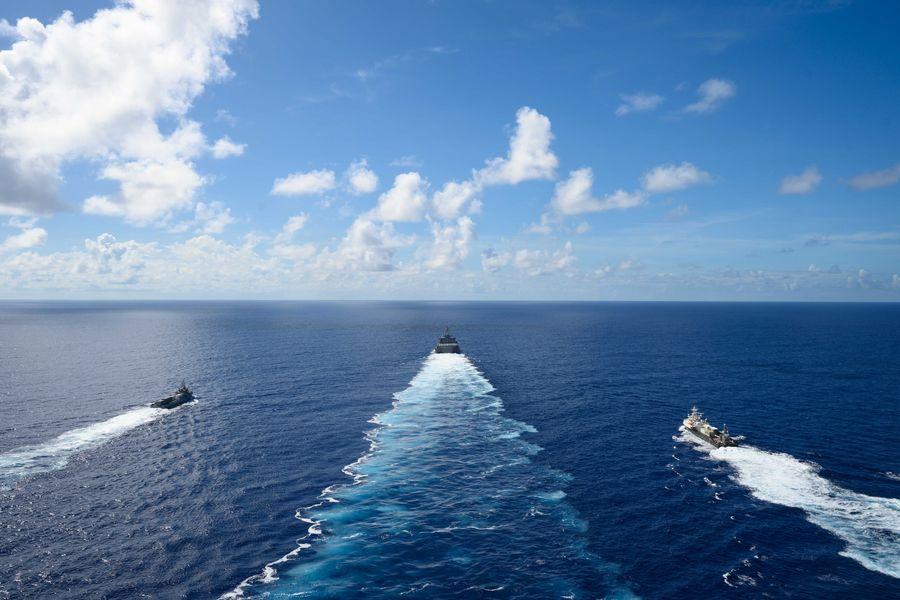
Countering China's Fleet of Autonomous Maritime Vehicles
Last updated 01:00 AM EST • Read time: 4m
When President Biden and Chinese President Xi Jinping met at the APEC summit, both leaders talked about the devastating impact any conflict between the two superpowers would have on both nations. Unfortunately, what is being said at the negotiating table differs drastically from what China is doing in the wild as it encroaches on traditional U.S. partners in the Indo-Pacific like Taiwan and the Philippines.
Part of guaranteeing a continued amicable relationship between the two nations is ensuring that Beijing knows that the U.S. Armed Forces have the technology and power to counter any military threat to the U.S. and its allies. That is why leaders at the Defense Department must continue to embrace new technologies to keep pace with their counterparts in China.
This is especially true when it comes to operationalizing emerging technologies – such as its fleet of autonomous maritime vehicles. In this arena, we need to change the way we operate to keep from falling behind.
Military leaders in Beijing have realized the potential of maritime autonomous vehicles since the 1980s when then-Chinese Premier Zhao Ziyang initiated the State High-Tech Development Plan (863 Plan) that funds billions of dollars in applied technology development. Since then, the country has expanded its program with a document published in 2019 by the Chinese Society of Naval Architecture listing 159 undersea vehicle research projects under development at over 40 Chinese universities.
Among the roles these Autonomous Uncrewed Vehicles play in the Chinese military is the laying and maintaining of 50,000 to 100,000 floating and submerged mines in key strategic areas.
Chinese vehicles also have the ability to tap or sever undersea fiber-optic cables in a conflict – allowing the country to eavesdrop or completely cut off the communications abilities of their adversaries. This is particularly worrisome when considering the large concentration of undersea fiber-optic cables off the north coast of Taiwan. The potential to attack any critical undersea infrastructure gives the Chinese a significant strategic competitive advantage.
In the face of this threat, efforts by the Pentagon to purchase and integrate new technologies to deter Beijing’s maritime power have been mixed.
Without question, there are voices at the Pentagon and within the halls of Congress pushing to elevate the role of unmanned maritime vehicles in U.S. national security and the Navy’s maritime dominance. Deputy Secretary of Defense Kathleen Hick recently announced the Replicator initiative, and the Senate Armed Services Committee directed the Secretary of Defense to devise “a strategy for addressing such incursions, and whether the [DoD] needs to acquire different or enhanced capabilities to neutralize future threats.”
At the same time, the Navy announced this spring that it was abandoning the Large Displacement Unmanned Undersea Vehicle (LDUUV) research program despite investing over $200 million and 14 years into the project.
China’s investments in the space and ambitions to challenge the U.S. for global naval dominance demonstrate that those threats are here. We must be just as unambiguous.
We need a sustained commitment and national investment in these technologies. The Navy should accelerate its partnerships with the private sector and streamline direct investment in readily available unmanned maritime solutions.
All services should embrace the Contractor Owned Contractor Operated (COCO) model to quickly introduce and experiment in unmanned maritime technologies in situ. Transitioning to a Government Owned Government Operated (GOGO) model will bridge the infamous “valley of death” for these crucial capabilities and reduce risk for the Navy and the industry partner.
There are encouraging signs, including a Navy Request For Information released in August seeking “technologies related to seabed and port security for defense against divers and [unmanned underseas vehicles]. These technologies will support detection, tracking, and the targeting necessary for engagement of potential undersea manned and unmanned threats.”
The Navy must also expand and accelerate its pursuit of technology and equipment that can “hold a threat target at risk of prosecution” by U.S. weapons and are focused on areas such as multi-domain autonomous operation and interaction; multi-source sensor data fusion and exploitation; contested undersea battlespace payload delivery; “netted” anti-submarine warfare weapons and delivery; and others.
This will require a sustained effort and the type of public-private partnership that has been successful with other types of military technology – including, to an extent, with China’s own development.
The Navy’s proactive partnerships throughout the Indo-Pacific are just the beginning. Prioritized investments in unmanned maritime vehicles, strong partnerships with industry and flexible operational funding with a path to acquisition are imperative as we build our bulwark against Beijing’s fleet of unmanned vehicles.
Joe “Digger” DiGuardo is a retired Rear Admiral with over 20 years of service in the U.S. Navy. He is currently the senior director of government strategy at Ocean Power Technologies.

The Gulf of Finland’s Forgotten Islands
By Ben Poulin • RealClearDefense
NATO’s New Spending Pledge Must Buy Real Energy Resilience
By Chuck Dockery • RealClearDefense
The Army Needs a Data Logistics Discipline Before the Next Surge
By Steve Ferenzi • RealClearDefense
2949 Marine Prisoners, Hostages, and Peacetime Governmental Detainees Since Our Corps' Founding
By Jon Couch • RealClearDefense
America Must Win the Biotech Race Against China
By Rob Maness • RealClearDefense
U.S. Air Force To Arm C-17 Cargo Aircraft With Cruise Missiles
By C. Jones, Defence Blog
How Marine Vet Ernest Langdon Became a Renowned Shooter & Gunsmith
By WATM
In First, Two CCAs Fly Air Combat Maneuvers Using Autonomy Software
By A&SF
Space Force Launches Mission Operations Center
By Jon Harper, DefenseScoop
Pentagon Mulls Placing Fleet of Military Satellites Around the Moon
By Ars Technica