
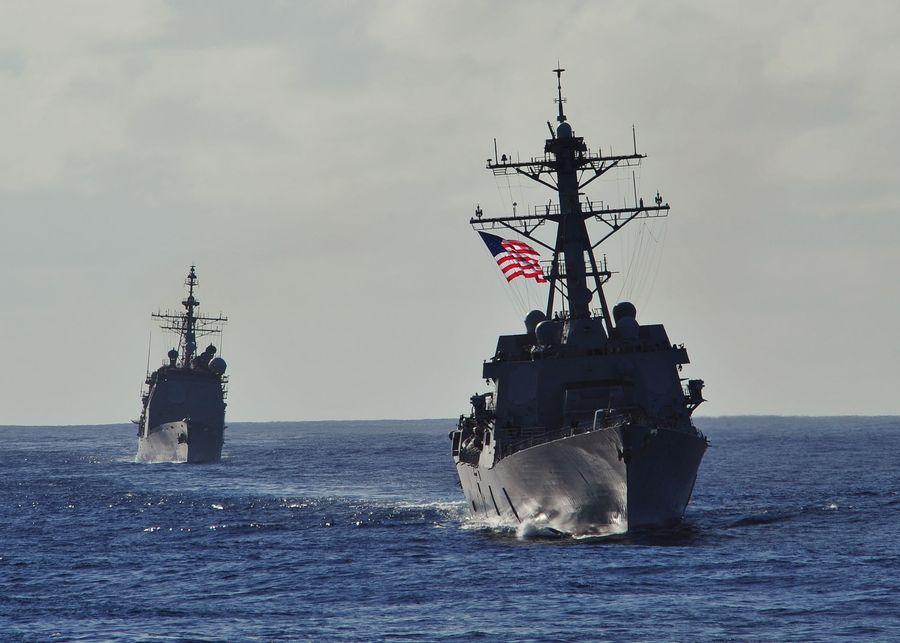
Mahan for Our Time
Published Feb. 8, 2024 • Read time: 5m
Alfred Thayer Mahan was the most important public intellectual of his time. Between 1885 and 1914, he authored some twenty books, dozens of articles, and hundreds of letters, advised presidents, influenced allies and adversaries, and left behind an intellectual legacy on naval history, strategy, and sea power that continues to be debated more than one hundred years after his death. In his new book The Neptune Factor: Alfred Thayer Mahan and the Concept of Sea Power, Nicholas Lambert has vigorously and provocatively joined that debate.
Lambert, who was the Class of 1957 Chair at the U.S. Naval Academy from 2016 to 2018, and who has authored books on Britain’s Admiral Sir John “Jacky” Fisher and World War I’s Gallipoli campaign, dissects Mahan’s major works to support his overarching claim that Mahan’s concept of sea power was primarily economic, not military or naval, in nature. Lambert contends that a careful reading of Mahan’s books, articles, and correspondence reveals that Mahan’s worldview was “profoundly economics centric.” According to Lambert, for Mahan exercising naval “command of the sea” was the military means to the achieve the political end of undermining the economy of the enemy. The Clausewitzian center of gravity was commercial, not naval.
Unlike many of Mahan’s admirers and some of his detractors, Lambert refuses to place undue emphasis on Mahan’s most famous work, The Influence of Sea Power Upon History 1660-1783 and that book’s most famous chapter where Mahan outlined the elements of sea power: geographical position, physical conformation, extent of territory, number of population, national character, and character of the government. Lambert deems Mahan’s The Influence of Sea Power Upon the French Revolution and Empire and Sea Power in Its Relation to the War of 1812 as more impressive works that show Mahan’s focus on the economic aspects of warfare instead of sea battles. But Lambert detects the primacy of economics in virtually all of Mahan’s writings, including his many articles and essays on geopolitics.
Mahan, Lambert writes, was a product of his times. The United States in the late 19th-early 20th centuries was growing economically and producing more than it could sell domestically. That circumstance, not external events, Lambert contends, was the primary motivation for American overseas expansion and the beginnings of U.S. imperialism. Here, Lambert engages in a quasi-Marxist analysis which posits that capitalism causes imperialism. He relies on the writings and theories of leftist historians William Appleman Williams and Walter LaFeber who claimed that domestic overproduction caused overseas expansion. While the search for overseas markets was certainly a factor that contributed to the beginnings of the American empire, Lambert is too dismissive of the impact of external events, such as the “scramble for empire” among the world’s great powers, the rivalry for spheres of influence in China, the Spanish-American War, the Russo-Japanese War, and the influence of geopolitical theorists like Britain’s Halford Mackinder, America’s Brooks Adams, and Alfred Thayer Mahan.
Lambert notes that Mahan was a founding father of geopolitical thought, yet economics is only one aspect of geopolitics, albeit an important one. Mahan’s articles on East Asian geopolitics which were collected into a book titled The Problem of Asia, and his book The Interest of America in International Conditions reveal that Mahan’s concept of sea power was geopolitics-centric, not economics-centric. In those two books, Mahan’s geopolitical prescience is fully on display. The Interest of America in International Conditions foreshadowed the First and Second World Wars, while The Problem of Asia foreshadowed the Cold War and in some respects today’s rivalry between China and the United States.
Mahan’s concept of sea power is both naval and economic in the service of geopolitics. History’s great sea powers (Great Britain and the United States) have been pitted against great continental-based land powers (Louis XIV’s and Napoleonic France; Wilhelmian, and Hitlerian Germany; the Soviet Union; and today China) in a recurring, though not identical, struggle for global preeminence. The late Colin Gray explored what he called the “leverage of sea power” in concluding that throughout history sea powers have usually prevailed in these struggles, but usually in combination with other land powers. Lambert rightly notes that Britain’s and America’s sea power attacked opponents’ trade and commerce on the high seas and via blockades, but Anglo-American sea power also transported troops and funded continental allies to fight its opponents on land.
None of this diminishes Lambert’s point that Mahan viewed economic warfare as a crucial element of sea power. But sea power is a crucial element of geopolitics. That is the more enduring legacy of Mahan’s writings. And we are seeing it play out today in the western Pacific, where sea power will likely decide the questions of whether Taiwan maintains its independence and whether China replaces the United States as the world’s leading power.
Francis P. Sempa writes on foreign policy and geopolitics. His Best Defense columns appear at the beginning of each month. Read his latest "Is America the "New" Great Britain?."
End the Jones Act Waiver
By Mark H. Buzby • RealClearDefense
Prediction Markets Are Becoming a New Frontline for Military Operational Security
By Yang Yunke • RealClearDefense
Can Robots Bring Maneuver Warfare Back?
By Ayeza Areej • RealClearDefense
Buy Smarter, Fly More
By Jeff Kojac • RealClearDefense
Stop Gutting the Conventional Army
By R.D. Hooker, Jr. • RealClearDefense
Hung Cao Facing Contentious Confirmation To Become Navy Secretary
By Konstantin Toropin • Associated Press
U.S. Marines Expand M27 Rifle Contract
By Inder Singh Bisht
Kadena AFB Gets First F-15EX Eagle IIs
By Emily Ryan Miller, Defence BlogHung Cao Facing Contentious Confirmation To Become Navy Secretary
By AP
Fair Winds, Peacoat and Desert Camo: Navy Makes Big Changes to Seabag
By MTimes