
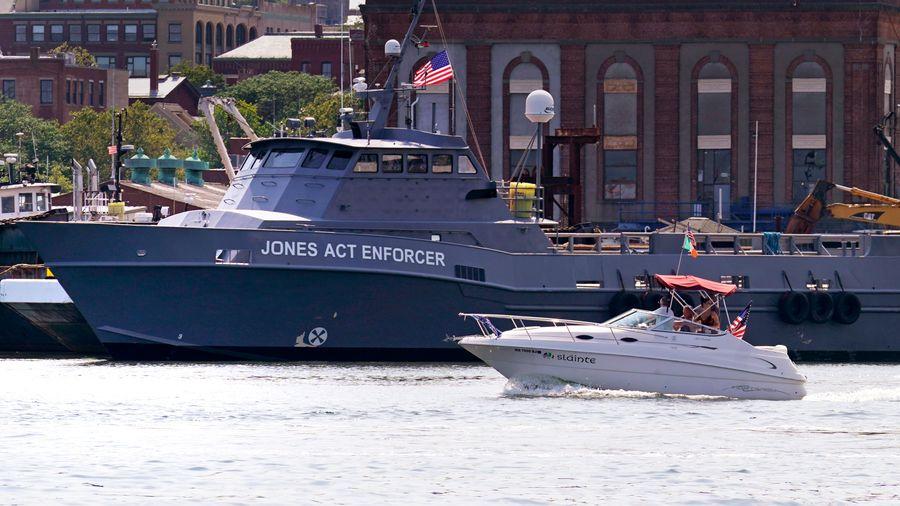
A boat passes the vessel Jones Act Enforcer, along the waterfront, Tuesday, July 11, 2023, in New Bedford, Mass. The trade association that represents the offshore service industry is going to great lengths to make sure that jobs go to Americans as the U.S. offshore wind industry ramps up.
End the Jones Act Waiver
Restore American Sealift to American Mariners
Published Nov. 16, 2026 • Read time: 5m
The Trump Administration has made rebuilding American maritime strength a national priority, and it is encouraging to see the progress being made thus far in new ship construction contracts and recently announced investments in new and modernized shipyards. All good, and long overdue.
But the administration is at the same time inflicting a serious wound on a vital part of our national maritime security by continuing to waive the Jones Act.
The Jones Act requires goods transported by water between U.S. ports to move aboard American-flagged, American-built, American-owned, and American-crewed vessels. The law helps sustain the fleet and shipyards and provides a pool of trained mariners upon which our military depends in times of crisis or conflict.
Since March, the federal government has waived the Jones Act for reasons of national security to allow foreign vessels to transport energy products and fertilizer between American ports – purportedly to control and reduce rising fuel costs brought on by the Iran war. The waiver has done neither. Initially authorized for 60 days, the waiver has been modified and extended through mid-November as the war in Iran has stretched on.
The Trump Administration's recently revised waiver process requires determining whether qualified American vessels are available before foreign flag voyages are authorized.
To its credit, the U.S. Maritime Administration under Administrator Stephen Carmel appears to be doing a good job implementing this process. By reviewing individual requests and giving American vessels the opportunity to compete, MARAD is applying a more disciplined approach that may prevent unnecessary dependence on foreign shipping.
That does not resolve the larger concern.
Do we really want to turn over control of our nation’s domestic sea transportation of vital energy and agricultural products to foreign entities – particularly China? It is already happening today.
Congress recognized that extraordinary circumstances may require exceptions to the law. Waivers exist for legitimate national defense needs, and there are situations in which their use is justified.
But an emergency exception should not become a routine commercial alternative to profit the oil majors and others. Our fuel prices have not gone down, but their profits have certainly gone up.
And all the while, available U.S.-flag ships have been sidelined, and their U.S. crews idled while foreign mariners aboard foreign flag ships reap the rewards. That does not sit well with me.
The U.S. Merchant Marine Academy, six state maritime academies, and union training programs are preparing the next generation of mariners. More than 1,250 cadets graduated from maritime academies in 2026, adding to a workforce essential to our national defense.
To ensure jobs for these men and women, America needs more ships and to use its existing ships to carry American cargo. But shipping is not some make-work jobs program. A strong American merchant marine is critical to deterring China and, should deterrence fail, ensuring our military has the sealift capacity — manned by civilian U.S. mariners — needed to sustain a prolonged conflict.
During my time commanding the Navy’s Military Sealift Command and later serving as Maritime Administrator, I saw firsthand how closely military sealift depends on the commercial U.S.-flag fleet and its crews.
Today, America has fewer than 100 large, internationally operating commercial ships flying the U.S. flag, and another 100 or so large ships operating in our domestic Jones Act trade. Another 40,000 smaller vessels operate in the broader Jones Act fleet along our coasts and inland waterways.
Together, these fleets provide experience for American mariners, the very same officers, and crews our military relies upon. A qualified deck or engineering officer needs years of education, training, and experience at sea.
Thanks to the Jones Act, Maritime Security Program and Tanker Security Program, our nation can rely on the private sector to maintain critical capacity. These programs sustain commercial opportunities, keeping American ships operating and qualified mariners employed so they can be called upon in times of need to crew our Ready Reserve Force sealift fleet when activated.
But when commercial shipping opportunities disappear, mariners may leave the industry for other careers, shrinking the pool of qualified personnel. The commercial maritime industry provides the regular employment and experience necessary to sustain a workforce the military cannot afford to maintain entirely on its own.
The Jones Act is an important part of that system.
The availability of an American vessel today is important. So is the availability of American vessels and mariners ten years from now. If American shipping companies in the Jones Act trade or flying under a U.S. ensign internationally cannot plan confidently for future cargo opportunities, it becomes harder to justify buying American-built ships and hiring American mariners.
The Trump Administration must end the prolonged Jones Act waiver and return to the established national defense standard for narrowly justified exceptions.
RADM Mark H. Buzby (U.S. Navy, Ret.) served as Administrator of the U.S. Maritime Administration from 2017 to 2021 and as commander of Military Sealift Command from 2009 to 2013. He is a 1979 graduate of the U.S. Merchant Marine Academy.
End the Jones Act Waiver
By Mark H. Buzby • RealClearDefense
Prediction Markets Are Becoming a New Frontline for Military Operational Security
By Yang Yunke • RealClearDefense
Can Robots Bring Maneuver Warfare Back?
By Ayeza Areej • RealClearDefense
Buy Smarter, Fly More
By Jeff Kojac • RealClearDefense
Stop Gutting the Conventional Army
By R.D. Hooker, Jr. • RealClearDefense
Hung Cao Facing Contentious Confirmation To Become Navy Secretary
By Konstantin Toropin • Associated Press
U.S. Marines Expand M27 Rifle Contract
By Inder Singh Bisht
Kadena AFB Gets First F-15EX Eagle IIs
By Emily Ryan Miller, Defence BlogHung Cao Facing Contentious Confirmation To Become Navy Secretary
By AP
Fair Winds, Peacoat and Desert Camo: Navy Makes Big Changes to Seabag
By MTimes