
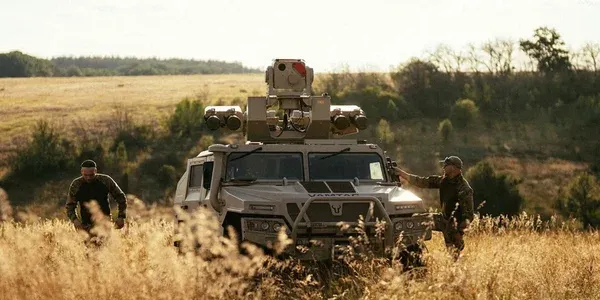
Operation Vivaldi in northern Donetsk Oblast.
Can Robots Bring Maneuver Warfare Back?
Published Nov. 16, 2026 • Read time: 6m
Join the Conversation
0In the Russia-Ukraine war, the persistent use of drones for Intelligence, Surveillance and Reconnaissance (ISR) operations has made it difficult to conceal concentrations of troops and vehicles, while the use of mines, electronic warfare, artillery and First-person-view (FPV) drones has made maneuvering on the battlefield increasingly dangerous and costly. Even ground robots, crossing several kilometers of open terrain, can be destroyed by an FPV or mine before accomplishing their mission. For many operations, getting to the target is the most costly and challenging phase of a mission.
Even the frontline itself is complex to define in real-time as both sides operate in a dense environment of drones and small, dispersed infantry units rather than along clearly established defensive lines. All these conditions have made the three elements of maneuver warfare—movement, concentration of force, and surprise—extremely difficult to achieve. Conventional forces attempting a breakthrough are exposed long before they reach their objective, and the result has been a largely positional war of attrition.
Ukraine's recent experiments with robotic systems suggest this deadlock may not be permanent. Reportedly, in July 2026, Ukraine’s 123rd Separate Territorial Defense Brigade conducted an operation in which an uncrewed surface vessel was used to deliver an unmanned ground vehicle (UGV) to the occupied Kinburn Spit. The ground robot, after reaching the shore, opened fire on adversary positions using a Wolly 7.62 remotely operated weapon station. Similarly, in August 2026, Kyiv’s Defense Forces used a heavy drone to deliver an ARK-1 UGV (armed with an anti-tank mine) behind the enemy lines. The UGV then continued its mission on the ground independently after reaching its designated position. This emerging trend, referred to as the ‘marsupial tactic,’ is described as when an unmanned system is used to transport another closer to a target that it would otherwise be unable to reach on its own. This innovation, which involves the collaborative use of multiple uncrewed systems, demonstrates the potential of long-range, low-risk deployment as well as enhanced mobility in restricted terrain.
The operational value of this strategy became more evident in Ukraine’s latest counteroffensive, Operation Vivaldi, conducted by Third Army Corps in the north of Lyman. On 20 September 2026, Third Army Corps revealed the details of the operations. During the assault, heavy bomber drones were used to drop kamikaze ground robots ten kilometers behind the Russian lines, which allowed the robots to be delivered closer to their targets. Thus, Ukraine successfully repurposed aerial vehicles to carry and deploy ground-based strike systems near enemy positions, enabling them to maneuver past obstacles.
The kamikaze land-based robots did not operate in isolation. Brigadier General Andrii Biletskyi, who is Ukrainian Third Army Corp Commander, claimed that drones and UGVs moved ahead of Ukraine’s infantry to disrupt Russian defenses and open the way for advancing troops. During the operation, artillery and UAVs targeted Russian command posts, logistics, river crossings, communication centers, and reserves while electronic warfare and air defense created a defensive shield around the combat zone. This blinded the Russian defenses and prevented them from understanding the operation's design.
Operation Vivaldi, thus, represents a consequential development because it combined unmanned aerial and ground systems to extend the operational reach of attacks beyond the range at which the ground robots could have operated independently, creating opportunities for infantry to advance later. The results of the operation are noteworthy. The robots successfully completed approximately 15,700 missions and delivered around 3,300 tons of cargo. Moreover, Ukraine’s forces claimed that they had denied the Russian troops from encircling the Fortress Belt, liberated three settlements, Drobysheve, Shandryholove and Derylove, and reclaimed about 19 square miles of territory from Russian occupation.
Can robots, then, bring maneuver warfare back? Their primary contribution is to reduce human exposure during the riskiest part of an offensive operation, which involves approaching enemy positions and making initial contact. This significantly minimizes the risk of casualties. The emerging robotic systems can advance further into previously inaccessible positions to trigger defenses, probe positions, clear routes, and divert fire, thus enabling them to avert risks to personnel. This is precisely the reason Ukraine’s Third Army Corps adopted this strategy, as explained by its commander, ‘Infantry wins wars, but we protect our infantry, so robots go to the enemy first.’
More importantly, these unmanned systems can be utilized to disrupt defensive cohesion. These systems can conduct strikes against forward positions and rear-area targets to create confusion and localized gaps before the main assault. Infantry units can exploit the gaps to penetrate and occupy terrain after the openings emerge. Therefore, robots can help create the conditions for conventional forces to maneuver with reduced vulnerability as well as greater operational flexibility. In Operation Vivaldi, Ukrainian forces have demonstrated the limited ability to break away from positional warfare and incorporate some elements of mechanized maneuver at the tactical level through the use of UGVs.
Accordingly, Ukraine’s ambitions are growing, as evident in its recent procurement plan to replace up to 30 per cent of combat personnel with robotic systems. However, UGVs cannot fully replace soldiers, who are still indispensable for capturing and occupying terrain. Besides, robots are limited in their effectiveness as they are still susceptible to jamming, FPV drones and mines and Vivaldi's success was also dependent on operational secrecy, electronic warfare, and the close integration of artillery, UAVs and air defense. Hence, robots can act as decisive enablers, yet their ability to do so is largely dependent on integration with other supporting technologies.
Overall, Kyiv’s Operation Vivaldi represents a transformative shift in the character of land warfare. Ukraine has presented an emerging model of robotic maneuver, which is based on the integration of aerial and ground robots. The development illustrates that if states efficiently deploy sophisticated technology alongside careful planning and execution, maneuver warfare remains possible even on a transparent battlefield. Robots have not yet restored maneuver warfare completely, but Vivaldi may come to be seen as the first real crack in the deadlock of positional warfare.
Ayeza Areej is a researcher at the Centre for Aerospace & Security Studies (CASS). A Gold Medalist in Strategic Studies from the National Defence University, her expertise spans military strategy, defense modernization, emerging technologies, nuclear security, and the Revolution in Military Affairs (RMA).

End the Jones Act Waiver
By Mark H. Buzby • RealClearDefense
Prediction Markets Are Becoming a New Frontline for Military Operational Security
By Yang Yunke • RealClearDefense
Can Robots Bring Maneuver Warfare Back?
By Ayeza Areej • RealClearDefense
Buy Smarter, Fly More
By Jeff Kojac • RealClearDefense
Stop Gutting the Conventional Army
By R.D. Hooker, Jr. • RealClearDefense

Hung Cao Facing Contentious Confirmation To Become Navy Secretary
By Konstantin Toropin • Associated Press
U.S. Marines Expand M27 Rifle Contract
By Inder Singh Bisht
Kadena AFB Gets First F-15EX Eagle IIs
By Emily Ryan Miller, Defence BlogHung Cao Facing Contentious Confirmation To Become Navy Secretary
By AP
Fair Winds, Peacoat and Desert Camo: Navy Makes Big Changes to Seabag
By MTimes